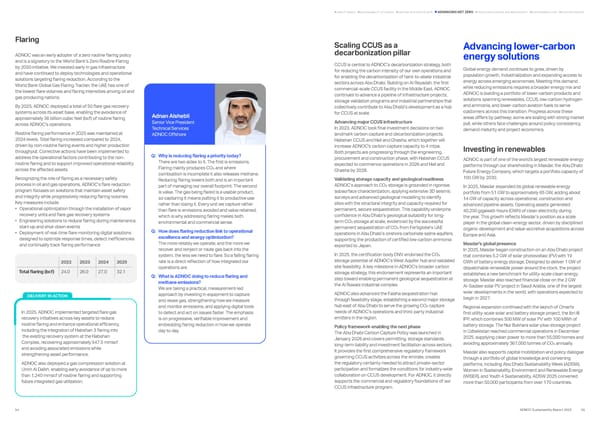
ADNOC was an early adopter of a zero routine flaring policy and is a signatory to the World Bank’s Zero Routine Flaring by 2030 initiative. We invested early in gas infrastructure and have continued to deploy technologies and operational solutions targeting flaring reduction. According to the World Bank Global Gas Flaring Tracker, the UAE has one of the lowest flare volumes and flaring intensities among oil and gas producing nations. By 2025, ADNOC deployed a total of 50 flare gas recovery systems across its asset base, enabling the avoidance of approximately 36 billion cubic feet (bcf) of routine flaring across ADNOC’s operations. Routine flaring performance in 2025 was maintained at 2024 levels. Total flaring increased compared to 2024, driven by non-routine flaring events and higher production throughput. Corrective actions have been implemented to address the operational factors contributing to the non- routine flaring and to support improved operational reliability across the affected assets. Recognizing the role of flaring as a necessary safety process in oil and gas operations, ADNOC’s flare reduction program focuses on solutions that maintain asset safety and integrity while progressively reducing flaring volumes. Key measures include: • Operational optimization through the installation of vapor recovery units and flare gas recovery systems • Engineering solutions to reduce flaring during maintenance, start-up and shut-down events • Deployment of real-time flare monitoring digital solutions designed to optimize response times, detect inefficiencies and continually track flaring performance Flaring CCUS is central to ADNOC’s decarbonization strategy, both for reducing the carbon intensity of our own operations and for enabling the decarbonization of hard-to-abate industrial sectors across Abu Dhabi. Building on Al Reyadah, the first commercial-scale CCUS facility in the Middle East, ADNOC continues to advance a pipeline of infrastructure projects, storage validation programs and industrial partnerships that collectively contribute to Abu Dhabi’s development as a hub for CCUS at scale. Advancing major CCUS infrastructure In 2023, ADNOC took final investment decisions on two landmark carbon capture and decarbonization projects, Habshan CCUS and Hail and Ghasha, which together will increase ADNOC's carbon capture capacity to 4 mtpa. Both projects are progressing through the engineering, procurement and construction phase, with Habshan CCUS expected to commence operations in 2026 and Hail and Ghasha by 2028. Validating storage capacity and geological readiness ADNOC’s approach to CO₂ storage is grounded in rigorous subsurface characterization, applying extensive 3D seismic surveys and advanced geological modelling to identify sites with the structural integrity and capacity required for permanent, secure sequestration. This capability underpins confidence in Abu Dhabi’s geological suitability for long- term CO₂ storage at scale, evidenced by the successful permanent sequestration of CO₂ from Fertiglobe’s UAE operations in Abu Dhabi’s onshore carbonate saline aquifers, supporting the production of certified low-carbon ammonia exported to Japan. In 2025, the certification body DNV endorsed the CO₂ storage potential of ADNOC’s West Aquifer hub and validated site feasibility. A key milestone in ADNOC's broader carbon storage strategy, this endorsement represents an important step toward enabling permanent geological sequestration at the Al Ruwais industrial complex. ADNOC also advanced the Falaha sequestration hub through feasibility stage, establishing a second major storage hub east of Abu Dhabi to serve the growing CO₂ capture needs of ADNOC’s operations and third-party industrial emitters in the region. Policy framework enabling the next phase The Abu Dhabi Carbon Capture Policy was launched in January 2026 and covers permitting, storage standards, long-term liability and investment facilitation across sectors. It provides the first comprehensive regulatory framework governing CCUS activities across the emirate, creates the regulatory certainty needed to attract private-sector participation and formalizes the conditions for industry-wide collaboration on CCUS development. For ADNOC, it directly supports the commercial and regulatory foundations of our CCUS infrastructure program. Scaling CCUS as a decarbonization pillar ADNOC is part of one of the world's largest renewable energy platforms through our shareholding in Masdar, the Abu Dhabi Future Energy Company, which targets a portfolio capacity of 100 GW by 2030. In 2025, Masdar expanded its global renewable energy portfolio from 51 GW to approximately 65 GW, adding about 14 GW of capacity across operational, construction and advanced pipeline assets. Operating assets generated 40,200 gigawatt-hours (GWh) of clean electricity during the year. This growth reflects Masdar’s position as a scale player in the global clean-energy sector, driven by disciplined organic development and value-accretive acquisitions across Europe and Asia. Masdar's global presence In 2025, Masdar began construction on an Abu Dhabi project that combines 5.2 GW of solar photovoltaic (PV) with 19 GWh of battery energy storage. Designed to deliver 1 GW of dispatchable renewable power around the clock, the project establishes a new benchmark for utility-scale clean energy storage. Masdar also reached financial close on the 2 GW Al-Sadawi solar PV project in Saudi Arabia, one of the largest solar developments in the world, with operations expected to begin in 2027. Regional expansion continued with the launch of Oman's first utility-scale solar and battery storage project, the Ibri III IPP, which combines 500 MW of solar PV with 100 MWh of battery storage. The Nur Bukhara solar-plus-storage project in Uzbekistan reached commercial operations in December 2025, supplying clean power to more than 55,000 homes and avoiding approximately 367,000 tonnes of CO₂ annually. Masdar also supports capital mobilization and policy dialogue through a portfolio of global knowledge and convening platforms, including Abu Dhabi Sustainability Week (ADSW), Women in Sustainability, Environment and Renewable Energy (WiSER), and Youth 4 Sustainability. ADSW 2025 convened more than 50,000 participants from over 170 countries. Investing in renewables Advancing lower-carbon energy solutions Global energy demand continues to grow, driven by population growth, industrialization and expanding access to energy across emerging economies. Meeting this demand while reducing emissions requires a broader energy mix and ADNOC is building a portfolio of lower-carbon products and solutions spanning renewables, CCUS, low-carbon hydrogen and ammonia, and lower-carbon aviation fuels to serve customers across this transition. Progress across these areas differs by pathway; some are scaling with strong market pull, while others face challenges around policy consistency, demand maturity and project economics. Q: Why is reducing flaring a priority today? There are two sides to it. The first is emissions. Flaring mainly produces CO₂ and where combustion is incomplete it also releases methane. Reducing flaring lowers both and is an important part of managing our overall footprint. The second is value. The gas being flared is a usable product, so capturing it means putting it to productive use rather than losing it. Every unit we capture rather than flare is emissions avoided and value retained, which is why addressing flaring makes both environmental and commercial sense. Q: How does flaring reduction link to operational excellence and energy optimization? The more reliably we operate, and the more we recover and reinject or route gas back into the system, the less we need to flare. So a falling flaring rate is a direct reflection of how integrated our operations are. Q: What is ADNOC doing to reduce flaring and methane emissions? We are taking a practical, measurement-led approach by investing in equipment to capture and reuse gas, strengthening how we measure and monitor emissions, and applying digital tools to detect and act on issues faster. The emphasis is on progressive, verifiable improvement and embedding flaring reduction in how we operate day to day. Adnan Alshebli Senior Vice President Technical Services ADNOC Offshore 2022 2023 2024 2025 Total flaring (bcf) 24.0 26.0 27.0 32.1 In 2025, ADNOC implemented targeted flare gas recovery initiatives across key assets to reduce routine flaring and enhance operational efficiency, including the integration of Habshan 3 flaring into the existing recovery system at the Habshan Complex, recovering approximately 547.5 mmscf and avoiding associated emissions while strengthening asset performance. ADNOC also deployed a gas compression solution at Umm Al Dalkh, enabling early avoidance of up to more than 1,240 mmscf of routine flaring and supporting future integrated gas utilization. DELIVERY IN ACTION 55 ADNOC Sustainability Report 2025 54 ADVANCING NET ZERO KEEPING OUR PEOPLE SAFE EMPOWERING LIVES HOW WE OPERATE SUSTAINABILITY AT ADNOC ABOUT ADNOC PROTECTING NATURE AND BIODIVERSITY
 Sustainability Report 2025: Delivering Responsibly Page 26 Page 28