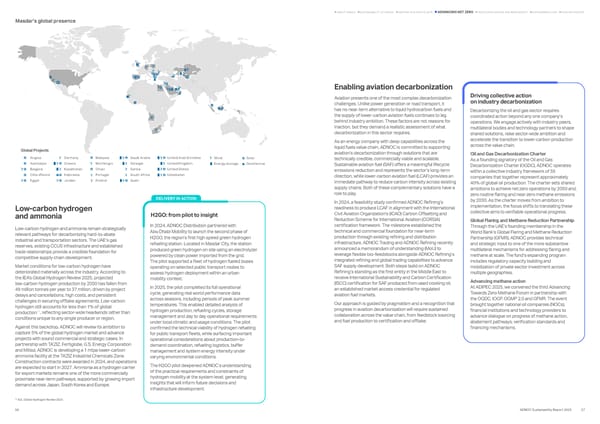
In 2024, ADNOC Distribution partnered with Abu Dhabi Mobility to launch the second phase of H2GO, the region’s first high speed green hydrogen refueling station. Located in Masdar City, the station produced green hydrogen on site using an electrolyzer powered by clean power imported from the grid. The pilot supported a fleet of hydrogen fueled buses operating on selected public transport routes to assess hydrogen deployment within an urban mobility context. In 2025, the pilot completed its full operational cycle, generating real world performance data across seasons, including periods of peak summer temperatures. This enabled detailed analysis of hydrogen production, refueling cycles, storage management and day to day operational requirements under local climatic and usage conditions. The pilot confirmed the technical viability of hydrogen refueling for public transport fleets, while surfacing important operational considerations about production-to- demand coordination, refueling logistics, buffer management and system energy intensity under varying environmental conditions. The H2GO pilot deepened ADNOC’s understanding of the practical requirements and constraints of hydrogen mobility at the system level, generating insights that will inform future decisions and infrastructure development. H2GO: from pilot to insight DELIVERY IN ACTION 11 IEA, Global Hydrogen Review 2025 Low-carbon hydrogen and ammonia remain strategically relevant pathways for decarbonizing hard-to-abate industrial and transportation sectors. The UAE’s gas reserves, existing CCUS infrastructure and established trade relationships provide a credible foundation for competitive supply chain development. Market conditions for low-carbon hydrogen have deteriorated materially across the industry. According to the IEA's Global Hydrogen Review 2025, projected low-carbon hydrogen production by 2030 has fallen from 49 million tonnes per year to 37 million, driven by project delays and cancellations, high costs, and persistent challenges in securing offtake agreements. Low-carbon hydrogen still accounts for less than 1% of global production11, reflecting sector-wide headwinds rather than conditions unique to any single producer or region. Against this backdrop, ADNOC will review its ambition to capture 5% of the global hydrogen market and advance projects with sound commercial and strategic cases. In partnership with TA’ZIZ, Fertiglobe, G.S. Energy Corporation and Mitsui, ADNOC is developing a 1 mtpa lower-carbon ammonia facility at the TA'ZIZ Industrial Chemicals Zone. Construction contracts were awarded in 2024, and operations are expected to start in 2027. Ammonia as a hydrogen carrier for export markets remains one of the more commercially proximate near-term pathways, supported by growing import demand across Japan, South Korea and Europe. Low-carbon hydrogen and ammonia Aviation presents one of the most complex decarbonization challenges. Unlike power generation or road transport, it has no near-term alternative to liquid hydrocarbon fuels and the supply of lower-carbon aviation fuels continues to lag behind industry ambition. These factors are not reasons for inaction, but they demand a realistic assessment of what decarbonization in this sector requires. As an energy company with deep capabilities across the liquid fuels value chain, ADNOC is committed to supporting aviation’s decarbonization through solutions that are technically credible, commercially viable and scalable. Sustainable aviation fuel (SAF) offers a meaningful lifecycle emissions reduction and represents the sector’s long-term direction, while lower-carbon aviation fuel (LCAF) provides an immediate pathway to reduce carbon intensity across existing supply chains. Both of these complementary solutions have a role to play. In 2024, a feasibility study confirmed ADNOC Refining’s readiness to produce LCAF in alignment with the International Civil Aviation Organization’s (ICAO) Carbon Offsetting and Reduction Scheme for International Aviation (CORSIA) certification framework. The milestone established the technical and commercial foundation for near-term production through existing refining and distribution infrastructure. ADNOC Trading and ADNOC Refining recently announced a memorandum of understanding (MoU) to leverage flexible bio-feedstocks alongside ADNOC Refining’s integrated refining and global trading capabilities to advance SAF supply development. Both steps build on ADNOC Refining’s standing as the first entity in the Middle East to receive International Sustainability and Carbon Certification (ISCC) certification for SAF produced from used cooking oil, an established market access credential for regulated aviation fuel markets. Our approach is guided by pragmatism and a recognition that progress in aviation decarbonization will require sustained collaboration across the value chain, from feedstock sourcing and fuel production to certification and offtake. Enabling aviation decarbonization Driving collective action on industry decarbonization Decarbonizing the oil and gas sector requires coordinated action beyond any one company’s operations. We engage actively with industry peers, multilateral bodies and technology partners to shape shared solutions, raise sector-wide ambition and accelerate the transition to lower-carbon production across the value chain. Oil and Gas Decarbonization Charter As a founding signatory of the Oil and Gas Decarbonization Charter (OGDC), ADNOC operates within a collective industry framework of 55 companies that together represent approximately 40% of global oil production. The charter sets shared ambitions to achieve net zero operations by 2050 and, zero routine flaring and near-zero methane emissions by 2030. As the charter moves from ambition to implementation, the focus shifts to translating these collective aims to verifiable operational progress. Global Flaring and Methane Reduction Partnership Through the UAE’s founding membership in the World Bank’s Global Flaring and Methane Reduction Partnership (GFMR), ADNOC provides technical and strategic input to one of the more substantive multilateral mechanisms for addressing flaring and methane at scale. The fund’s expanding program includes regulatory capacity building and mobilization of private sector investment across multiple geographies. Advancing methane action At ADIPEC 2025, we convened the third Advancing Towards Zero Methane Forum in partnership with the OGDC, IOGP, OGMP 2.0 and GFMR. The event brought together national oil companies (NOCs), financial institutions and technology providers to advance dialogue on progress of methane action, abatement pathways, verification standards and financing mechanisms. United Arab Emirates United Kingdom United States Uzbekistan Angloa Azerbaijan Bulgaria Côte d'Ivoire Egypt Germany Greece Kazakhstan Indonesia Jordan Malaysia Montengro Oman Portugal Poland Saudi Arabia Senegal Serbia South Africa Spain Wind Solar Energy storage Geothermal Global Projects Masdar’s global presence 57 ADNOC Sustainability Report 2025 56 ADVANCING NET ZERO KEEPING OUR PEOPLE SAFE EMPOWERING LIVES HOW WE OPERATE SUSTAINABILITY AT ADNOC ABOUT ADNOC PROTECTING NATURE AND BIODIVERSITY
 Sustainability Report 2025: Delivering Responsibly Page 27 Page 29