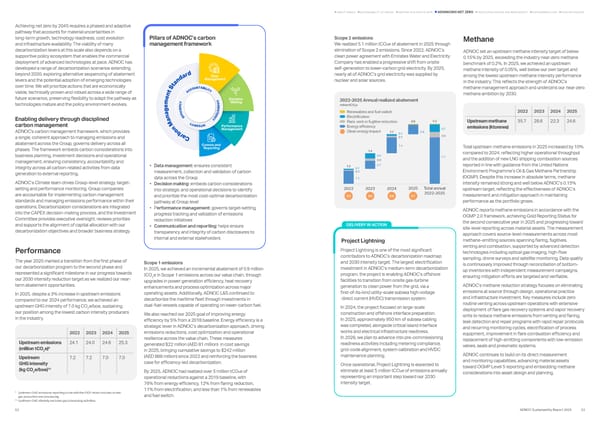
Achieving net zero by 2045 requires a phased and adaptive pathway that accounts for material uncertainties in long-term growth, technology readiness, cost evolution and infrastructure availability. The viability of many decarbonization levers at this scale also depends on a supportive policy ecosystem that enables the commercial deployment of advanced technologies at pace. ADNOC has developed a range of decarbonization scenarios extending beyond 2030, exploring alternative sequencing of abatement levers and the potential adoption of emerging technologies over time. We will prioritize actions that are economically viable, technically proven and robust across a wide range of future scenarios, preserving flexibility to adapt the pathway as technologies mature and the policy environment evolves. Enabling delivery through disciplined carbon management ADNOC's carbon management framework, which provides a single, coherent approach to managing emissions and abatement across the Group, governs delivery across all phases. The framework embeds carbon considerations into business planning, investment decisions and operational management, ensuring consistency, accountability and integrity across all carbon-related activities from data generation to external reporting. ADNOC’s Climate team drives Group-level strategy, target- setting and performance monitoring. Group companies are accountable for implementing carbon management standards and managing emissions performance within their operations. Decarbonization considerations are integrated into the CAPEX decision-making process, and the Investment Committee provides executive oversight, reviews priorities and supports the alignment of capital allocation with our decarbonization objectives and broader business strategy. ADNOC set an upstream methane intensity target of below 0.15% by 2025, exceeding the industry near-zero methane benchmark of 0.2%. In 2025, we achieved an upstream methane intensity of 0.05%, well below our own target and among the lowest upstream methane intensity performance in the industry. This reflects the strength of ADNOC’s methane management approach and underpins our near-zero methane ambition by 2030. Total upstream methane emissions in 2025 increased by 10% compared to 2024, reflecting higher operational throughput and the addition of new LNG shipping combustion sources reported in line with guidance from the United Nations Environment Programme’s Oil & Gas Methane Partnership (OGMP). Despite this increase in absolute terms, methane intensity remained strong and well below ADNOC’s 0.15% upstream target, reflecting the effectiveness of ADNOC’s measurement and mitigation approach in maintaining performance as the portfolio grows. ADNOC reports methane emissions in accordance with the OGMP 2.0 framework, achieving Gold Reporting Status for the second consecutive year in 2025 and progressing toward site-level reporting across material assets. The measurement approach covers source-level measurements across most methane-emitting sources spanning flaring, fugitives, venting and combustion, supported by advanced detection technologies including optical gas imaging, high-flow sampling, drone surveys and satellite monitoring. Data quality is continuously improved through reconciliation of bottom- up inventories with independent measurement campaigns, ensuring mitigation efforts are targeted and verifiable. ADNOC’s methane reduction strategy focuses on eliminating emissions at source through design, operational practice and infrastructure investment. Key measures include zero routine venting across upstream operations with extensive deployment of flare gas recovery systems and vapor recovery units to reduce methane emissions from venting and flaring, leak detection and repair programs with rapid repair protocols and recurring monitoring cycles, electrification of process equipment, improvement in flare combustion efficiency and replacement of high-emitting components with low-emission valves, seals and pneumatic systems. ADNOC continues to build on its direct measurement and monitoring capabilities, advancing material assets toward OGMP Level 5 reporting and embedding methane considerations into asset design and planning. Scope 1 emissions In 2025, we achieved an incremental abatement of 0.9 million tCO2e in Scope 1 emissions across our value chain, through upgrades in power generation efficiency, heat recovery enhancements and process optimization across major operating assets. Additionally, ADNOC L&S continued to decarbonize the maritime fleet through investments in dual-fuel vessels capable of operating on lower-carbon fuel. We also reached our 2025 goal of improving energy efficiency by 5% from a 2018 baseline. Energy efficiency is a strategic lever in ADNOC’s decarbonization approach, driving emissions reductions, cost optimization and operational resilience across the value chain. These measures generated $22 million (AED 81 million) in cost savings in 2025, bringing cumulative savings to $242 million (AED 888 million) since 2022 and reinforcing the business case for efficiency-led decarbonization. By 2025, ADNOC had realized over 5 million tCO₂e of operational reductions against a 2019 baseline, with 76% from energy efficiency, 12% from flaring reduction, 11% from electrification, and less than 1% from renewables and fuel switch. The year 2025 marked a transition from the first phase of our decarbonization program to the second phase and represented a significant milestone in our progress towards our 2030 intensity reduction target as we realized our near- term abatement opportunities. In 2025, despite a 3% increase in upstream emissions compared to our 2024 performance, we achieved an upstream GHG intensity of 7.0 kg CO2e/boe, sustaining our position among the lowest carbon intensity producers in the industry. Performance Methane 2022 2023 2024 2025 Upstream emissions (million tCO2e)9 24.1 24.0 24.6 25.3 Upstream GHG intensity (kg CO2e/boe)10 7.2 7.2 7.0 7.0 2022 2023 2024 2025 Upstream methane emissions (ktonnes) 35.7 28.6 22.3 24.6 Scope 2 emissions We realized 5.1 million tCO₂e of abatement in 2025 through elimination of Scope 2 emissions. Since 2022, ADNOC’s clean power agreement with Emirates Water and Electricity Company has enabled a progressive shift from onsite self-generation to lower-carbon grid electricity. By 2025, nearly all of ADNOC’s grid electricity was supplied by nuclear and solar sources. Project Lightning is one of the most significant contributors to ADNOC’s decarbonization roadmap and 2030 intensity target. The largest electrification investment in ADNOC’s medium-term decarbonization program, the project is enabling ADNOC’s offshore facilities to transition from onsite gas-turbine generation to clean power from the grid, via a first-of-its-kind utility-scale subsea high-voltage direct current (HVDC) transmission system. In 2024, the project focused on large-scale construction and offshore interface preparation. In 2025, approximately 950 km of subsea cabling was completed, alongside critical island interface works and electrical infrastructure readiness. In 2026, we plan to advance into pre-commissioning readiness activities including metering compliance, grid-code alignment, system calibration and HVDC maintenance planning. Once operational, Project Lightning is expected to eliminate at least 5 million tCO₂e of emissions annually representing an important step toward our 2030 intensity target. Project Lightning DELIVERY IN ACTION 4.2 4.8 5.0 5.1 2022 2023 1.1 0.1 0.1 0.7 0.2 0.4 1.4 0.1 0.1 0.8 4.1 0.5 0.7 2024 Total annual 2022-2025 2025 1.3 1.4 1.7 5.2 0.9 Renewables and fuel switch Electrification Flare, vent or fugitive reduction Energy efficiency Clean energy impact 2022-2025 Annual realized abatement million tCO2e Pillars of ADNOC’s carbon management framework • Data management: ensures consistent measurement, collection and validation of carbon data across the Group • Decision making: embeds carbon considerations into strategic and operational decisions to identify and prioritize the most cost-optimal decarbonization pathway at Group level • Performance management: governs target-setting, progress tracking and validation of emissions reduction initiatives • Communication and reporting: helps ensure transparency and integrity of carbon disclosures to internal and external stakeholders Decision Making Data Management Comms and Reporting Performance Management C O N S I S T E N C Y E F F I C I E N C Y A C C O U N T A B I L I T Y I N T E G R I T Y C a r b o n M a n a g e m e n t S t a n d a r d 9 Upstream GHG emissions reporting in line with the IOGP, which includes oil and gas production and processing. 10 Upstream GHG intensity excludes gas processing activities. 53 ADNOC Sustainability Report 2025 52 ADVANCING NET ZERO KEEPING OUR PEOPLE SAFE EMPOWERING LIVES HOW WE OPERATE SUSTAINABILITY AT ADNOC ABOUT ADNOC PROTECTING NATURE AND BIODIVERSITY
 Sustainability Report 2025: Delivering Responsibly Page 25 Page 27