Tracking methane from sky to sensor
ADNOC’s program utilizes advanced technology to detect and manage methane emissions effectively.
Tracking methane from sky to sensor ADNOC’s methane management program combines advanced technology with practical objectives: find emissions, address them at the source, and conserve valuable gas
26 Oct 2026・5 min read In the early 1970s, while visiting an oil production facility, Sheikh Zayed bin Sultan Al Nahyan, the UAE’s late Founding Father, was concerned by the sight and smell of gas flaring. Disturbed that valuable gas was being burned, he issued Law No. 8 of 1978, the oil and gas sector’s first directive to minimize flaring. Today, ADNOC applies the same principle to methane, a valuable component of natural gas that can escape into the atmosphere, through a multilayered program designed to eliminate emissions at the source using smarter design, operational practices, and advanced technologies. “Our long-standing focus on minimizing routine flaring and putting gas to productive use gave us a strong foundation for managing methane,” says Samar Al Hameedi, ADNOC’s Vice President of Climate Change. “The key is understanding where emissions occur, addressing their sources, and following up on the results.” ADNOC has translated this approach into measurable achievements. Upstream methane intensity was 0.05% in 2025, below both its target of less than 0.15% and industry benchmarks. On October 12, 2026, ADNOC also retained the Oil and Gas Methane Partnership (OGMP) 2.0 Gold Standard reporting status for the third consecutive year. OGMP recognition marks an important milestone for ADNOC’s Group Health, Safety and Environment (HSE) department. The Gold Standard is the United Nations Environment Programme’s benchmark for credible, measurement-based methane emissions reporting. “Measurement helps us identify the largest sources, prioritize action, and build confidence in the information we report,” says Fatima Naji, ADNOC’s Vice President of Group Environment OH & Social Risk, who leads methane monitoring for ADNOC.

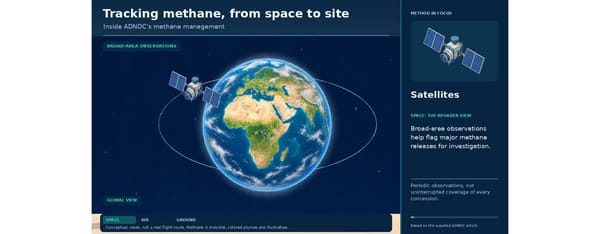
Because methane is invisible and releases can occur across a wide area, detecting emissions requires a combination of space-based monitoring technologies, drones, and ground-level sensors. From orbit, satellites can spot major releases over large areas. That wider view helps compare measurements from individual sources with site-level observations. This reconciliation is central to OGMP 2.0’s measurement-based reporting, helping teams check whether significant sources have been missed. Satellite data also feeds the Methane Alert and Response System (MARS), run by the UN Environment Programme’s International Methane Emissions Observatory. MARS combines observations from existing satellites to identify major releases and notify operators, so they can investigate and act. ADNOC verifies any release flagged by MARS through investigation and ground-level monitoring. Fixed-wing Fixed-wing aircraft cover pipeline corridors over longer flights. Multirotors Multirotors use multiple rotors to hover, giving a closer view of selected equipment such as wellheads and flare tips.
However, while satellite sweeps provide broad coverage, they can only capture information infrequently when passing over the Earth. This gap in coverage has led ADNOC to explore the use of aerial drones that enable targeted, close-range inspections of defined areas but have limited flight times. ADNOC’s Group HSE department has established an annual methane drone survey program covering material Upstream assets. Fixed-wing aircraft cover pipeline corridors over longer flights, while multirotor drones can hover over tanks, wellheads, and flare tips. “The drones identified methane emissions at specific tank locations. After corrective action, follow-up verification flights confirmed lower methane concentrations", says Mai Alhammadi, a senior electrical maintenance engineer in Bab Operations, part of ADNOC Onshore’s oil and gas field operations in Abu Dhabi. i, has led the use of drones fitted with methane sensors. “The drones identified methane emissions at specific tank locations. Reports, including photographs and location references, were submitted to the operations and maintenance teams for c Fixed sensors provide continuous monitoring, but only of individual assets. Used together, they help generate accurate data for all operating conditions.
This is a modal window.
Drones up close Below the satellites, drones narrow the search to individual sites. Mai Alhammadi, a senior electrical maintenance engineer in Bab Operations, part of ADNOC Onshore’s oil and gas field operations in Abu Dhabi, has led the use of drones fitted with methane sensors. Surveys above tanks have searched for methane releases, measuring concentrations location by location. “The drones identified methane emissions at specific tank locations. Reports, including photographs and location references, were submitted to the operations and maintenance teams for corrective action,” she says. “Follow-up verification flights confirmed lower methane concentrations after the work was completed.” Building on this work, ADNOC’s Group HSE department has established an annual methane drone survey program covering material Upstream assets. The surveys provide site-level monitoring and help validate source-level data, building confidence in how emissions are quantified and reported. Fixed-wing aircraft cover pipeline corridors over longer flights, while multirotor drones can hover over tanks, wellheads, and flare tips. ADNOC is also strengthening its internal methane management capabilities, with 15 UAE National drone operators trained across two cohorts.
~205,000 dairy cows Illustrative annual methane equivalent for 24.6 ktonnes of methane. Assumes 120 kg per cow per year 15 UAE national drone operators trained across two cohorts. 0.050% Upstream methane intensity in 2025 Sensors on the ground A drone survey is a snapshot, while emissions can change with operations. At source level, optical gas imaging (OGI) cameras and fixed sensors detect emissions from individual assets. To fill the gaps between surveys, Group HSE and Group Technology are evaluating three continuous-monitoring pilots. At Asab oil field, source-level sensors focus on emitting equipment or release points, while fence-line sensors monitor the site boundary. At the Habshan gas processing plant, the pilot uses a 360-degree methane-detection camera. At Jebel Dhanna, methane-tracking sensors are linked to a tanker-loading emissions-reduction project. Together, these pilots are intended to support the development of a continuous monitoring system that enables rapid responses to unexpected releases and provides real-time information on leaks under different operating scenarios. “A useful comparison is a home smoke alarm: permanently installed sensors operate around the clock and alert teams when methane levels rise, with AI helping to interpret the data,” says Fatima.* Robots are another avenue being explored. A Taurob inspector at the Taweelah Gas Compression Plant already uses thermal cameras to check for potential gas leaks and abnormal heat. The intention is to equip robots with advanced methane sensors so they can reach places that people cannot easily access, improving the coverage and accuracy of plant-level emissions data.**
Value in the system Khalid Yousef Al Awadhi, ADNOC Technology and Innovation Manager, notes that technology plays an important role in methane reduction. But ADNOC has another reason to advance these efforts: commercial optimization. This echoes the concern Sheikh Zayed raised about flaring more than 50 years ago. “Reducing methane emissions also means conserving a valuable resource,” says Khalid. “That is an important part of the business case.” Methane is the main component of natural gas, so a leak is not merely an emission. It is inventory escaping through a faulty seal, energy that was extracted and then quietly lost somewhere between the wellhead and the tanker. The value of methane management also extends beyond the operating site. In Europe, the EU’s methane regulation introduces monitoring, reporting, and verification requirements for oil and gas imports, reinforcing the importance of credible emissions information. For Samar, cutting methane also means giving customers information they can trust. “Frameworks such as OGMP 2.0 help us strengthen our methane measurement and reporting,” she says. “That gives customers greater confidence in the information we share and in how we manage methane emissions.” ADNOC joined OGMP 2.0 as a founding member in 2020, supporting the collective effort to improve methane measurement and reporting. Its participation also advances ADNOC’s decarbonization strategy by driving methane abatement and progress toward internationally recognized Gold Standard reporting. Nearly 50 years on, the thinking behind Law No. 8 continues to guide investment and research at ADNOC. The principle remains the same: gas that escapes pollutes the air and squanders a valuable resource. As technologies improve, ADNOC can make further progress in fulfilling that vision. “Measurement is the starting point,” says Samar. “The value comes from acting on what we find.”
MORE STORIES How ADNOC is quietly making carbon storage work How ADNOC’s In Country Value Program Reaches Every Emirate in the UAE World-scale chemicals hub in the UAE How governance and human judgment can accelerate AI adoption