
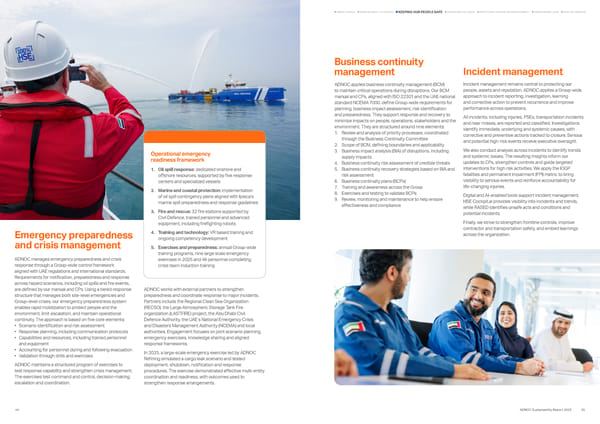
Emergency preparedness and crisis management ADNOC manages emergency preparedness and crisis response through a Group-wide control framework aligned with UAE regulations and international standards. Requirements for notification, preparedness and response across hazard scenarios, including oil spills and fire events, are defined by our manual and CPs. Using a tiered response structure that manages both site-level emergencies and Group-level crises, our emergency preparedness system enables rapid mobilization to protect people and the environment, limit escalation, and maintain operational continuity. The approach is based on five core elements: • Scenario identification and risk assessment • Response planning, including communication protocols • Capabilities and resources, including trained personnel and equipment • Accounting for personnel during and following evacuation • Validation through drills and exercises ADNOC maintains a structured program of exercises to test response capability and strengthen crisis management. The exercises test command and control, decision‑making, escalation and coordination. Operational emergency readiness framework 1. Oil spill response: dedicated onshore and offshore resources, supported by five response centers and specialized vessels 2. Marine and coastal protection: implementation of oil spill contingency plans aligned with Ipieca’s marine spill preparedness and response guidelines 3. Fire and rescue: 32 fire stations supported by Civil Defence, trained personnel and advanced equipment, including firefighting robots 4. Training and technology: VR based training and ongoing competency development 5. Exercises and preparedness: annual Group-wide training programs, nine large scale emergency exercises in 2025 and 46 personnel completing crisis team induction training ADNOC works with external partners to strengthen preparedness and coordinate response to major incidents. Partners include the Regional Clean Sea Organization (RECSO), the Large Atmospheric Storage Tank Fire organization (LASTFIRE) project, the Abu Dhabi Civil Defence Authority, the UAE’s National Emergency Crisis and Disasters Management Authority (NCEMA) and local authorities. Engagement focuses on joint scenario planning, emergency exercises, knowledge sharing and aligned response frameworks. In 2025, a large‑scale emergency exercise led by ADNOC Refining simulated a cargo leak scenario and tested deployment, shutdown, notification and response procedures. The exercise demonstrated effective multi‑entity coordination and readiness, with outcomes used to strengthen response arrangements. Business continuity management ADNOC applies business continuity management (BCM) to maintain critical operations during disruptions. Our BCM manual and CPs, aligned with ISO 22301 and the UAE national standard NCEMA 7000, define Group-wide requirements for planning, business impact assessment, risk identification and preparedness. They support response and recovery to minimize impacts on people, operations, stakeholders and the environment. They are structured around nine elements: 1. Review and analysis of priority processes, coordinated through the Business Continuity Committee 2. Scope of BCM, defining boundaries and applicability 3. Business impact analysis (BIA) of disruptions, including supply impacts 4. Business continuity risk assessment of credible threats 5. Business continuity recovery strategies based on BIA and risk assessment 6. Business continuity plans (BCPs) 7. Training and awareness across the Group 8. Exercises and testing to validate BCPs 9. Review, monitoring and maintenance to help ensure effectiveness and compliance Incident management Incident management remains central to protecting our people, assets and reputation. ADNOC applies a Group‑wide approach to incident reporting, investigation, learning and corrective action to prevent recurrence and improve performance across operations. All incidents, including injuries, PSEs, transportation incidents and near misses, are reported and classified. Investigations identify immediate, underlying and systemic causes, with corrective and preventive actions tracked to closure. Serious and potential high‑risk events receive executive oversight. We also conduct analysis across incidents to identify trends and systemic issues. The resulting insights inform our updates to CPs, strengthen controls and guide targeted interventions for high risk activities. We apply the IOGP fatalities and permanent impairment (FPI) metric to bring visibility to serious events and reinforce accountability for life‑changing injuries. Digital and AI‑enabled tools support incident management. HSE Cockpit.ai provides visibility into incidents and trends, while RASED identifies unsafe acts and conditions and potential incidents. Finally, we strive to strengthen frontline controls, improve contractor and transportation safety, and embed learnings across the organization. 45 ADNOC Sustainability Report 2025 44 KEEPING OUR PEOPLE SAFE ADVANCING NET ZERO EMPOWERING LIVES HOW WE OPERATE SUSTAINABILITY AT ADNOC ABOUT ADNOC PROTECTING NATURE AND BIODIVERSITY
 Sustainability Report 2025: Delivering Responsibly Page 21 Page 23