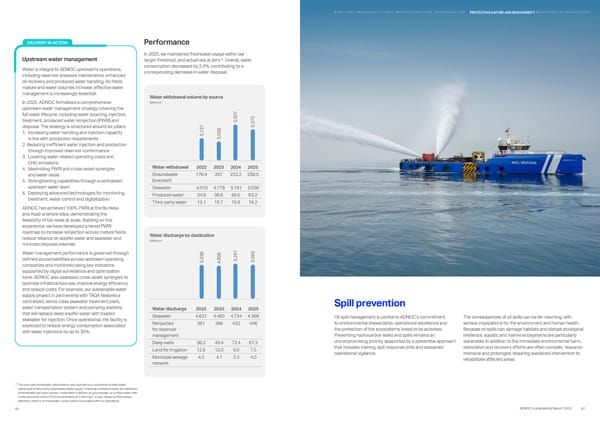
16 The prior-year freshwater withdrawal % was reported as a proportion of total water withdrawal to third party desalinated water supply. Following a detailed review, the definition of freshwater has been revised. Freshwater is defined as groundwater or surface water with a total dissolved solids (TDS) concentration of 1,000 mg/L or less. Based on the revised definition, there is no freshwater consumption associated with our operations. Performance In 2025, we maintained freshwater usage within our target threshold, and actual use at zero16. Overall, water consumption decreased by 2.4%, contributing to a corresponding decrease in water disposal. Water withdrawal 2022 2023 2024 2025 Groundwater (brackish) 176.4 207 232.2 258.0 Seawater 4,910 4,778 5,191 5,036 Produced water 34.8 36.6 68.5 63.2 Third-party water 15.1 15.7 15.9 16.2 Water withdrawal volume by source Million m3 5,137 5,038 5,507 5,373 Water discharge 2022 2023 2024 2025 Seawater 4,621 4,483 4,734 4,568 Reinjected for reservoir management 361 386 422 446 Deep wells 38.2 40.4 72.4 67.3 Land for irrigation 12.6 12.0 9.0 7.5 Municipal sewage network 4.3 4.1 3.3 4.0 Water discharge by destination Million m3 5,038 4,926 5,241 5,093 Spill prevention Oil spill management is central to ADNOC’s commitment to environmental stewardship, operational excellence and the protection of the ecosystems linked to its activities. Preventing hydrocarbon leaks and spills remains an uncompromising priority, supported by a preventive approach that includes training, spill response drills and sustained operational vigilance. The consequences of oil spills can be far-reaching, with serious implications for the environment and human health. Because oil spills can damage habitats and disrupt ecological resilience, aquatic and marine ecosystems are particularly vulnerable. In addition to the immediate environmental harm, restoration and recovery efforts are often complex, resource- intensive and prolonged, requiring sustained intervention to rehabilitate affected areas. Water is integral to ADNOC upstream's operations, including reservoir pressure maintenance, enhanced oil recovery and produced water handling. As fields mature and water volumes increase, effective water management is increasingly essential. In 2025, ADNOC formalized a comprehensive upstream water management strategy covering the full water lifecycle, including water sourcing, injection, treatment, produced water reinjection (PWRI) and disposal. The strategy is structured around six pillars: 1. Increasing water handling and injection capacity in line with production requirements 2. Reducing inefficient water injection and production through improved reservoir conformance 3. Lowering water-related operating costs and GHG emissions 4. Maximizing PWRI and cross-asset synergies and water reuse 5. Strengthening capabilities through a centralized upstream water team 6. Deploying advanced technologies for monitoring, treatment, water control and digitalization ADNOC has achieved 100% PWRI at the Bu Hasa and Asab onshore sites, demonstrating the feasibility of full reuse at scale. Building on this experience, we have developed a tiered PWRI roadmap to increase reinjection across mature fields, reduce reliance on aquifer water and seawater and minimize disposal volumes. Water management performance is governed through defined accountabilities across upstream operating companies and monitored using key indicators supported by digital surveillance and optimization tools. ADNOC also assesses cross-asset synergies to optimize infrastructure use, improve energy efficiency and reduce costs. For example, our sustainable water supply project in partnership with TAQA features a centralized, world-class seawater treatment plant, water transportation system and pumping stations, that will replace deep aquifer water with treated seawater for injection. Once operational, the facility is expected to reduce energy consumption associated with water injections by up to 30%. Upstream water management DELIVERY IN ACTION ADVANCING NET ZERO KEEPING OUR PEOPLE SAFE EMPOWERING LIVES HOW WE OPERATE SUSTAINABILITY AT ADNOC ABOUT ADNOC PROTECTING NATURE AND BIODIVERSITY 67 ADNOC Sustainability Report 2025 66
 Sustainability Report 2025: Delivering Responsibly Page 32 Page 34