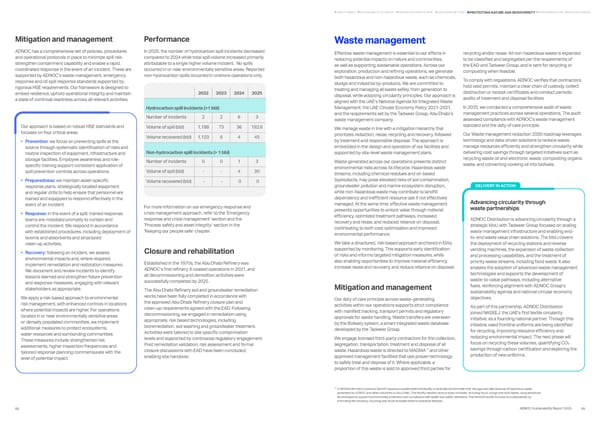
2022 2023 2024 2025 Hydrocarbon spill incidents (>1 bbl) Number of incidents 2 2 6 3 Volume of spill (bbl) 1,188 73 36 192.6 Volume recovered (bbl) 1,103 6 4 45 Non-hydrocarbon spill incidents (> 1 bbl) Number of incidents 0 0 1 3 Volume of spill (bbl) - - 4 30 Volume recovered (bbl) - - 0 0 Performance Closure and rehabilitation In 2025, the number of hydrocarbon spill incidents decreased compared to 2024 while total spill volume increased primarily attributable to a single higher volume incident. No spills occurred in or near environmentally sensitive areas. Reported non-hydrocarbon spills occurred in onshore operations only. Established in the 1970s, the Abu Dhabi Refinery was ADNOC’s first refinery. It ceased operations in 2021, and all decommissioning and demolition activities were successfully completed by 2025. The Abu Dhabi Refinery soil and groundwater remediation works have been fully completed in accordance with the approved Abu Dhabi Refinery closure plan and clean-up requirements agreed with the EAD. Following decommissioning, we engaged in remediation using appropriate, risk based technologies, including bioremediation, soil washing and groundwater treatment. Activities were tailored to site specific contamination levels and supported by continuous regulatory engagement. Post remediation validation, risk assessment and formal closure discussions with EAD have been concluded, enabling site handover. For more information on our emergency response and crisis management approach, refer to the ‘Emergency response and crisis management’ section and the ‘Process safety and asset integrity’ section in the ‘Keeping our people safe’ chapter. Mitigation and management ADNOC has a comprehensive set of policies, procedures and operational protocols in place to minimize spill risk, strengthen containment capability and enable a rapid, coordinated response in the event of an incident. These are supported by ADNOC’s waste management, emergency response and oil spill response standards supported by rigorous HSE requirements. Our framework is designed to embed resilience, uphold operational integrity and maintain a state of continual readiness across all relevant activities. 17 A MAGMA (formerly known as BeAAT) hazardous waste treatment facility is dedicated to the treatment, storage and safe disposal of hazardous waste generated by ADNOC and other industries in Abu Dhabi. This facility handles various types of waste, including liquid, sludge and solid waste, using advanced technologies to support environmental protection and compliance with health and safety standards. The MAGMA facility focuses on sustainability by promoting the recovery, recycling and reuse of waste streams whenever feasible. Our approach is based on robust HSE standards and focuses on four critical areas. • Prevention: we focus on preventing spills at the source through systematic identification of risks and routine inspection of equipment, infrastructure and storage facilities. Employee awareness and role- specific training support consistent application of spill prevention controls across operations. • Preparedness: we maintain asset-specific response plans, strategically located equipment and regular drills to help ensure that personnel are trained and equipped to respond effectively in the event of an incident. • Response: in the event of a spill, trained response teams are mobilized promptly to contain and control the incident. We respond in accordance with established procedures, including deployment of booms and absorbents and structured clean-up activities. • Recovery: following an incident, we assess environmental impacts and, where required, implement remediation and restoration measures. We document and review incidents to identify lessons learned and strengthen future prevention and response measures, engaging with relevant stakeholders as appropriate. We apply a risk‑based approach to environmental risk management, with enhanced controls in locations where potential impacts are higher. For operations located in or near environmentally sensitive areas or densely populated communities, we implement additional measures to protect ecosystems, water resources and surrounding communities. These measures include strengthened risk assessments, higher inspection frequencies and tailored response planning commensurate with the level of potential impact. Mitigation and management Waste management Effective waste management is essential to our efforts in reducing potential impacts on nature and communities, as well as supporting sustainable operations. Across our exploration, production and refining operations, we generate both hazardous and non-hazardous waste, such as chemicals, sludge and industrial by-products. We are committed to treating and managing all waste safely, from generation to disposal, while adopting circularity principles. Our approach is aligned with the UAE’s National Agenda for Integrated Waste Management, the UAE Circular Economy Policy 2021-2031, and the requirements set by the Tadweer Group, Abu Dhabi’s waste management company. We manage waste in line with a mitigation hierarchy that prioritizes reduction, reuse, recycling and recovery, followed by treatment and responsible disposal. The approach is embedded in the design and operation of our facilities and supported by site-level waste management plans. Waste generated across our operations presents distinct environmental risks across its lifecycle. Hazardous waste streams, including chemical residues and oil-based byproducts, may pose elevated risks of soil contamination, groundwater pollution and marine ecosystem disruption, while non-hazardous waste may contribute to landfill dependency and inefficient resource use if not effectively managed. At the same time, effective waste management presents opportunities to unlock value through material efficiency, optimized treatment pathways, increased recovery and reuse, and reduced reliance on disposal, contributing to both cost optimization and improved environmental performance. We take a structured, risk-based approach anchored in EIAs, supported by monitoring. This supports early identification of risks and informs targeted mitigation measures, while also enabling opportunities to improve material efficiency, increase reuse and recovery, and reduce reliance on disposal. Our duty of care principle across waste-generating activities within our operations supports strict compliance with manifest tracking, transport permits and regulatory approvals for waste handling. Waste transfers are overseen by the Bolisaty system, a smart integrated waste database developed by the Tadweer Group. We engage licensed third-party contractors for the collection, segregation, transportation, treatment and disposal of all waste. Hazardous waste is directed to MAGMA17 and other approved management facilities that use proven technology to safely treat and dispose of it. Where applicable, a proportion of this waste is sold to approved third parties for ADNOC Distribution is advancing circularity through a strategic MoU with Tadweer Group focused on scaling waste management infrastructure and enabling end- to-end waste value chain solutions. The MoU covers the deployment of recycling stations and reverse vending machines, the expansion of waste collection and processing capabilities, and the treatment of priority waste streams, including food waste. It also enables the adoption of advanced waste management technologies and supports the development of waste-to-value pathways, including alternative fuels, reinforcing alignment with ADNOC Group’s sustainability agenda and national circular economy objectives. As part of this partnership, ADNOC Distribution joined NASEEJ, the UAE’s first textile circularity initiative, as a founding national partner. Through this initiative, used frontline uniforms are being identified for recycling, improving resource efficiency and reducing environmental impact. The next phase will focus on recycling these volumes, quantifying CO₂ savings through carbon certification and exploring the production of new uniforms. Advancing circularity through waste partnerships DELIVERY IN ACTION recycling and/or reuse. All non-hazardous waste is expected to be classified and segregated per the requirements of the EAD and Tadweer Group, and is sent for recycling or composting when feasible. To comply with regulations, ADNOC verifies that contractors hold valid permits, maintain a clear chain of custody, collect destruction or receipt certificates and conduct periodic audits of treatment and disposal facilities. In 2025, we conducted a comprehensive audit of waste management practices across several operations. The audit assessed compliance with ADNOC’s waste management standard and the duty of care principle. Our Waste management reduction 2030 roadmap leverages technology and data-driven solutions to reduce waste, manage resources efficiently and strengthen circularity while delivering cost savings through targeted initiatives such as recycling waste oil and electronic waste, composting organic waste, and converting cooking oil into biofuels. 69 68 ADNOC Sustainability Report 2025 ADVANCING NET ZERO KEEPING OUR PEOPLE SAFE EMPOWERING LIVES HOW WE OPERATE SUSTAINABILITY AT ADNOC ABOUT ADNOC PROTECTING NATURE AND BIODIVERSITY
 Sustainability Report 2025: Delivering Responsibly Page 33 Page 35