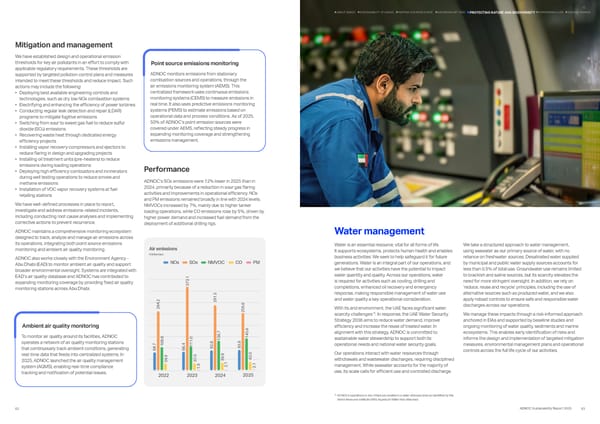
Performance ADNOC’s SOx emissions were 12% lower in 2025 than in 2024, primarily because of a reduction in sour gas flaring activities and improvements in operational efficiency. NOx and PM emissions remained broadly in line with 2024 levels. NMVOCs increased by 7%, mainly due to higher tanker loading operations, while CO emissions rose by 5%, driven by higher power demand and increased fuel demand from the deployment of additional drilling rigs. Water management Water is an essential resource, vital for all forms of life. It supports ecosystems, protects human health and enables business activities. We seek to help safeguard it for future generations. Water is an integral part of our operations, and we believe that our activities have the potential to impact water quantity and quality. Across our operations, water is required for activities such as cooling, drilling and completions, enhanced oil recovery and emergency response, making responsible management of water use and water quality a key operational consideration. With its arid environment, the UAE faces significant water scarcity challenges15. In response, the UAE Water Security Strategy 2036 aims to reduce water demand, improve efficiency and increase the reuse of treated water. In alignment with this strategy, ADNOC is committed to sustainable water stewardship to support both its operational needs and national water security goals. Our operations interact with water resources through withdrawals and wastewater discharges, requiring disciplined management. While seawater accounts for the majority of use, its scale calls for efficient use and controlled discharge. 15 ADNOCs operations in Abu Dhabi are located in a water stressed area as identified by the World Resource Institute (WRI) Aqueduct Water Risk Atlas tool. Air emissions Kilotonnes SOx NMVOC CO PM NOx 2022 84.7 264.2 108.8 34.9 2023 86.4 373.1 111.0 37.0 1.9 2024 92.8 291.5 136.7 39.9 2.1 2025 93.8 255.6 145.6 42.0 2.1 Mitigation and management We have established design and operational emission thresholds for key air pollutants in an effort to comply with applicable regulatory requirements. These thresholds are supported by targeted pollution control plans and measures intended to meet these thresholds and reduce impact. Such actions may include the following: • Deploying best available engineering controls and technologies, such as dry low NOx combustion systems • Electrifying and enhancing the efficiency of power turbines • Conducting regular leak detection and repair (LDAR) programs to mitigate fugitive emissions • Switching from sour to sweet gas fuel to reduce sulfur dioxide (SO₂) emissions • Recovering waste heat through dedicated energy efficiency projects • Installing vapor recovery compressors and ejectors to reduce flaring in design and upgrading projects • Installing oil treatment units (pre-heaters) to reduce emissions during loading operations • Deploying high efficiency combustors and incinerators during well testing operations to reduce smoke and methane emissions • Installation of VOC vapor recovery systems at fuel retailing stations We have well-defined processes in place to report, investigate and address emissions-related incidents, including conducting root cause analyses and implementing corrective actions to prevent recurrence. ADNOC maintains a comprehensive monitoring ecosystem designed to track, analyze and manage air emissions across its operations, integrating both point source emissions monitoring and ambient air quality monitoring. ADNOC also works closely with the Environment Agency - Abu Dhabi (EAD) to monitor ambient air quality and support broader environmental oversight. Systems are integrated with EAD’s air quality database and ADNOC has contributed to expanding monitoring coverage by providing fixed air quality monitoring stations across Abu Dhabi. To monitor air quality around its facilities, ADNOC operates a network of air quality monitoring stations that continuously track ambient conditions, generating real-time data that feeds into centralized systems. In 2025, ADNOC launched the air quality management system (AQMS), enabling real-time compliance tracking and notification of potential issues. Ambient air quality monitoring ADNOC monitors emissions from stationary combustion sources and operations, through the air emissions monitoring system (AEMS). This centralized framework uses continuous emissions monitoring systems (CEMS) to measure emissions in real time. It also uses predictive emissions monitoring systems (PEMS) to estimate emissions based on operational data and process conditions. As of 2025, 50% of ADNOC’s point emission sources were covered under AEMS, reflecting steady progress in expanding monitoring coverage and strengthening emissions management. Point source emissions monitoring We take a structured approach to water management, using seawater as our primary source of water, with no reliance on freshwater sources. Desalinated water supplied by municipal and public water supply sources accounts for less than 0.5% of total use. Groundwater use remains limited to brackish and saline sources, but its scarcity elevates the need for more stringent oversight. In addition, we rely on ‘reduce, reuse and recycle’ principles, including the use of alternative sources such as produced water, and we also apply robust controls to ensure safe and responsible water discharges across our operations. We manage these impacts through a risk-informed approach anchored in EIAs and supported by baseline studies and ongoing monitoring of water quality, sediments and marine ecosystems. This enables early identification of risks and informs the design and implementation of targeted mitigation measures, environmental management plans and operational controls across the full life cycle of our activities. ADVANCING NET ZERO KEEPING OUR PEOPLE SAFE EMPOWERING LIVES HOW WE OPERATE SUSTAINABILITY AT ADNOC ABOUT ADNOC PROTECTING NATURE AND BIODIVERSITY 63 ADNOC Sustainability Report 2025 62
 Sustainability Report 2025: Delivering Responsibly Page 30 Page 32