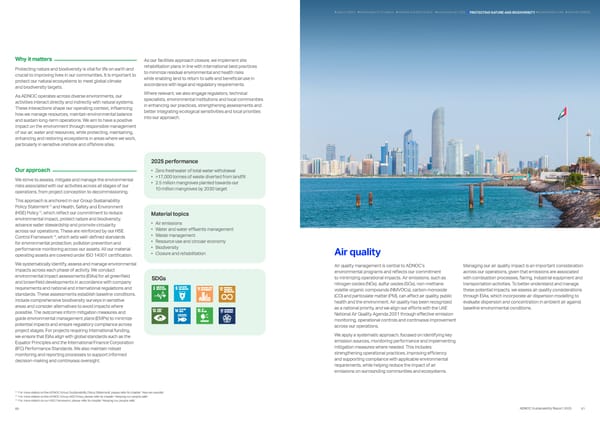
12 For more details on the ADNOC Group Sustainability Policy Statement, please refer to chapter ‘How we operate’. 13 For more details on the ADNOC Group HSE Policy, please refer to chapter ‘Keeping our people safe’. 14 For more details on our HSE Framework, please refer to chapter ‘Keeping our people safe’. Why it matters Material topics • Air emissions • Water and water effluents management • Waste management • Resource use and circular economy • Biodiversity • Closure and rehabilitation 2025 performance • Zero freshwater of total water withdrawal • >17,000 tonnes of waste diverted from landfill • 2.5 million mangroves planted towards our 10 million mangroves by 2030 target Protecting nature and biodiversity is vital for life on earth and crucial to improving lives in our communities. It is important to protect our natural ecosystems to meet global climate and biodiversity targets. As ADNOC operates across diverse environments, our activities interact directly and indirectly with natural systems. These interactions shape our operating context, influencing how we manage resources, maintain environmental balance and sustain long-term operations. We aim to have a positive impact on the environment through responsible management of our air, water and resources, while protecting, maintaining, enhancing and restoring ecosystems in areas where we work, particularly in sensitive onshore and offshore sites. As our facilities approach closure, we implement site rehabilitation plans in line with international best practices to minimize residual environmental and health risks while enabling land to return to safe and beneficial use in accordance with legal and regulatory requirements. Where relevant, we also engage regulators, technical specialists, environmental institutions and local communities in enhancing our practices, strengthening assessments and better integrating ecological sensitivities and local priorities into our approach. We strive to assess, mitigate and manage the environmental risks associated with our activities across all stages of our operations, from project conception to decommissioning. This approach is anchored in our Group Sustainability Policy Statement12 and Health, Safety and Environment (HSE) Policy13, which reflect our commitment to reduce environmental impact, protect nature and biodiversity, advance water stewardship and promote circularity across our operations. These are reinforced by our HSE Control Framework14, which sets well-defined standards for environmental protection, pollution prevention and performance monitoring across our assets. All our material operating assets are covered under ISO 14001 certification. We systematically identify, assess and manage environmental impacts across each phase of activity. We conduct environmental impact assessments (EIAs) for all greenfield and brownfield developments in accordance with company requirements and national and international regulations and standards. These assessments establish baseline conditions, include comprehensive biodiversity surveys in sensitive areas and consider alternatives to avoid impacts where possible. The outcomes inform mitigation measures and guide environmental management plans (EMPs) to minimize potential impacts and ensure regulatory compliance across project stages. For projects requiring international funding, we ensure that EIAs align with global standards such as the Equator Principles and the International Finance Corporation (IFC) Performance Standards. We also maintain robust monitoring and reporting processes to support informed decision-making and continuous oversight. Our approach SDGs Air quality Air quality management is central to ADNOC’s environmental programs and reflects our commitment to minimizing operational impacts. Air emissions, such as nitrogen oxides (NOx), sulfur oxides (SOx), non-methane volatile organic compounds (NMVOCs), carbon monoxide (CO) and particulate matter (PM), can affect air quality, public health and the environment. Air quality has been recognized as a national priority, and we align our efforts with the UAE National Air Quality Agenda 2031 through effective emission monitoring, operational controls and continuous improvement across our operations. We apply a systematic approach, focused on identifying key emission sources, monitoring performance and implementing mitigation measures where needed. This includes strengthening operational practices, improving efficiency and supporting compliance with applicable environmental requirements, while helping reduce the impact of air emissions on surrounding communities and ecosystems. Managing our air quality impact is an important consideration across our operations, given that emissions are associated with combustion processes, flaring, industrial equipment and transportation activities. To better understand and manage these potential impacts, we assess air quality considerations through EIAs, which incorporate air dispersion modelling to evaluate dispersion and concentration in ambient air against baseline environmental conditions. ADVANCING NET ZERO KEEPING OUR PEOPLE SAFE EMPOWERING LIVES HOW WE OPERATE SUSTAINABILITY AT ADNOC ABOUT ADNOC PROTECTING NATURE AND BIODIVERSITY 61 ADNOC Sustainability Report 2025 60
 Sustainability Report 2025: Delivering Responsibly Page 29 Page 31