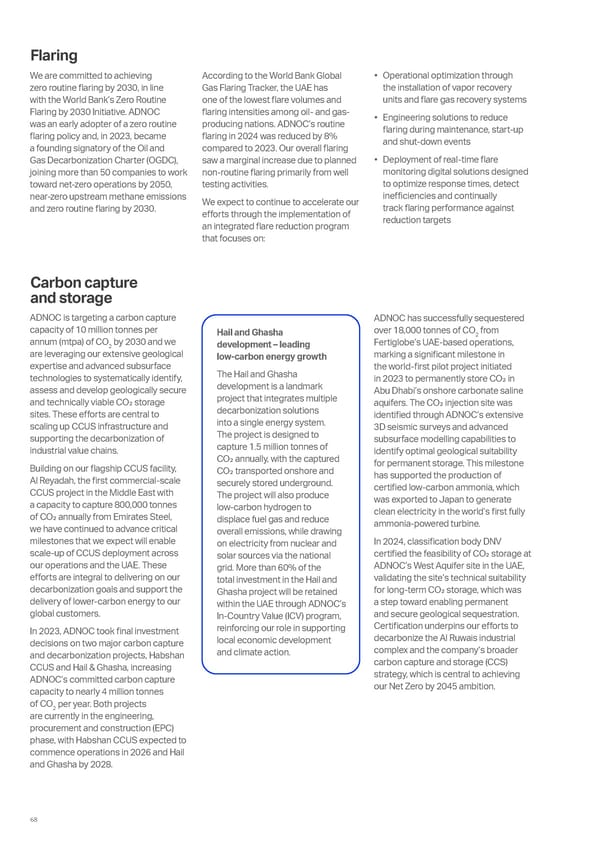
Flaring Carbon capture and storage We are committed to achieving zero routine flaring by 2030, in line with the World Bank’s Zero Routine Flaring by 2030 Initiative. ADNOC was an early adopter of a zero routine flaring policy and, in 2023, became a founding signatory of the Oil and Gas Decarbonization Charter (OGDC), joining more than 50 companies to work toward net-zero operations by 2050, near-zero upstream methane emissions and zero routine flaring by 2030. ADNOC is targeting a carbon capture capacity of 10 million tonnes per annum (mtpa) of CO 2 by 2030 and we are leveraging our extensive geological expertise and advanced subsurface technologies to systematically identify, assess and develop geologically secure and technically viable CO₂ storage sites. These efforts are central to scaling up CCUS infrastructure and supporting the decarbonization of industrial value chains. Building on our flagship CCUS facility, Al Reyadah, the first commercial-scale CCUS project in the Middle East with a capacity to capture 800,000 tonnes of CO₂ annually from Emirates Steel, we have continued to advance critical milestones that we expect will enable scale-up of CCUS deployment across our operations and the UAE. These efforts are integral to delivering on our decarbonization goals and support the delivery of lower-carbon energy to our global customers. In 2023, ADNOC took final investment decisions on two major carbon capture and decarbonization projects, Habshan CCUS and Hail & Ghasha, increasing ADNOC’s committed carbon capture capacity to nearly 4 million tonnes of CO 2 per year. Both projects are currently in the engineering, procurement and construction (EPC) phase, with Habshan CCUS expected to commence operations in 2026 and Hail and Ghasha by 2028. According to the World Bank Global Gas Flaring Tracker, the UAE has one of the lowest flare volumes and flaring intensities among oil- and gas- producing nations. ADNOC’s routine flaring in 2024 was reduced by 8% compared to 2023. Our overall flaring saw a marginal increase due to planned non-routine flaring primarily from well testing activities. We expect to continue to accelerate our efforts through the implementation of an integrated flare reduction program that focuses on: • Operational optimization through the installation of vapor recovery units and flare gas recovery systems • Engineering solutions to reduce flaring during maintenance, start-up and shut-down events • Deployment of real-time flare monitoring digital solutions designed to optimize response times, detect inefficiencies and continually track flaring performance against reduction targets Hail and Ghasha development – leading low-carbon energy growth The Hail and Ghasha development is a landmark project that integrates multiple decarbonization solutions into a single energy system. The project is designed to capture 1.5 million tonnes of CO₂ annually, with the captured CO₂ transported onshore and securely stored underground. The project will also produce low-carbon hydrogen to displace fuel gas and reduce overall emissions, while drawing on electricity from nuclear and solar sources via the national grid. More than 60% of the total investment in the Hail and Ghasha project will be retained within the UAE through ADNOC’s In-Country Value (ICV) program, reinforcing our role in supporting local economic development and climate action. ADNOC has successfully sequestered over 18,000 tonnes of CO 2 from Fertiglobe’s UAE-based operations, marking a significant milestone in the world-first pilot project initiated in 2023 to permanently store CO₂ in Abu Dhabi’s onshore carbonate saline aquifers. The CO₂ injection site was identified through ADNOC’s extensive 3D seismic surveys and advanced subsurface modelling capabilities to identify optimal geological suitability for permanent storage. This milestone has supported the production of certified low-carbon ammonia, which was exported to Japan to generate clean electricity in the world’s first fully ammonia-powered turbine. In 2024, classification body DNV certified the feasibility of CO₂ storage at ADNOC’s West Aquifer site in the UAE, validating the site’s technical suitability for long-term CO₂ storage, which was a step toward enabling permanent and secure geological sequestration. Certification underpins our efforts to decarbonize the Al Ruwais industrial complex and the company’s broader carbon capture and storage (CCS) strategy, which is central to achieving our Net Zero by 2045 ambition. 68
 ADNOC Sustainability Report 2024: Driving Progress & Prosperity Page 67 Page 69