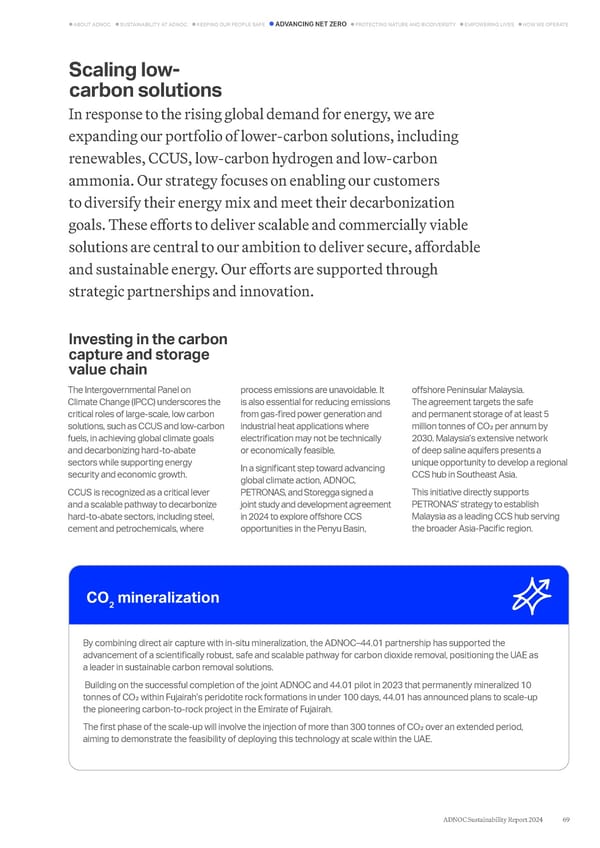
The Intergovernmental Panel on Climate Change (IPCC) underscores the critical roles of large-scale, low carbon solutions, such as CCUS and low-carbon fuels, in achieving global climate goals and decarbonizing hard-to-abate sectors while supporting energy security and economic growth. CCUS is recognized as a critical lever and a scalable pathway to decarbonize hard-to-abate sectors, including steel, cement and petrochemicals, where Investing in the carbon capture and storage value chain In response to the rising global demand for energy, we are expanding our portfolio of lower-carbon solutions, including renewables, CCUS, low-carbon hydrogen and low-carbon ammonia. Our strategy focuses on enabling our customers to diversify their energy mix and meet their decarbonization goals. These efforts to deliver scalable and commercially viable solutions are central to our ambition to deliver secure, affordable and sustainable energy. Our efforts are supported through strategic partnerships and innovation. Scaling low- carbon solutions By combining direct air capture with in-situ mineralization, the ADNOC–44.01 partnership has supported the advancement of a scientifically robust, safe and scalable pathway for carbon dioxide removal, positioning the UAE as a leader in sustainable carbon removal solutions. Building on the successful completion of the joint ADNOC and 44.01 pilot in 2023 that permanently mineralized 10 tonnes of CO₂ within Fujairah’s peridotite rock formations in under 100 days, 44.01 has announced plans to scale-up the pioneering carbon-to-rock project in the Emirate of Fujairah. The first phase of the scale-up will involve the injection of more than 300 tonnes of CO₂ over an extended period, aiming to demonstrate the feasibility of deploying this technology at scale within the UAE. CO 2 mineralization process emissions are unavoidable. It is also essential for reducing emissions from gas-fired power generation and industrial heat applications where electrification may not be technically or economically feasible. In a significant step toward advancing global climate action, ADNOC, PETRONAS, and Storegga signed a joint study and development agreement in 2024 to explore offshore CCS opportunities in the Penyu Basin, offshore Peninsular Malaysia. The agreement targets the safe and permanent storage of at least 5 million tonnes of CO₂ per annum by 2030. Malaysia’s extensive network of deep saline aquifers presents a unique opportunity to develop a regional CCS hub in Southeast Asia. This initiative directly supports PETRONAS’ strategy to establish Malaysia as a leading CCS hub serving the broader Asia-Pacific region. 69 ADNOC Sustainability Report 2024 ADVANCING NET ZERO KEEPING OUR PEOPLE SAFE EMPOWERING LIVES HOW WE OPERATE SUSTAINABILITY AT ADNOC ABOUT ADNOC PROTECTING NATURE AND BIODIVERSITY
 ADNOC Sustainability Report 2024: Driving Progress & Prosperity Page 68 Page 70