
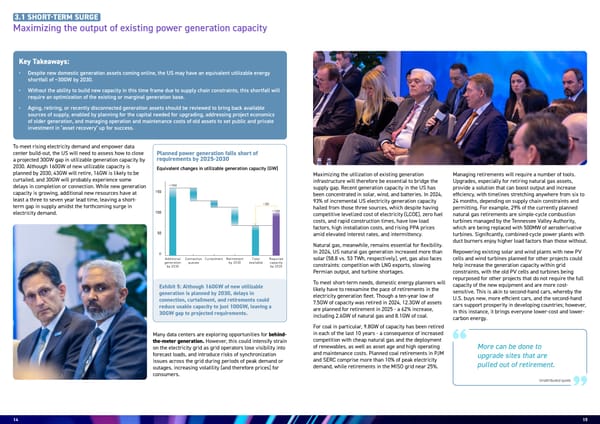
14 15 Maximizing the output of existing power generation capacity 3.1 SHORT-TERM SURGE Key Takeaways: • Despite new domestic generation assets coming online, the US may have an equivalent utilizable energy shortfall of ~30GW by 2030. • Without the ability to build new capacity in this time frame due to supply chain constraints, this shortfall will require an optimization of the existing or marginal generation base. • Aging, retiring, or recently disconnected generation assets should be reviewed to bring back available sources of supply, enabled by planning for the capital needed for upgrading, addressing project economics of older generation, and managing operation and maintenance costs of old assets to set public and private investment in ‘asset recovery’ up for success. Many data centers are exploring opportunities for behind- the-meter generation. However, this could intensify strain on the electricity grid as grid operators lose visibility into forecast loads, and introduce risks of synchronization issues across the grid during periods of peak demand or outages, increasing volatility (and therefore prices) for consumers. To meet rising electricity demand and empower data center build-out, the US will need to assess how to close a projected 30GW gap in utilizable generation capacity by 2030. Although 160GW of new utilizable capacity is planned by 2030, 43GW will retire, 16GW is likely to be curtailed, and 30GW will probably experience some delays in completion or connection. While new generation capacity is growing, additional new resources have at least a three to seven year lead time, leaving a short- term gap in supply amidst the forthcoming surge in electricity demand. Managing retirements will require a number of tools. Upgrades, especially for retiring natural gas assets, provide a solution that can boost output and increase efficiency, with timelines stretching anywhere from six to 24 months, depending on supply chain constraints and permitting. For example, 29% of the currently planned natural gas retirements are simple-cycle combustion turbines managed by the Tennessee Valley Authority, which are being replaced with 500MW of aeroderivative turbines. Significantly, combined-cycle power plants with duct burners enjoy higher load factors than those without. Repowering existing solar and wind plants with new PV cells and wind turbines planned for other projects could help increase the generation capacity within grid constraints, with the old PV cells and turbines being repurposed for other projects that do not require the full capacity of the new equipment and are more cost- sensitive. This is akin to second-hand cars, whereby the U.S. buys new, more efficient cars, and the second-hand cars support prosperity in developing countries; however, in this instance, it brings everyone lower-cost and lower- carbon energy. Planned power generation falls short of requirements by 2025-2030 ~160 Additional generation by 2030 Total available ~100 ~30 Required capacity by 2030 0 50 100 150 Curtailment Connection queues Retirement by 2030 Equivalent changes in utilizable generation capacity (GW) Exhibit 5: Although 160GW of new utilizable generation is planned by 2030, delays in connection, curtailment, and retirements could reduce usable capacity to just 100GW, leaving a 30GW gap to projected requirements. Maximizing the utilization of existing generation infrastructure will therefore be essential to bridge the supply gap. Recent generation capacity in the US has been concentrated in solar, wind, and batteries. In 2024, 93% of incremental US electricity generation capacity hailed from those three sources, which despite having competitive levelized cost of electricity (LCOE), zero fuel costs, and rapid construction times, have low load factors, high installation costs, and rising PPA prices amid elevated interest rates, and intermittency. Natural gas, meanwhile, remains essential for flexibility. In 2024, US natural gas generation increased more than solar (58.8 vs. 53 TWh, respectively), yet, gas also faces constraints: competition with LNG exports, slowing Permian output, and turbine shortages. To meet short-term needs, domestic energy planners will likely have to reexamine the pace of retirements in the electricity generation fleet. Though a ten-year low of 7.5GW of capacity was retired in 2024, 12.3GW of assets are planned for retirement in 2025 - a 62% increase, including 2.6GW of natural gas and 8.1GW of coal. For coal in particular, 9.8GW of capacity has been retired in each of the last 10 years - a consequence of increased competition with cheap natural gas and the deployment of renewables, as well as asset age and high operating and maintenance costs. Planned coal retirements in PJM and SERC comprise more than 10% of peak electricity demand, while retirements in the MISO grid near 25%. More can be done to upgrade sites that are pulled out of retirement. Unattributed quote
 Energy-AI Nexus: Powering the Next Great Leap for Human Progress Page 7 Page 9