
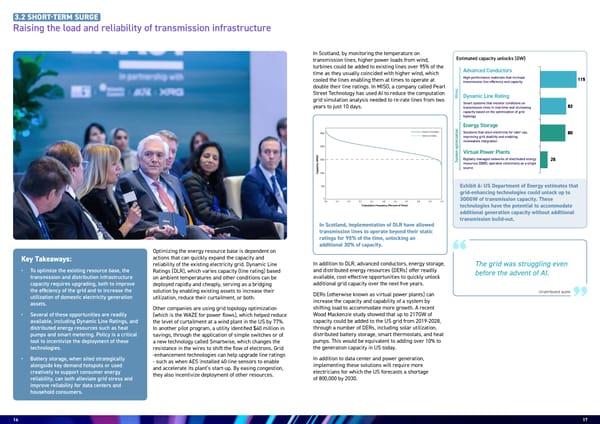
16 17 Raising the load and reliability of transmission infrastructure Estimated capacity unlocks (GW) Exhibit 6: US Department of Energy estimates that grid-enhancing technologies could unlock up to 300GW of transmission capacity. These technologies have the potential to accommodate additional generation capacity without additional transmission build-out. Advanced Conductors High-performance materials that increase transmission line efficiency and capacity Wires System optimization Dynamic Line Rating Smart systems that monitor conditions on transmission lines in real-time and increasing capacity based on the optimization of grid topology Energy Storage Solutions that store electricity for later use, improving grid stability and enabling renewables integration Virtual Power Plants Digitally managed networks of distributed energy resources (DER), operated collectively as a single source In Scotland, by monitoring the temperature on transmission lines, higher power loads from wind, turbines could be added to existing lines over 95% of the time as they usually coincided with higher wind, which cooled the lines enabling them at times to operate at double their line ratings. In MISO, a company called Pearl Street Technology has used AI to reduce the computation grid simulation analysis needed to re-rate lines from two years to just 10 days. In addition to DLR, advanced conductors, energy storage, and distributed energy resources (DERs) offer readily available, cost-effective opportunities to quickly unlock additional grid capacity over the next five years. DERs (otherwise known as virtual power plants) can increase the capacity and capability of a system by shifting load to accommodate more growth. A recent Wood Mackenzie study showed that up to 217GW of capacity could be added to the US grid from 2019-2028, through a number of DERs, including solar utilization, distributed battery storage, smart thermostats, and heat pumps. This would be equivalent to adding over 10% to the generation capacity in US today. In addition to data center and power generation, implementing these solutions will require more electricians for which the US forecasts a shortage of 800,000 by 2030. Key Takeaways: • To optimize the existing resource base, the transmission and distribution infrastructure capacity requires upgrading, both to improve the efficiency of the grid and to increase the utilization of domestic electricity generation assets. • Several of these opportunities are readily available, including Dynamic Line Ratings, and distributed energy resources such as heat pumps and smart metering. Policy is a critical tool to incentivize the deployment of these technologies. • Battery storage, when sited strategically alongside key demand hotspots or used creatively to support consumer energy reliability, can both alleviate grid stress and improve reliability for data centers and household consumers. Optimizing the energy resource base is dependent on actions that can quickly expand the capacity and reliability of the existing electricity grid. Dynamic Line Ratings (DLR), which varies capacity (line rating) based on ambient temperatures and other conditions can be deployed rapidly and cheaply, serving as a bridging solution by enabling existing assets to increase their utilization, reduce their curtailment, or both. Other companies are using grid topology optimization (which is the WAZE for power flows), which helped reduce the level of curtailment at a wind plant in the US by 77%. In another pilot program, a utility identified $40 million in savings, through the application of simple switches or of a new technology called Smartwise, which changes the resistance in the wires to shift the flow of electrons. Grid -enhancement technologies can help upgrade line ratings - such as when AES installed 40-line sensors to enable and accelerate its plant’s start-up. By easing congestion, they also incentivize deployment of other resources. 3.2 SHORT-TERM SURGE In Scotland, implementation of DLR have allowed transmission lines to operate beyond their static ratings for 95% of the time, unlocking an additional 30% of capacity. 2500 2000 1500 1000 Capability (MVA) 500 0 0.0 0.1 0.2 0.3 0.4 0.5 0.6 0.7 0.8 0.9 1.0 Cumulative Frequency (Percent of Time) Dynamic Line Rating Static Line Rating The grid was struggling even before the advent of AI. Unattributed quote
 Energy-AI Nexus: Powering the Next Great Leap for Human Progress Page 8 Page 10