
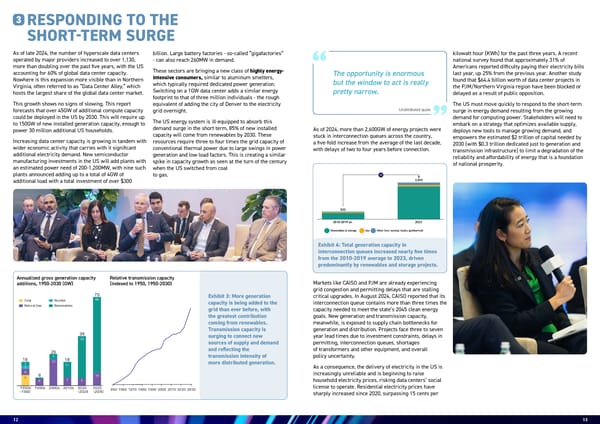
12 13 13 As of late 2024, the number of hyperscale data centers operated by major providers increased to over 1,130, more than doubling over the past five years, with the US accounting for 60% of global data center capacity. Nowhere is this expansion more visible than in Northern Virginia, often referred to as “Data Center Alley,” which hosts the largest share of the global data center market. This growth shows no signs of slowing. This report forecasts that over 45GW of additional compute capacity could be deployed in the US by 2030. This will require up to 150GW of new installed generation capacity, enough to power 30 million additional US households. Increasing data center capacity is growing in tandem with wider economic activity that carries with it significant additional electricity demand. New semiconductor manufacturing investments in the US will add plants with an estimated power need of 200-1,200MW, with nine such plants announced adding up to a total of 4GW of additional load with a total investment of over $300 As of 2024, more than 2,600GW of energy projects were stuck in interconnection queues across the country, a five-fold increase from the average of the last decade, with delays of two to four years before connection. Markets like CAISO and PJM are already experiencing grid congestion and permitting delays that are stalling critical upgrades. In August 2024, CAISO reported that its interconnection queue contains more than three times the capacity needed to meet the state’s 2045 clean energy goals. New generation and transmission capacity, meanwhile, is exposed to supply chain bottlenecks for generation and distribution. Projects face three to seven year lead times due to investment constraints, delays in permitting, interconnection queues, shortages of transformers and other equipment, and overall policy uncertainty. As a consequence, the delivery of electricity in the US is increasingly unreliable and is beginning to raise household electricity prices, risking data centers’ social license to operate. Residential electricity prices have sharply increased since 2020, surpassing 15 cents per billion. Large battery factories - so-called “gigafactories” - can also reach 260MW in demand. These sectors are bringing a new class of highly energy- intensive consumers, similar to aluminum smelters, which typically required dedicated power generation. Switching on a 1GW data center adds a similar energy footprint to that of three million individuals - the rough equivalent of adding the city of Denver to the electricity grid overnight. The US energy system is ill-equipped to absorb this demand surge in the short term, 85% of new installed capacity will come from renewables by 2030. These resources require three to four times the grid capacity of conventional thermal power due to large swings in power generation and low load factors. This is creating a similar spike in capacity growth as seen at the turn of the century when the US switched from coal to gas. Exhibit 3: More generation capacity is being added to the grid than ever before, with the greatest contribution coming from renewables. Transmission capacity is surging to connect new sources of supply and demand and reflecting the transmission intensity of more distributed generation. Exhibit 4: Total generation capacity in interconnection queues increased nearly five times from the 2010-2019 average to 2023, driven predominantly by renewables and storage projects. 1950 1960 1970 1980 1990 2000 2010 2020 2030 Renewables Natural Gas 1950s -1980 1990s 2000s 2010s 2020 -2024 2025 -2030 Coal Nuclear 18 6 25 18 39 70 2 2 5 9 6 4 11 33 60 10 6 7 21 Annualized gross generation capacity additions, 1950-2030 (GW) Relative transmission capacity (Indexed to 1950, 1950-2030) kilowatt hour (KWh) for the past three years. A recent national survey found that approximately 31% of Americans reported difficulty paying their electricity bills last year, up 25% from the previous year. Another study found that $64.4 billion worth of data center projects in the PJM/Northern Virginia region have been blocked or delayed as a result of public opposition. The US must move quickly to respond to the short-term surge in energy demand resulting from the growing demand for computing power. Stakeholders will need to embark on a strategy that optimizes available supply, deploys new tools to manage growing demand, and empowers the estimated $2 trillion of capital needed by 2030 (with $0.3 trillion dedicated just to generation and transmission infrastructure) to limit a degradation of the reliability and affordability of energy that is a foundation of national prosperity. RESPONDING TO THE SHORT-TERM SURGE 3 x5 533 2,592 2023 0 500 1,000 1,500 2,000 2,500 3,000 2010-2019 av. Gas Renewables & storage Other (incl. nuclear, hydro, geothermal) Source: Energy Markets & Policy, Berkeley Lab, Authors calculations x5 533 2,592 2023 0 500 1,000 1,500 2,000 2,500 3,000 2010-2019 av. Gas Renewables & storage Other (incl. nuclear, hydro, geothermal) The opportunity is enormous but the window to act is really pretty narrow. Unattributed quote
 Energy-AI Nexus: Powering the Next Great Leap for Human Progress Page 6 Page 8