
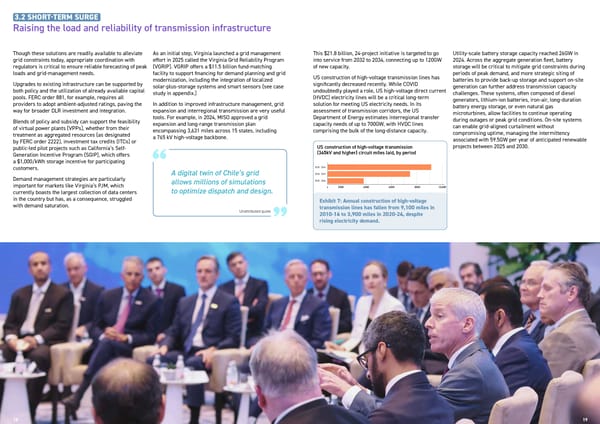
18 19 Raising the load and reliability of transmission infrastructure This $21.8 billion, 24-project initiative is targeted to go into service from 2032 to 2034, connecting up to 120GW of new capacity. US construction of high-voltage transmission lines has significantly decreased recently. While COVID undoubtedly played a role, US high-voltage direct current (HVDC) electricity lines will be a critical long-term solution for meeting US electricity needs. In its assessment of transmission corridors, the US Department of Energy estimates interregional transfer capacity needs of up to 700GW, with HVDC lines comprising the bulk of the long-distance capacity. Utility-scale battery storage capacity reached 26GW in 2024. Across the aggregate generation fleet, battery storage will be critical to mitigate grid constraints during periods of peak demand, and more strategic siting of batteries to provide back-up storage and support on-site generation can further address transmission capacity challenges. These systems, often composed of diesel generators, lithium-ion batteries, iron-air, long-duration battery energy storage, or even natural gas microturbines, allow facilities to continue operating during outages or peak grid conditions. On-site systems can enable grid-aligned curtailment without compromising uptime, managing the intermittency associated with 59.5GW per year of anticipated renewable projects between 2025 and 2030. Though these solutions are readily available to alleviate grid constraints today, appropriate coordination with regulators is critical to ensure reliable forecasting of peak loads and grid-management needs. Upgrades to existing infrastructure can be supported by both policy and the utilization of already available capital pools. FERC order 881, for example, requires all providers to adopt ambient-adjusted ratings, paving the way for broader DLR investment and integration. Blends of policy and subsidy can support the feasibility of virtual power plants (VPPs), whether from their treatment as aggregated resources (as designated by FERC order 2222), investment tax credits (ITCs) or public-led pilot projects such as California’s Self- Generation Incentive Program (SGIP), which offers a $1,000/kWh storage incentive for participating customers. Demand management strategies are particularly important for markets like Virginia’s PJM, which currently boasts the largest collection of data centers in the country but has, as a consequence, struggled with demand saturation. As an initial step, Virginia launched a grid management effort in 2025 called the Virginia Grid Reliability Program (VGRIP). VGRIP offers a $11.5 billion fund-matching facility to support financing for demand planning and grid modernization, including the integration of localized solar-plus-storage systems and smart sensors (see case study in appendix.) In addition to improved infrastructure management, grid expansion and interregional transmission are very useful tools. For example, in 2024, MISO approved a grid expansion and long-range transmission plan encompassing 3,631 miles across 15 states, including a 765 kV high-voltage backbone. 18 19 3.2 SHORT-TERM SURGE Exhibit 7: Annual construction of high-voltage transmission lines has fallen from 9,100 miles in 2010-14 to 3,900 miles in 2020-24, despite rising electricity demand. 2010 - 2014 2020 - 2024 2015 - 2019 0 2000 4000 6000 8000 10,000 US construction of high-voltage transmission (345kV and higher) circuit miles laid, by period A digital twin of Chile’s grid allows millions of simulations to optimize dispatch and design. Unattributed quote
 Energy-AI Nexus: Powering the Next Great Leap for Human Progress Page 9 Page 11