
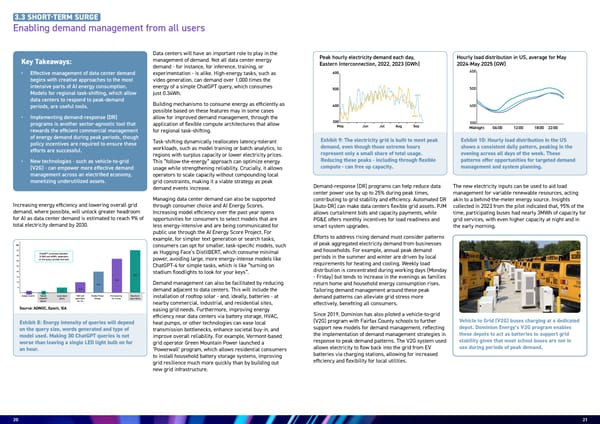
20 21 Enabling demand management from all users Increasing energy efficiency and lowering overall grid demand, where possible, will unlock greater headroom for AI as data center demand is estimated to reach 9% of total electricity demand by 2030. Data centers will have an important role to play in the management of demand. Not all data center energy demand - for instance, for inference, training, or experimentation - is alike. High-energy tasks, such as video generation, can demand over 1,000 times the energy of a simple ChatGPT query, which consumes just 0.34Wh. Building mechanisms to consume energy as efficiently as possible based on these features may in some cases allow for improved demand management, through the application of flexible compute architectures that allow for regional task-shifting. Task-shifting dynamically reallocates latency-tolerant workloads, such as model training or batch analytics, to regions with surplus capacity or lower electricity prices. This “follow-the-energy” approach can optimize energy usage while strengthening reliability. Crucially, it allows operators to scale capacity without compounding local grid constraints, making it a viable strategy as peak demand events increase. Managing data center demand can also be supported through consumer choice and AI Energy Scores. Increasing model efficiency over the past year opens opportunities for consumers to select models that are less energy-intensive and are being communicated for public use through the AI Energy Score Project. For example, for simpler text generation or search tasks, consumers can opt for smaller, task-specific models, such as Hugging Face’s DistilBERT, which consume minimal power, avoiding large, more energy-intense models like ChatGPT-4 for simple tasks, which is like “turning on stadium floodlights to look for your keys”. Demand management can also be facilitated by reducing demand adjacent to data centers. This will include the installation of rooftop solar - and, ideally, batteries - at nearby commercial, industrial, and residential sites, easing grid needs. Furthermore, improving energy efficiency near data centers via battery storage, HVAC, heat pumps, or other technologies can ease local transmission bottlenecks, enhance societal buy-in, and improve overall reliability. For example, Vermont-based grid operator Green Mountain Power launched a ‘Powerwall’ program, which allows residential consumers to install household battery storage systems, improving grid resilience much more quickly than by building out new grid infrastructure. Exhibit 8: Energy intensity of queries will depend on the query size, words generated and type of model used. Making 30 ChatGPT queries is not worse than leaving a single LED light bulb on for an hour. Vehicle to Grid (V2G) buses charging at a dedicated depot. Dominion Energy’s V2G program enables these depots to act as batteries to support grid stability given that most school buses are not in use during periods of peak demand. Demand-response (DR) programs can help reduce data center power use by up to 25% during peak times, contributing to grid stability and efficiency. Automated DR (Auto-DR) can make data centers flexible grid assets. PJM allows curtailment bids and capacity payments, while PG&E offers monthly incentives for load readiness and smart system upgrades. Efforts to address rising demand must consider patterns of peak aggregated electricity demand from businesses and households. For example, annual peak demand periods in the summer and winter are driven by local requirements for heating and cooling. Weekly load distribution is concentrated during working days (Monday - Friday) but tends to increase in the evenings as families return home and household energy consumption rises. Tailoring demand management around these peak demand patterns can alleviate grid stress more effectively, benefiting all consumers. Since 2019, Dominion has also piloted a vehicle-to-grid (V2G) program with Fairfax County schools to further support new models for demand management, reflecting the implementation of demand management strategies in response to peak demand patterns. The V2G system used allows electricity to flow back into the grid from EV batteries via charging stations, allowing for increased efficiency and flexibility for local utilities. Exhibit 9: The electricity grid is built to meet peak demand, even though those extreme hours represent only a small share of total usage. Reducing these peaks - including through flexible compute - can free up capacity. Exhibit 10: Hourly load distribution in the US shows a consistent daily pattern, peaking in the evening across all days of the week. These patterns offer opportunities for targeted demand management and system planning. May Jun Jul Aug Sep 2023 2022 600 500 400 300 600 500 400 300 Midnight 06:00 12:00 18:00 22:00 Hourly load distribution in US, average for May 2024-May 2025 (GW) Peak hourly electricity demand each day, Eastern Interconnection, 2022, 2023 (GWh) The new electricity inputs can be used to aid load management for variable renewable resources, acting akin to a behind-the-meter energy source. Insights collected in 2023 from the pilot indicated that, 95% of the time, participating buses had nearly 3MWh of capacity for grid services, with even higher capacity at night and in the early morning. 3.3 SHORT-TERM SURGE Key Takeaways: • Effective management of data center demand begins with creative approaches to the most intensive parts of AI energy consumption. Models for regional task-shifting, which allow data centers to respond to peak-demand periods, are useful tools. • Implementing demand-response (DR) programs is another sector-agnostic tool that rewards the efficient commercial management of energy demand during peak periods, though policy incentives are required to ensure these efforts are successful. • New technologies - such as vehicle-to-grid (V2G) - can empower more effective demand management across an electrified economy, monetizing underutilized assets. 0.29 0.3 4.9 40 35 30 25 Wh Google Search Typical ChatGPT Query* Long-input Query ChatGPT consumes between 0.3Wh and 40Wh, dependent on the query, prompt and task 20 15 10 5 10.0 20.0 32.0 40.0 10W LED Light Bulb for 1hr Mobile Phone Charge Microwaving for 2 mins Maximum input Query Source: ADNOC, Epoch, IEA
 Energy-AI Nexus: Powering the Next Great Leap for Human Progress Page 10 Page 12