
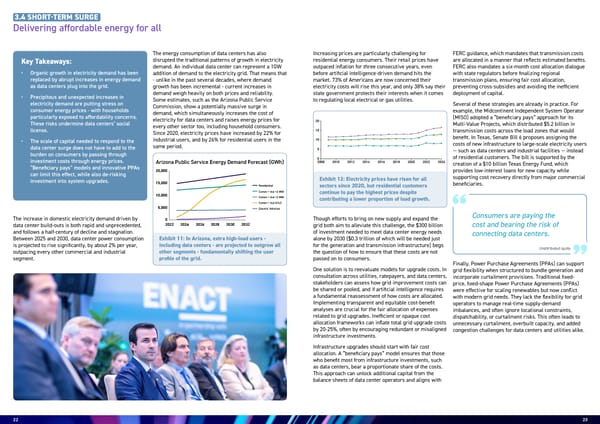
22 23 Delivering affordable energy for all The increase in domestic electricity demand driven by data center build-outs is both rapid and unprecedented, and follows a half-century of decline and stagnation. Between 2025 and 2030, data center power consumption is projected to rise significantly, by about 2% per year, outpacing every other commercial and industrial segment. Though efforts to bring on new supply and expand the grid both aim to alleviate this challenge, the $300 billion of investment needed to meet data center energy needs alone by 2030 ($0.3 trillion of which will be needed just for the generation and transmission infrastructure) begs the question of how to ensure that these costs are not passed on to consumers. One solution is to reevaluate models for upgrade costs. In consultation across utilities, ratepayers, and data centers, stakeholders can assess how grid improvement costs can be shared or pooled, and if artificial intelligence requires a fundamental reassessment of how costs are allocated. Implementing transparent and equitable cost-benefit analyses are crucial for the fair allocation of expenses related to grid upgrades. Inefficient or opaque cost allocation frameworks can inflate total grid upgrade costs by 20-25%, often by encouraging redundant or misaligned infrastructure investments. Infrastructure upgrades should start with fair cost allocation. A “beneficiary pays” model ensures that those who benefit most from infrastructure investments, such as data centers, bear a proportionate share of the costs. This approach can unlock additional capital from the balance sheets of data center operators and aligns with Exhibit 11: In Arizona, extra high-load users - including data centers - are projected to outgrow all other segments - fundamentally shifting the user profile of the grid. Exhibit 12: Electricity prices have risen for all sectors since 2020, but residential customers continue to pay the highest prices despite contributing a lower proportion of load growth. The energy consumption of data centers has also disrupted the traditional patterns of growth in electricity demand. An individual data center can represent a 1GW addition of demand to the electricity grid. That means that - unlike in the past several decades, where demand growth has been incremental - current increases in demand weigh heavily on both prices and reliability. Some estimates, such as the Arizona Public Service Commission, show a potentially massive surge in demand, which simultaneously increases the cost of electricity for data centers and raises energy prices for every other sector too, including household consumers. Since 2020, electricity prices have increased by 22% for industrial users, and by 26% for residential users in the same period. Increasing prices are particularly challenging for residential energy consumers. Their retail prices have outpaced inflation for three consecutive years, even before artificial intelligence-driven demand hits the market. 73% of Americans are now concerned their electricity costs will rise this year, and only 38% say their state government protects their interests when it comes to regulating local electrical or gas utilities. FERC guidance, which mandates that transmission costs are allocated in a manner that reflects estimated benefits. FERC also mandates a six-month cost allocation dialogue with state regulators before finalizing regional transmission plans, ensuring fair cost allocation, preventing cross-subsidies and avoiding the inefficient deployment of capital. Several of these strategies are already in practice. For example, the Midcontinent Independent System Operator (MISO) adopted a “beneficiary pays” approach for its Multi-Value Projects, which distributed $5.2 billion in transmission costs across the load zones that would benefit. In Texas, Senate Bill 6 proposes assigning the costs of new infrastructure to large-scale electricity users — such as data centers and industrial facilities — instead of residential customers. The bill is supported by the creation of a $10 billion Texas Energy Fund, which provides low-interest loans for new capacity while supporting cost recovery directly from major commercial beneficiaries. 2008 5 10 15 20 0 2010 2012 2014 2016 2018 2020 2022 2024 22 Finally, Power Purchase Agreements (PPAs) can support grid flexibility when structured to bundle generation and incorporate curtailment provisions. Traditional fixed- price, fixed-shape Power Purchase Agreements (PPAs) were effective for scaling renewables but now conflict with modern grid needs. They lack the flexibility for grid operators to manage real-time supply-demand imbalances, and often ignore locational constraints, dispatchability, or curtailment risks. This often leads to unnecessary curtailment, overbuilt capacity, and added congestion challenges for data centers and utilities alike. 3.4 SHORT-TERM SURGE Key Takeaways: • Organic growth in electricity demand has been replaced by abrupt increases in energy demand as data centers plug into the grid. • Precipitous and unexpected increases in electricity demand are putting stress on consumer energy prices - with households particularly exposed to affordability concerns. These risks undermine data centers’ social license. • The scale of capital needed to respond to the data center surge does not have to add to the burden on consumers by passing through investment costs through energy prices. “Beneficiary pays” models and innovative PPAs can limit this effect, while also de-risking investment into system upgrades. 5,000 2022 2024 2026 2028 2030 2032 10,000 15,000 20,000 0 Residential Comm + Ind 3 MW Comm + Ind XHLF Electric Vehicles Arizona Public Service Energy Demand Forecast (GWh) Consumers are paying the cost and bearing the risk of connecting data centers. Unattributed quote
 Energy-AI Nexus: Powering the Next Great Leap for Human Progress Page 11 Page 13