
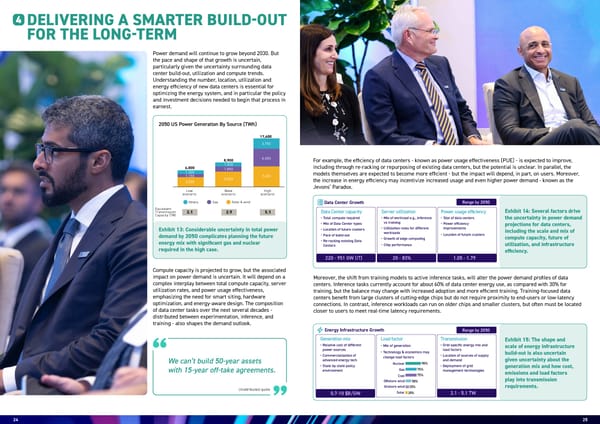
24 25 Power demand will continue to grow beyond 2030. But the pace and shape of that growth is uncertain, particularly given the uncertainty surrounding data center build-out, utilization and compute trends. Understanding the number, location, utilization and energy efficiency of new data centers is essential for optimizing the energy system, and in particular the policy and investment decisions needed to begin that process in earnest. For example, the efficiency of data centers - known as power usage effectiveness (PUE) - is expected to improve, including through re-racking or repurposing of existing data centers, but the potential is unclear. In parallel, the models themselves are expected to become more efficient - but the impact will depend, in part, on users. Moreover, the increase in energy efficiency may incentivize increased usage and even higher power demand - known as the Jevons’ Paradox. Compute capacity is projected to grow, but the associated impact on power demand is uncertain. It will depend on a complex interplay between total compute capacity, server utilization rates, and power usage effectiveness, emphasizing the need for smart siting, hardware optimization, and energy-aware design. The composition of data center tasks over the next several decades - distributed between experimentation, inference, and training - also shapes the demand outlook. Exhibit 14: Several factors drive the uncertainty in power demand projections for data centers, including the scale and mix of compute capacity, future of utilization, and infrastructure efficiency. Exhibit 15: The shape and scale of energy infrastructure build-out is also uncertain given uncertainty about the generation mix and how cost, emissions and load factors play into transmission requirements. Exhibit 13: Considerable uncertainty in total power demand by 2050 complicates planning the future energy mix with significant gas and nuclear required in the high case. 3,750 6,450 7,400 8,900 Low scenario Equivalent Transmission Capacity (TW) Base scenario High scenario Solar & wind Gas Others 2.1 2.9 5.1 6,000 17,600 1,500 1,850 5,550 1,300 1,150 3,550 2050 US Power Generation By Source (TWh) Moreover, the shift from training models to active inference tasks, will alter the power demand profiles of data centers. Inference tasks currently account for about 60% of data center energy use, as compared with 30% for training, but the balance may change with increased adoption and more efficient training. Training-focused data centers benefit from large clusters of cutting-edge chips but do not require proximity to end-users or low-latency connections. In contrast, inference workloads can run on older chips and smaller clusters, but often must be located closer to users to meet real-time latency requirements. Data Center Growth Data Center capacity • Total compute required • Mix of Data Center types • Location of future clusters • Pace of build-out • Re-racking existing Data Centers Server utilization • Mix of workload e.g., inference vs training • Utilization rates for different workloads • Growth of edge computing • Chip performance Power usage efficiency • Size of data centers • Power efficiency improvements • Location of future clusters 220 - 951 GW (IT) 20 - 83% 1.05 - 1.79 Energy Infrastructure Growth Generation mix • Relative cost of different power sources • Commercialization of advanced energy tech • State-by-state policy environment Load factor • Mix of generation • Technology & economics may change load factors Transmission • Grid-specific energy mix and load factors • Location of sources of supply and demand • Deployment of grid management technologies 0.7-10 $B/GW 2.1 - 5.1 TW 90% 75% 75% 50% 35% 20% Nuclear Gas Coal Offshore wind Onshore wind Solar DELIVERING A SMARTER BUILD-OUT FOR THE LONG-TERM 4 Range by 2050 Range by 2050 We can’t build 50-year assets with 15-year off-take agreements. Unattributed quote
 Energy-AI Nexus: Powering the Next Great Leap for Human Progress Page 12 Page 14