
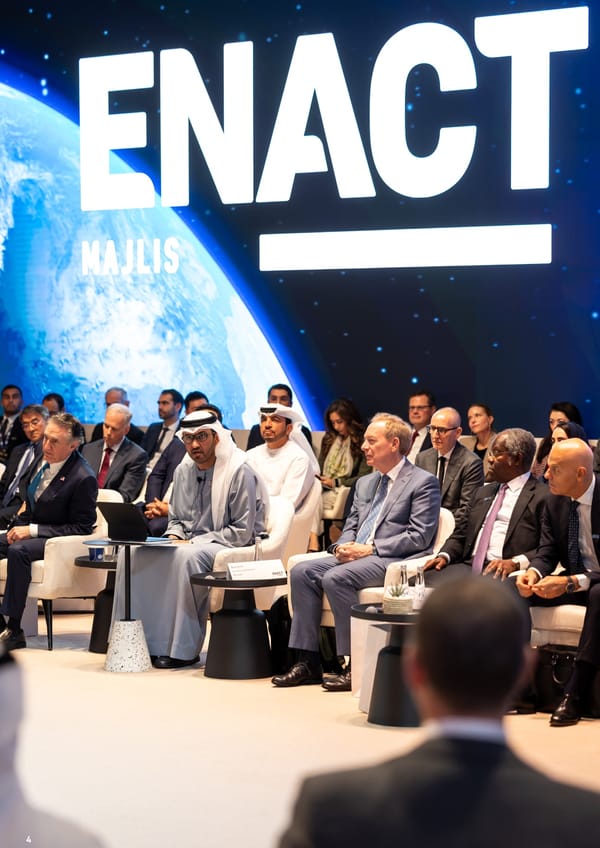
6 7 Since the first ENACT Majlis held in Abu Dhabi in November 2024, much has happened and many of the actions identified have seen material progress. In that short space of time, 12GW of additional data center capacity has been added in the US, putting the energy system under strain, while AI has helped to accelerate technical and scientific progress and improve corporate productivity. Last year, energy, AI, investment and climate leaders defined a broad five-point action agenda, to help realize the transformative potential of AI and drive adoption across diverse energy systems: • Drive AI Integration: Develop a common framework to integrate surging AI demand in the energy system, including the development of a global integrated energy model (GIEM). • Deploy AI to Transform Energy: Use AI to plan and deploy infrastructure faster and decarbonize energy production, delivery and consumption • Empower the Emerging Economies: Address the technology and energy access gap through AI and energy partnerships • Mobilize Financing: Create financing models that incorporate the AI and energy value chain as a whole • Embrace AI Adoption and Build Talent: Develop concrete plans to create the necessary culture for AI and energy to work together and tackle the energy sector’s talent gap In June, we met up for the second ENACT in Washington and focused on opportunities and challenges in the US, developing a cross-sector framework for AI’s energy challenge to the solve for the short-term surge (2030) and address long-term uncertainties (2050) across energy, infrastructure, investment and policy. 7 In this report we explore the progress made since the first ENACT, the changes that have happened in the market, the lessons learnt, and the next steps needed to turbo-charge the global economy with the twin engines of energy and AI, through: • Meeting energy demand growth needed to support the next wave of AI growth • Build generation and infrastructure at scale and pace while maximizing the integrated economic value • Fund the growth efficiently through the effective distribution of capital The ENACT Journey And underpinning it all: People, Policy & Permitting: we need skilled workforces and cultures that embrace AI; and smarter, faster, more predictable regulatory frameworks, where permitting becomes a catalyst, not a constraint. Meet energy demand growth ensuring investment in secure, accessible, sustainable supplies Fund the growth, by effectively and efficiently distributing capital Build infrastructure at scale and pace, through integrated approaches • Momentum has accelerated on meeting AI-driven surge with operators pulling all levers to repurpose power to supply near-term data center demand • US added 12 GW of data center capacity and approved 55mtpa of new LNG projects • China mandated 80% of data center electricity come from renewables by 2030, and in the UAE, Masdar is advancing a project to deliver 1 GW of 24/7 solar • Consumer energy costs have risen while industry has continued to deliver efficiencies reducing the unit cost of production • AI has helped to raise corporate profits in the face of lower energy prices and drive 40% of US GDP growth in Q3 • Al has helped to raise corporate profits in the face of lower energy prices and drive 40% of US GDP growth in Q3 • Tech-energy partnerships are developing, like Google- Kairos Power, Amazon-Iberdrola, Nvidia-Reliance and Microsoft-Three Mile Island, providing greater insights and learnings • Public-private investment rising, but significant infrastructure constraints persist: Large joint public- private commitments are improving infrastructure funding, but transmission and interconnection bottlenecks continue • The UAE is leading by example, developing one of the world’s largest data center complexes in partnership with global AI leaders - a model for integrating technology, power, and investment at scale • Grid optimization tools deployed and battery solutions used to deconstrain grid • PPAs signed between DCOs and energy companies for SMRs, fusion and geothermal • Consensus is that building 1 GW of data center capacity requires $40–50 billion of capital, including power, chips, land, and cooling • Globally, about $4 trillion per year is needed to meet combined AI and energy investment needs (approx. $2.5 trillion in energy and $1.5 trillion for data centers and associated infrastructure) • Competition for capital is intensifying - energy projects must now rival AI infrastructure for investor attention • Concentration of the majority of new data center investment remains anchored in the US and mature markets with limited diversification into emerging regions SINCE THEN... SINCE THEN... SINCE THEN... • Agreed no single energy source can meet future needs - an “and, and” approach remains essential • Considered how to leverage AI to build a better integrated energy system, maximize existing generation, and optimize systems • Explored how we create value from AI, and specifically its role in energy optimization • Leaders agreed we need to leverage Al to build a better-integrated energy system and GIEM model, and leverage them to drive efficiencies in their businesses. • Identified co-location and siting strategy as critical, given it’s easier to move data than energy • Explored how policy and AI can accelerate every stage of infrastructure build-out • Learned the threat of higher electricity prices and lower reliability challenging social license • Industry recognized the need to better utilize existing assets and de-constrain the existing grid with the help of Al tools while accelerating advanced generation technologies • Heard capex ranging from 10-45bn for 1GW data centers • Highlighted the need for integrated financing models that link chip makers, hyperscalers, and energy producers • Explored how innovative financing such as catalytic equity and enterprise-backed credit can unlock capacity AT THE LAST TWO ENACTS WE... AT THE LAST TWO ENACTS WE... AT THE LAST TWO ENACTS WE... Responding to the short-term surge Delivering a smarter build-out for the long-term • Maximize the output of existing power generation capacity • Raise the load and reliability of transmission infrastructure • Enable demand management from all users • Deliver affordable energy for all • Optimally site the next wave of infrastructure • Build and fund a 21 st century grid • Create a smart energy economy • Accelerate next- generation energy technologies 7
 Energy & AI: Twin Engines Turbo-Charging Economic Growth Page 3 Page 5