
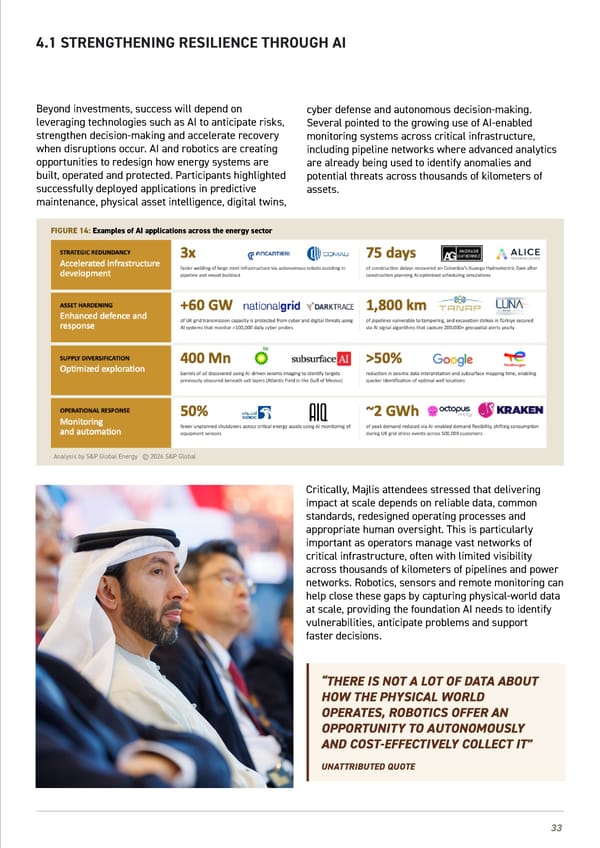
33 Beyond investments, success will depend on leveraging technologies such as AI to anticipate risks, strengthen decision-making and accelerate recovery when disruptions occur. AI and robotics are creating opportunities to redesign how energy systems are built, operated and protected. Participants highlighted successfully deployed applications in predictive maintenance, physical asset intelligence, digital twins, FIGURE 14:Examples of AI applications across the energy sector 4.1 STRENGTHENING RESILIENCE THROUGH AI Analysis by S&P Global Energy © 2026 S&P Global UNATTRIBUTED QUOTE “THERE IS NOT A LOT OF DATA ABOUT HOW THE PHYSICAL WORLD OPERATES, ROBOTICS OFFER AN OPPORTUNITY TO AUTONOMOUSLY AND COST-EFFECTIVELY COLLECT IT” cyber defense and autonomous decision-making. Several pointed to the growing use of AI-enabled monitoring systems across critical infrastructure, including pipeline networks where advanced analytics are already being used to identify anomalies and potential threats across thousands of kilometers of assets. Critically, Majlis attendees stressed that delivering impact at scale depends on reliable data, common standards, redesigned operating processes and appropriate human oversight. This is particularly important as operators manage vast networks of critical infrastructure, often with limited visibility across thousands of kilometers of pipelines and power networks. Robotics, sensors and remote monitoring can help close these gaps by capturing physical-world data at scale, providing the foundation AI needs to identify vulnerabilities, anticipate problems and support faster decisions.
 ENACT Majlis 2026 Page 32 Page 34