
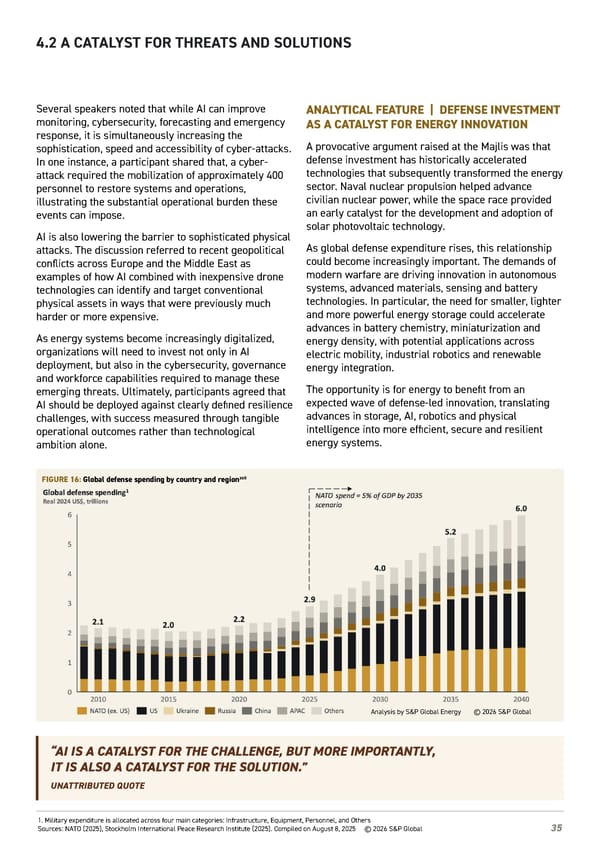
35 4.2 A CATALYST FOR THREATS AND SOLUTIONS Several speakers noted that while AI can improve monitoring, cybersecurity, forecasting and emergency response, it is simultaneously increasing the sophistication, speed and accessibility of cyber-attacks. In one instance, a participant shared that, a cyber- attack required the mobilization of approximately 400 personnel to restore systems and operations, illustrating the substantial operational burden these events can impose. AI is also lowering the barrier to sophisticated physical attacks. The discussion referred to recent geopolitical conflicts across Europe and the Middle East as examples of how AI combined with inexpensive drone technologies can identify and target conventional physical assets in ways that were previously much harder or more expensive. As energy systems become increasingly digitalized, organizations will need to invest not only in AI deployment, but also in the cybersecurity, governance and workforce capabilities required to manage these emerging threats. Ultimately, participants agreed that AI should be deployed against clearly defined resilience challenges, with success measured through tangible operational outcomes rather than technological ambition alone. UNATTRIBUTED QUOTE “AI IS A CATALYST FOR THE CHALLENGE, BUT MORE IMPORTANTLY, IT IS ALSO A CATALYST FOR THE SOLUTION.” ANALYTICAL FEATURE / DEFENSE INVESTMENT AS A CATALYST FOR ENERGY INNOVATION A provocative argument raised at the Majlis was that defense investment has historically accelerated technologies that subsequently transformed the energy sector. Naval nuclear propulsion helped advance civilian nuclear power, while the space race provided an early catalyst for the development and adoption of solar photovoltaic technology. As global defense expenditure rises, this relationship could become increasingly important. The demands of modern warfare are driving innovation in autonomous systems, advanced materials, sensing and battery technologies. In particular, the need for smaller, lighter and more powerful energy storage could accelerate advances in battery chemistry, miniaturization and energy density, with potential applications across electric mobility, industrial robotics and renewable energy integration. The opportunity is for energy to benefit from an expected wave of defense-led innovation, translating advances in storage, AI, robotics and physical intelligence into more efficient, secure and resilient energy systems. FIGURE 16: Global defense spending by country and regionxxii Analysis by S&P Global Energy © 2026 S&P Global 1. Military expenditure is allocated across four main categories: Infrastructure, Equipment, Personnel, and Others Sources: NATO (2025), Stockholm International Peace Research Institute (2025). Compiled on August 8, 2025 © 2026 S&P Global
 ENACT Majlis 2026 Page 34 Page 36