
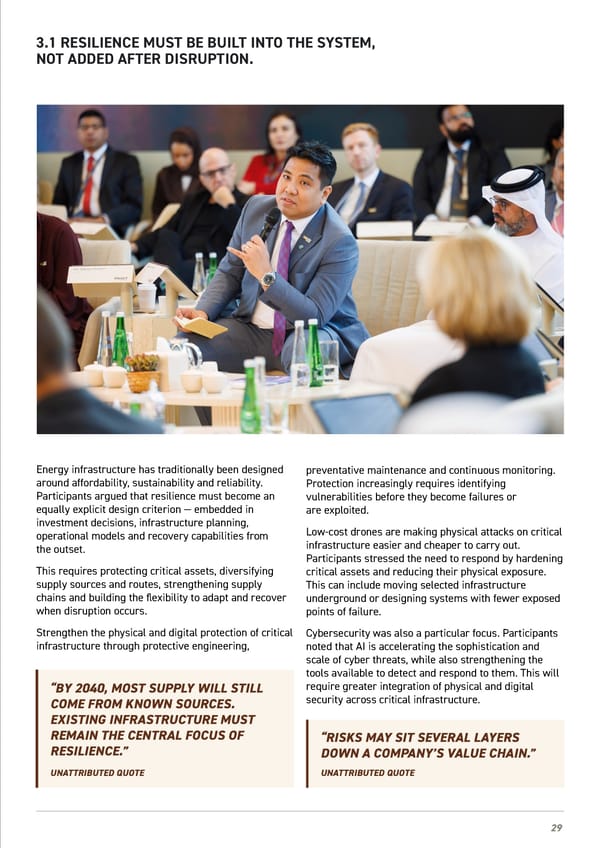
29 Energy infrastructure has traditionally been designed around affordability, sustainability and reliability. Participants argued that resilience must become an equally explicit design criterion — embedded in investment decisions, infrastructure planning, operational models and recovery capabilities from the outset. This requires protecting critical assets, diversifying supply sources and routes, strengthening supply chains and building the flexibility to adapt and recover when disruption occurs. Strengthen the physical and digital protection of critical infrastructure through protective engineering, 3.1 RESILIENCE MUST BE BUILT INTO THE SYSTEM, NOT ADDED AFTER DISRUPTION. UNATTRIBUTED QUOTE “BY 2040, MOST SUPPLY WILL STILL COME FROM KNOWN SOURCES. EXISTING INFRASTRUCTURE MUST REMAIN THE CENTRAL FOCUS OF RESILIENCE.” UNATTRIBUTED QUOTE “RISKS MAY SIT SEVERAL LAYERS DOWN A COMPANY’S VALUE CHAIN.” preventative maintenance and continuous monitoring. Protection increasingly requires identifying vulnerabilities before they become failures or are exploited. Low-cost drones are making physical attacks on critical infrastructure easier and cheaper to carry out. Participants stressed the need to respond by hardening critical assets and reducing their physical exposure. This can include moving selected infrastructure underground or designing systems with fewer exposed points of failure. Cybersecurity was also a particular focus. Participants noted that AI is accelerating the sophistication and scale of cyber threats, while also strengthening the tools available to detect and respond to them. This will require greater integration of physical and digital security across critical infrastructure.
 ENACT Majlis 2026 Page 28 Page 30