
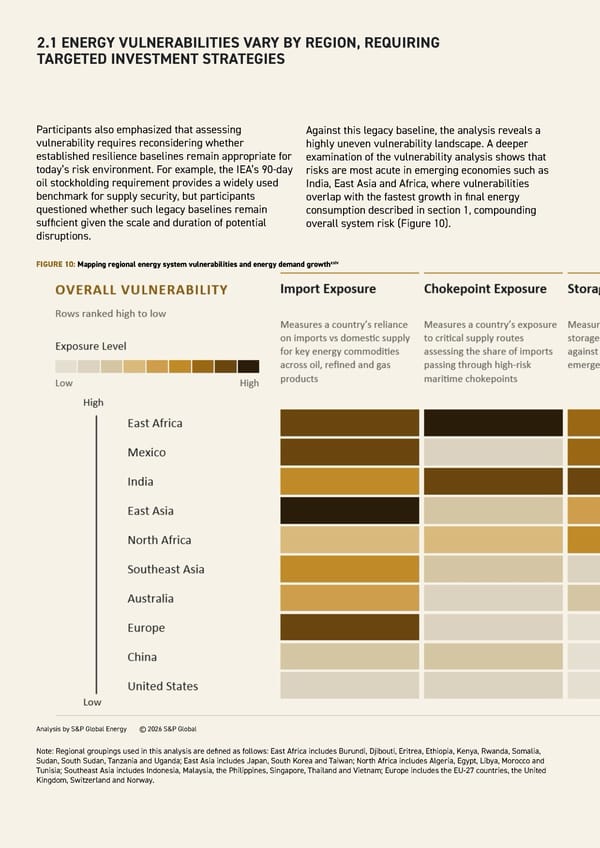
18 Participants also emphasized that assessing vulnerability requires reconsidering whether established resilience baselines remain appropriate for today’s risk environment. For example, the IEA’s 90-day oil stockholding requirement provides a widely used benchmark for supply security, but participants questioned whether such legacy baselines remain sufficient given the scale and duration of potential disruptions. Against this legacy baseline, the analysis reveals a highly uneven vulnerability landscape. A deeper examination of the vulnerability analysis shows that risks are most acute in emerging economies such as India, East Asia and Africa, where vulnerabilities overlap with the fastest growth in final energy consumption described in section 1, compounding overall system risk (Figure 10). Note: Regional groupings used in this analysis are defined as follows: East Africa includes Burundi, Djibouti, Eritrea, Ethiopia, Kenya, Rwanda, Somalia, Sudan, South Sudan, Tanzania and Uganda; East Asia includes Japan, South Korea and Taiwan; North Africa includes Algeria, Egypt, Libya, Morocco and Tunisia; Southeast Asia includes Indonesia, Malaysia, the Philippines, Singapore, Thailand and Vietnam; Europe includes the EU-27 countries, the United Kingdom, Switzerland and Norway. 2.1 ENERGY VULNERABILITIES VARY BY REGION, REQUIRING TARGETED INVESTMENT STRATEGIES FIGURE 10:Mapping regional energy system vulnerabilities and energy demand growthxxiv Analysis by S&P Global Energy © 2026 S&P Global
 ENACT Majlis 2026 Page 17 Page 19