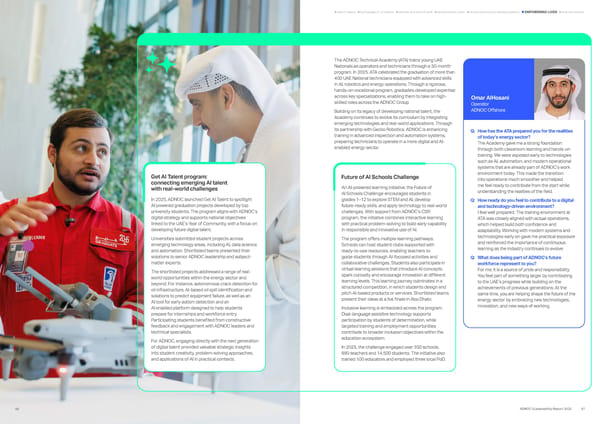
In 2025, ADNOC launched Get AI Talent to spotlight AI powered graduation projects developed by top university students. The program aligns with ADNOC’s digital strategy and supports national objectives linked to the UAE’s Year of Community, with a focus on developing future digital talent. Universities submitted student projects across emerging technology areas, including AI, data science and automation. Shortlisted teams presented their solutions to senior ADNOC leadership and subject- matter experts. The shortlisted projects addressed a range of real- world opportunities within the energy sector and beyond. For instance, autonomous crack detection for oil infrastructure, AI-based oil spill identification and solutions to predict equipment failure, as well as an AI tool for early autism detection and an AI enabled platform designed to help students prepare for internships and workforce entry. Participating students benefited from constructive feedback and engagement with ADNOC leaders and technical specialists. For ADNOC, engaging directly with the next generation of digital talent provided valuable strategic insights into student creativity, problem‑solving approaches, and applications of AI in practical contexts. Get AI Talent program: connecting emerging AI talent with real-world challenges Q: How has the ATA prepared you for the realities of today’s energy sector? The Academy gave me a strong foundation through both classroom learning and hands-on training. We were exposed early to technologies such as AI, automation, and modern operational systems that are already part of ADNOC’s work environment today. This made the transition into operations much smoother and helped me feel ready to contribute from the start while understanding the realities of the field. Q: How ready do you feel to contribute to a digital and technology-driven environment? I feel well prepared. The training environment at ATA was closely aligned with actual operations, which helped build both confidence and adaptability. Working with modern systems and technologies early on gave me practical exposure and reinforced the importance of continuous learning as the industry continues to evolve. Q: What does being part of ADNOC’s future workforce represent to you? For me, it is a source of pride and responsibility. You feel part of something larger by contributing to the UAE’s progress while building on the achievements of previous generations. At the same time, you are helping shape the future of the energy sector by embracing new technologies, innovation, and new ways of working. Omar AlHosani Operator ADNOC Offshore The ADNOC Technical Academy (ATA) trains young UAE Nationals as operators and technicians through a 30-month program. In 2025, ATA celebrated the graduation of more than 400 UAE National technicians equipped with advanced skills in AI, robotics and energy operations. Through a rigorous, hands-on vocational program, graduates developed expertise across key specializations, enabling them to take on high- skilled roles across the ADNOC Group. Building on its legacy of developing national talent, the Academy continues to evolve its curriculum by integrating emerging technologies and real-world applications. Through its partnership with Gecko Robotics, ADNOC is enhancing training in advanced inspection and automation systems, preparing technicians to operate in a more digital and AI- enabled energy sector. An AI‑powered learning initiative, the Future of AI Schools Challenge encourages students in grades 1–12 to explore STEM and AI, develop future‑ready skills, and apply technology to real‑world challenges. With support from ADNOC’s CSR program, the initiative combines interactive learning with practical problem‑solving to build early capability in responsible and innovative use of AI. The program offers multiple learning pathways. Schools can host student clubs supported with ready‑to‑use resources, enabling teachers to guide students through AI‑focused activities and collaborative challenges. Students also participate in virtual learning sessions that introduce AI concepts, spark curiosity and encourage innovation at different learning levels. This learning journey culminates in a structured competition, in which students design and pitch AI‑based products or services. Shortlisted teams present their ideas at a live finale in Abu Dhabi. Inclusive learning is embedded across the program. Dual‑language assistive technology supports participation by students of determination, while targeted training and employment opportunities contribute to broader inclusion objectives within the education ecosystem. In 2025, the challenge engaged over 350 schools, 890 teachers and 14,500 students. The initiative also trained 100 educators and employed three local PoD. Future of AI Schools Challenge 97 ADNOC Sustainability Report 2025 96 EMPOWERING LIVES KEEPING OUR PEOPLE SAFE ADVANCING NET ZERO HOW WE OPERATE SUSTAINABILITY AT ADNOC ABOUT ADNOC PROTECTING NATURE AND BIODIVERSITY
 Sustainability Report 2025: Delivering Responsibly Page 47 Page 49