
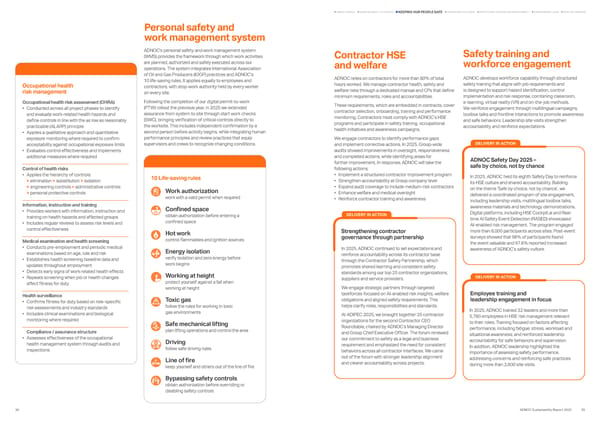
Occupational health risk assessment (OHRA) • Conducted across all project phases to identify and evaluate work-related health hazards and define controls in line with the as low as reasonably practicable (ALARP) principle • Applies a qualitative approach and quantitative exposure monitoring where required to confirm acceptability against occupational exposure limits • Evaluates control effectiveness and implements additional measures where required Control of health risks • Applies the hierarchy of controls: > elimination > substitution > isolation > engineering controls > administrative controls > personal protective controls Information, instruction and training • Provides workers with information, instruction and training on health hazards and affected groups • Includes regular reviews to assess risk levels and control effectiveness Medical examination and health screening • Conducts pre-employment and periodic medical examinations based on age, role and risk • Establishes health screening baseline data and updates throughout employment • Detects early signs of work-related health effects • Repeats screening when job or health changes affect fitness for duty Health surveillance • Confirms fitness for duty based on role-specific risk assessments and industry standards • Includes clinical examinations and biological monitoring where required Compliance / assurance structure • Assesses effectiveness of the occupational health management system through audits and inspections Occupational health risk management Personal safety and work management system ADNOC's personal safety and work management system (WMS) provides the framework through which work activities are planned, authorized and safely executed across our operations. The system integrates International Association of Oil and Gas Producers (IOGP) practices and ADNOC's 10 life-saving rules. It applies equally to employees and contractors, with stop-work authority held by every worker on every site. Following the completion of our digital permit-to-work (PTW) rollout the previous year, in 2025 we extended assurance from system to site through start work checks (SWC), bringing verification of critical controls directly to the worksite. This includes independent confirmation by a second person before activity begins, while integrating human performance principles and review practices that equip supervisors and crews to recognize changing conditions. 10 Life-saving rules Work authorization work with a valid permit when required Confined space obtain authorization before entering a confined space Hot work control flammables and ignition sources Energy isolation verify isolation and zero energy before work begins Working at height protect yourself against a fall when working at height Toxic gas follow the rules for working in toxic gas environments Safe mechanical lifting plan lifting operations and control the area Driving follow safe driving rules Line of fire keep yourself and others out of the line of fire Bypassing safety controls obtain authorization before overriding or disabling safety controls Contractor HSE and welfare ADNOC relies on contractors for more than 80% of total hours worked. We manage contractor health, safety and welfare risks through a dedicated manual and CPs that define minimum requirements, roles and accountabilities. These requirements, which are embedded in contracts, cover contractor selection, onboarding, training and performance monitoring. Contractors must comply with ADNOC’s HSE programs and participate in safety training, occupational health initiatives and awareness campaigns. We engage contractors to identify performance gaps and implement corrective actions. In 2025, Group-wide audits showed improvements in oversight, responsiveness and completed actions, while identifying areas for further improvement. In response, ADNOC will take the following actions: • Implement a structured contractor improvement program • Strengthen accountability at Group company level • Expand audit coverage to include medium-risk contractors • Enhance welfare and medical oversight • Reinforce contractor training and awareness In 2025, ADNOC continued to set expectations and reinforce accountability across its contractor base through the Contractor Safety Partnership, which promotes shared learning and consistent safety standards among our top 25 contractor organizations, suppliers and service providers. We engage strategic partners through targeted taskforces focused on AI-enabled risk insights, welfare obligations and aligned safety requirements. This helps clarify roles, responsibilities and standards. At ADIPEC 2025, we brought together 25 contractor organizations for the second Contractor CEO Roundtable, chaired by ADNOC’s Managing Director and Group Chief Executive Officer. The forum renewed our commitment to safety as a legal and business requirement and emphasized the need for consistent behaviors across all contractor interfaces. We came out of the forum with stronger leadership alignment and clearer accountability across projects. Strengthening contractor governance through partnership DELIVERY IN ACTION Safety training and workforce engagement ADNOC develops workforce capability through structured safety training that aligns with job requirements and is designed to support hazard identification, control implementation and risk response, combining classroom, e-learning, virtual reality (VR) and on-the-job methods. We reinforce engagement through multilingual campaigns, toolbox talks and frontline interactions to promote awareness and safe behaviors. Leadership site visits strengthen accountability and reinforce expectations. DELIVERY IN ACTION In 2025, ADNOC held its eighth Safety Day to reinforce its HSE culture and shared accountability. Building on the theme ‘Safe by choice, not by chance’, we delivered a coordinated program of site engagement, including leadership visits, multilingual toolbox talks, awareness materials and technology demonstrations. Digital platforms, including HSE Cockpit.ai and Real- time AI Safety Event Detection (RASED) showcased AI-enabled risk management. The program engaged more than 8,000 participants across sites. Post-event surveys showed that 98% of participants found the event valuable and 97.6% reported increased awareness of ADNOC’s safety culture. ADNOC Safety Day 2025 – safe by choice, not by chance In 2025, ADNOC trained 32 leaders and more than 5,780 employees in HSE risk management relevant to their roles. Training focused on factors affecting performance, including fatigue, stress, workload and situational awareness, and reinforced leadership accountability for safe behaviors and supervision. In addition, ADNOC leadership highlighted the importance of assessing safety performance, addressing concerns and reinforcing safe practices during more than 2,800 site visits. Employee training and leadership engagement in focus DELIVERY IN ACTION 39 ADNOC Sustainability Report 2025 38 KEEPING OUR PEOPLE SAFE ADVANCING NET ZERO EMPOWERING LIVES HOW WE OPERATE SUSTAINABILITY AT ADNOC ABOUT ADNOC PROTECTING NATURE AND BIODIVERSITY
 Sustainability Report 2025: Delivering Responsibly Page 18 Page 20