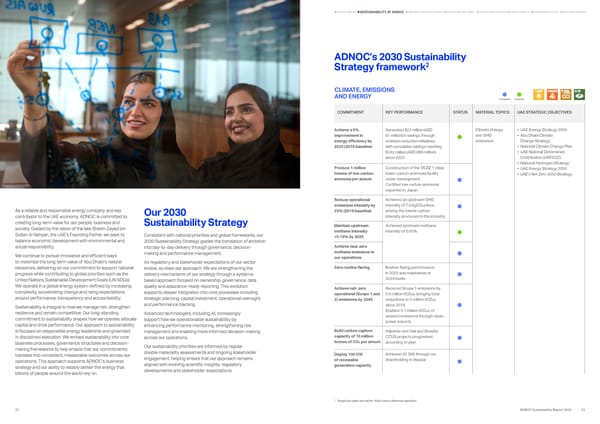
Our 2030 Sustainability Strategy As a reliable and responsible energy company and key contributor to the UAE economy, ADNOC is committed to creating long-term value for our people, business and society. Guided by the vision of the late Sheikh Zayed bin Sultan Al Nahyan, the UAE’s Founding Father, we seek to balance economic development with environmental and social responsibility. We continue to pursue innovative and efficient ways to maximize the long-term value of Abu Dhabi’s natural resources, delivering on our commitment to support national progress while contributing to global priorities such as the United Nations Sustainable Development Goals (UN SDGs). We operate in a global energy system defined by increasing complexity, accelerating change and rising expectations around performance, transparency and accountability. Sustainability is integral to how we manage risk, strengthen resilience and remain competitive. Our long-standing commitment to sustainability shapes how we operate, allocate capital and drive performance. Our approach to sustainability is focused on responsible energy leadership and grounded in disciplined execution. We embed sustainability into core business processes, governance structures and decision- making frameworks to help ensure that our commitments translate into consistent, measurable outcomes across our operations. This approach supports ADNOC’s business strategy and our ability to reliably deliver the energy that billions of people around the world rely on. Consistent with national priorities and global frameworks, our 2030 Sustainability Strategy guides the translation of ambition into day-to-day delivery through governance, decision- making and performance management. As regulatory and stakeholder expectations of our sector evolve, so does our approach. We are strengthening the delivery mechanisms of our strategy through a systems- based approach focused on ownership, governance, data quality and assurance-ready reporting. This evolution supports deeper integration into core processes including strategic planning, capital investment, operational oversight and performance tracking. Advanced technologies, including AI, increasingly support how we operationalize sustainability by enhancing performance monitoring, strengthening risk management and enabling more informed decision-making across our operations. Our sustainability priorities are informed by regular double materiality assessments and ongoing stakeholder engagement, helping ensure that our approach remains aligned with evolving scientific insights, regulatory developments and stakeholder expectations. ADNOC’s 2030 Sustainability Strategy framework2 2 Target due dates are set for 2030 unless otherwise specified. • UAE Energy Strategy 2050 • Abu Dhabi Climate Change Strategy • National Climate Change Plan • UAE National Determined Contribution (UNFCCC) • National Hydrogen Strategy • UAE Energy Strategy 2050 • UAE’s Net Zero 2050 Strategy Climate change and GHG emissions Generated $22 million (AED 81 million) in savings through emission reduction initiatives, with cumulative savings reaching $242 million (AED 888 million) since 2022 Achieve a 5% improvement in energy efficiency by 2025 (2018 baseline) Construction of the TA’ZIZ 1 mtpa lower-carbon ammonia facility under development Certified low-carbon ammonia exported to Japan Produce 1 million tonnes of low-carbon ammonia per annum Achieved an upstream GHG intensity of 7.0 kgCO₂e/boe, among the lowest carbon intensity producers in the industry Reduce operational emissions intensity by 25% (2019 baseline) Achieved upstream methane intensity of 0.05% Maintain upstream methane intensity
 Sustainability Report 2025: Delivering Responsibly Page 10 Page 12