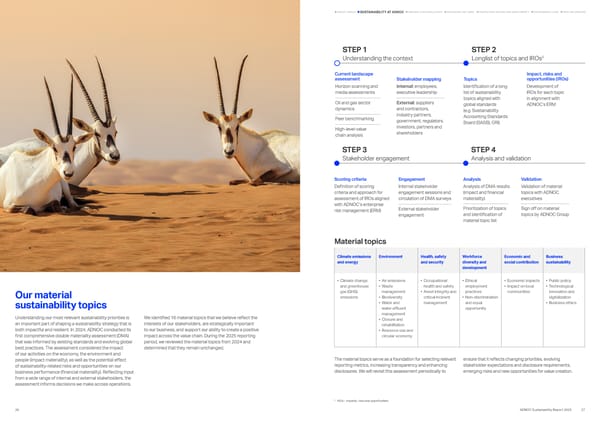
Our material sustainability topics Understanding our most relevant sustainability priorities is an important part of shaping a sustainability strategy that is both impactful and resilient. In 2024, ADNOC conducted its first comprehensive double materiality assessment (DMA) that was informed by existing standards and evolving global best practices. The assessment considered the impact of our activities on the economy, the environment and people (impact materiality), as well as the potential effect of sustainability-related risks and opportunities on our business performance (financial materiality). Reflecting input from a wide range of internal and external stakeholders, the assessment informs decisions we make across operations. We identified 16 material topics that we believe reflect the interests of our stakeholders, are strategically important to our business, and support our ability to create a positive impact across the value chain. During the 2025 reporting period, we reviewed the material topics from 2024 and determined that they remain unchanged. Understanding the context Longlist of topics and IROs5 Current landscape assessment Topics Stakeholder mapping Impact, risks and opportunities (IROs) STEP 1 STEP 2 Identification of a long list of sustainability topics aligned with global standards (e.g. Sustainability Accounting Standards Board (SASB), GRI) Development of IROs for each topic in alignment with ADNOC’s ERM Horizon scanning and media assessments Oil and gas sector dynamics Peer benchmarking High-level value chain analysis Internal: employees, executive leadership External: suppliers and contractors, industry partners, government, regulators, investors, partners and shareholders Stakeholder engagement Analysis and validation Scoring criteria Analysis Engagement Validation STEP 3 STEP 4 Definition of scoring criteria and approach for assessment of IROs aligned with ADNOC’s enterprise risk management (ERM) Internal stakeholder engagement sessions and circulation of DMA surveys External stakeholder engagement Analysis of DMA results (impact and financial materiality) Prioritization of topics and identification of material topic list Validation of material topics with ADNOC executives Sign off on material topics by ADNOC Group • Economic impacts • Impact on local communities • Public policy • Technological innovation and digitalization • Business ethics • Ethical employment practices • Non-discrimination and equal opportunity • Occupational health and safety • Asset integrity and critical incident management • Air emissions • Waste management • Biodiversity • Water and water effluent management • Closure and rehabilitation • Resource use and circular economy Environment Workforce diversity and development Climate emissions and energy • Climate change and greenhouse gas (GHG) emissions Health, safety and security Economic and social contribution Business sustainability Material topics 5 IROs – Impacts, risks and opportunities. The material topics serve as a foundation for selecting relevant reporting metrics, increasing transparency and enhancing disclosures. We will revisit this assessment periodically to ensure that it reflects changing priorities, evolving stakeholder expectations and disclosure requirements, emerging risks and new opportunities for value creation. ADNOC Sustainability Report 2025 27 26 KEEPING OUR PEOPLE SAFE ADVANCING NET ZERO EMPOWERING LIVES HOW WE OPERATE SUSTAINABILITY AT ADNOC ABOUT ADNOC PROTECTING NATURE AND BIODIVERSITY
 Sustainability Report 2025: Delivering Responsibly Page 12 Page 14