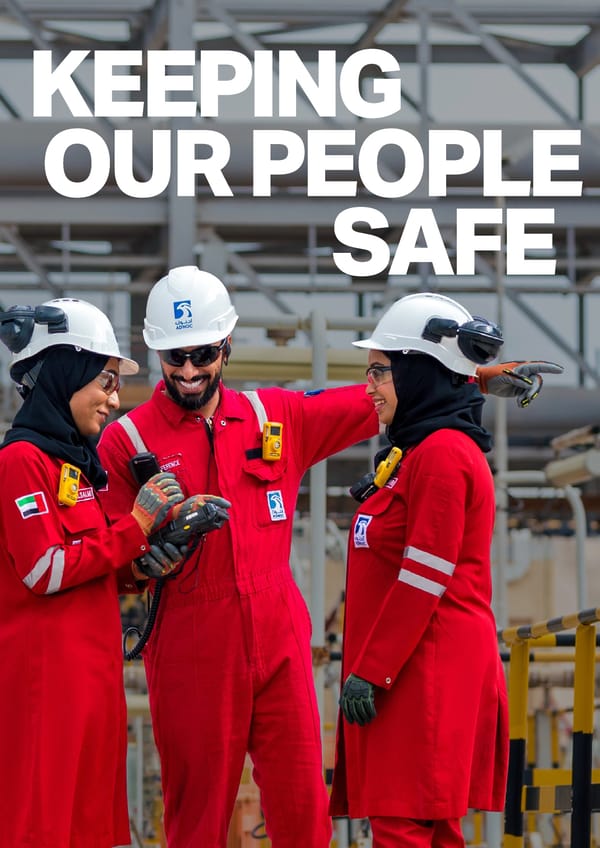
Material topics • Occupational health and safety • Asset integrity and critical incident management 2025 performance • 0.10 Total recordable injury rate (per million workhours) • 0.06 Lost time injury frequency (per million workhours) • 1 Tier 1 process safety events • 5 Tier 2 process safety events • 2 Fatalities • 5 Permanent impairments Safety is a core value at ADNOC and a cornerstone of our sustainability strategy. It is integrated across operations, supporting operational excellence and long-term resilience. Building and operating complex facilities to produce and process hydrocarbons and petrochemicals requires the highest health, safety and environment (HSE) standards. We work with our contractors and partners to help ensure everyone involved in our operations returns home safely each day. This reflects our unwavering commitment to safety and our responsibility to our employees, contractors, business partners and the communities in which we operate. ADNOC’s commitment to ‘100% HSE’ shapes how we work, enabling people to speak up, intervene and learn. We set clear targets to achieve zero life-altering injuries and prevent catastrophic events. We aim to reach these targets through a structured HSE control framework (HSECF), which provides a consistent approach to risk management. The HSECF is anchored in our HSE Policy, which commits us to zero harm and protecting people, assets, the environment and communities. It supports a proactive approach to risk management, asset integrity and process safety, and sets expectations to protect natural resources, manage emissions and effluents, and safeguard biodiversity. The HSECF encompasses HSE manuals and corporate practices (CPs), which translate requirements into practical controls for implementation and verification. Aligned with international regulations and standards and the plan- do-check-act cycle, the HSECF helps Group companies and contractors plan effectively, assess risk, monitor and continuously improve. We periodically consult with employees, contractors, business partners and joint ventures to review and update HSE manuals and CPs. This helps ensure alignment with operational experience and evolving best practice. We apply HSE impact assessments (HSEIA) at each step of the project lifecycle to identify risks and define controls. We manage HSE risks through defined risk domains across the value chain. Discipline lead councils provide technical governance, conduct discipline health checks and lead targeted improvement initiatives. They also develop competency frameworks and promote structured learning from incidents and audits, supported by the technical authority network and communities of practice. Our approach Why it matters SDGs 36
Sustainability Report 2025: Delivering Responsibly Page 31 Page 33