
How governance and human judgment can accelerate AI adoption
This document discusses the role of governance and human decision-making in responsibly scaling AI through safeguards, employee involvement, and clear accountability.
How governance and human judgment can accelerate AI adoption Scaling AI responsibly means building safeguards into deployment, equipping employees to assess its outputs, and keeping accountability clear at every stage.

26 Oct 2026・4 min read By Nada Al Meqbali, Acting Senior Vice President, Future Foresight & Creative Lab, ADNOC Energy sector leaders are right to want AI in more people’s hands, and to want it there quickly. These powerful tools can unlock new possibilities for safety, efficiency and value creation across an industry built on complex assets, safety-critical operations and the reliable supply of energy and materials that economies depend on. As adoption grows, so does our understanding of what it takes to turn that potential into lasting value. The strongest deployments are built on secure systems, sound governance and clear accountability, giving people the confidence to use AI ambitiously while continuing to apply their own judgment. I came into this work through smart-field projects after joining ADNOC in 2014 and have since led the development and deployment of more than 30 AI tools across the organization. That experience has reinforced my view that the deployments that deliver the greatest value are the ones our people help to shape and trust. At ADNOC, we bring engineers into AI projects early. An engineer who has spent years on a producing asset carries a model of their own: what a compressor sounds like when it is unhappy, why the numbers from a particular separator run slightly high, or how a reading behaves on a hot afternoon. In energy, this is valuable field intelligence. Our engineers and operators understand the processes AI tools are modelling and know when an insight can be applied to operations and when it needs another review. Their experience, combined with their role in co-designing these tools, supports safe adoption and drives value for the business. Energy makes the stakes tangible. A model that misreads critical data such as pressure or temperature might cascade that error into a query to an AI agent, which could then provide operators with inaccurate guidance. Embedding engineering expertise in the way tools are designed and deployed helps ensure that seasoned operators can assess these outputs for quality and accuracy.
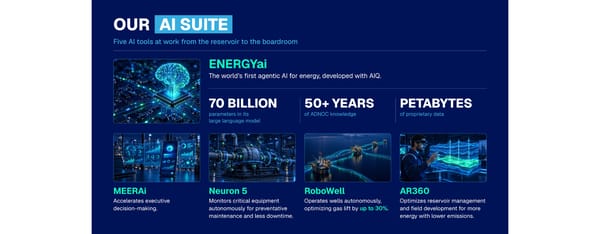
To ensure this AI fluency is embedded across our critical teams, ADNOC has invested significantly in training more than 18,000 of our people in agentic AI. We run an AI Accelerator that teaches advanced skills to engineers and have developed an AI-focused curriculum for the ADNOC Technical Academy. These programs help people understand how to use AI safely and effectively. The purpose is to give people a credible path from operating equipment to supervising intelligent systems, while keeping responsibility for decisions firmly with humans. Our teams have responded with enthusiasm and innovation. An AI-driven solution is already optimizing transport routes for staff and equipment across ADNOC Offshore, improving the working lives of tens of thousands of people while cutting emissions and costs. AI could cut unplanned plant shutdowns by up to 50%, while ENERGYai helps our experts find trusted answers in moments. Responsible adoption is about putting useful technology to work, with clear responsibility for how it is deployed and how its outputs are used. Supporting this empowered workforce is a strong institutional framework. Organizations must govern deployment and protect their systems and data. Protecting data and maintaining secure systems cannot depend on every user spotting every problem. Business leaders need to implement robust institutional safeguards, while ensuring employees review and validate AI-generated content and remain responsible for their work. At ADNOC, our rollout is governed by responsible AI, cybersecurity and data-governance frameworks. The organization retains control throughout, with safeguards to pause, isolate or roll back an AI capability as part of normal operational governance. These are the foundations on which employee confidence must rest.
"Those safeguards are not an argument for slowing AI down. They are what allow adoption to proceed with confidence" Nada Al Meqbali Acting Senior Vice President, Future Foresight & Creative Lab, ADNOC
Those safeguards are not an argument for slowing AI down. They are what allow adoption to proceed with confidence. People should be encouraged to push back when their judgment says an output is wrong. Human challenge belongs within formal governance. A decade ago, we were laying the groundwork by automating wells, integrating data and building digital infrastructure. Today, we are using those investments to create an AI-enabled business that makes faster, smarter decisions. The next step is not to make human judgment disappear. It is to make that judgment more informed and effective. Business leaders should therefore be both AI optimists and AI sceptics, empowering teams to deploy these tools to solve complex problems while building the security and validation needed to support decentralised innovation and strengthen institutional trust in AI. Put simply, we must place governance and accountability at the foundation, build skills alongside the rollout, and give people the confidence to challenge outputs based on professional experience. Trust in AI means knowing where responsibility lies and having the skills, safeguards and governance in place to expand its use with confidence.
MORE STORIES How ADNOC is quietly making carbon storage work Tracking methane from sky to sensor Inside ADNOC’s global gas ambitions The ADNOC Al Nouf Mangrove Forest