
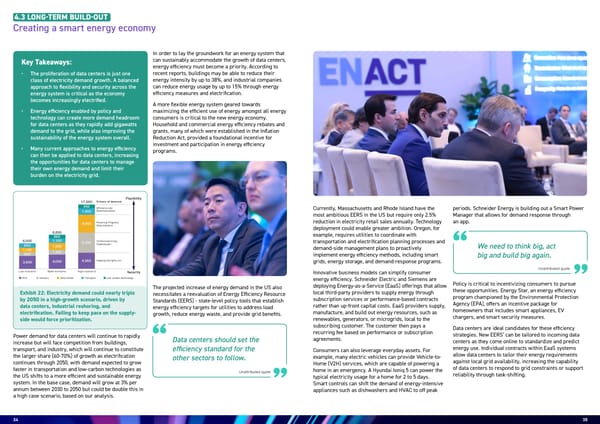
34 35 Creating a smart energy economy Power demand for data centers will continue to rapidly increase but will face competition from buildings, transport, and industry, which will continue to constitute the larger share (60-70%) of growth as electrification continues through 2050, with demand expected to grow faster in transportation and low-carbon technologies as the US shifts to a more efficient and sustainable energy system. In the base case, demand will grow at 3% per annum between 2030 to 2050 but could be double this in a high case scenario, based on our analysis. Exhibit 22: Electricity demand could nearly triple by 2050 in a high-growth scenario, driven by data centers, industrial reshoring, and electrification. Failing to keep pace on the supply- side would force prioritization. 4,550 5,450 4,950 1,650 950 4,000 1,350 1,550 1,100 850 3,500 500 1,150 850 6,000 8,850 17,550 Drivers of demand Efficiency and Decarbonization Powering Progress (Data Centers) US Manufacturing Superpower! Keeping the lights on! Low scenario Base scenario High scenario Security Flexibility RCA Industry Data Center Transport Low carbon technology Currently, Massachusetts and Rhode Island have the most ambitious EERS in the US but require only 2.5% reduction in electricity retail sales annually. Technology deployment could enable greater ambition. Oregon, for example, requires utilities to coordinate with transportation and electrification planning processes and demand-side management plans to proactively implement energy efficiency methods, including smart grids, energy storage, and demand-response programs. Innovative business models can simplify consumer energy efficiency. Schneider Electric and Siemens are deploying Energy-as-a-Service (EaaS) offerings that allow local third-party providers to supply energy through subscription services or performance-based contracts rather than up-front capital costs. EaaS providers supply, manufacture, and build out energy resources, such as renewables, generators, or microgrids, local to the subscribing customer. The customer then pays a recurring fee based on performance or subscription agreements. Consumers can also leverage everyday assets. For example, many electric vehicles can provide Vehicle-to- Home (V2H) services, which are capable of powering a home in an emergency. A Hyundai Ioniq 5 can power the typical electricity usage for a home for 2 to 5 days. Smart controls can shift the demand of energy-intensive appliances such as dishwashers and HVAC to off peak periods. Schneider Energy is building out a Smart Power Manager that allows for demand response through an app. In order to lay the groundwork for an energy system that can sustainably accommodate the growth of data centers, energy efficiency must become a priority. According to recent reports, buildings may be able to reduce their energy intensity by up to 38%, and industrial companies can reduce energy usage by up to 15% through energy efficiency measures and electrification. A more flexible energy system geared towards maximizing the efficient use of energy amongst all energy consumers is critical to the new energy economy. Household and commercial energy efficiency rebates and grants, many of which were established in the Inflation Reduction Act, provided a foundational incentive for investment and participation in energy efficiency programs. The projected increase of energy demand in the US also necessitates a reevaluation of Energy Efficiency Resource Standards (EERS) - state-level policy tools that establish energy efficiency targets for utilities to address load growth, reduce energy waste, and provide grid benefits. Key Takeaways: • The proliferation of data centers is just one class of electricity demand growth. A balanced approach to flexibility and security across the energy system is critical as the economy becomes increasingly electrified. • Energy efficiency enabled by policy and technology can create more demand headroom for data centers as they rapidly add gigawatts demand to the grid, while also improving the sustainability of the energy system overall. • Many current approaches to energy efficiency can then be applied to data centers, increasing the opportunities for data centers to manage their own energy demand and limit their burden on the electricity grid. 4.3 LONG-TERM BUILD-OUT Data centers should set the efficiency standard for the other sectors to follow. We need to think big, act big and build big again. Policy is critical to incentivizing consumers to pursue these opportunities. Energy Star, an energy efficiency program championed by the Environmental Protection Agency (EPA), offers an incentive package for homeowners that includes smart appliances, EV chargers, and smart security measures. Data centers are ideal candidates for these efficiency strategies. New EERS’ can be tailored to incoming data centers as they come online to standardize and predict energy use. Individual contracts within EaaS systems allow data centers to tailor their energy requirements against local grid availability, increasing the capability of data centers to respond to grid constraints or support reliability through task-shifting. Unattributed quote Unattributed quote
 Energy-AI Nexus: Powering the Next Great Leap for Human Progress Page 17 Page 19