
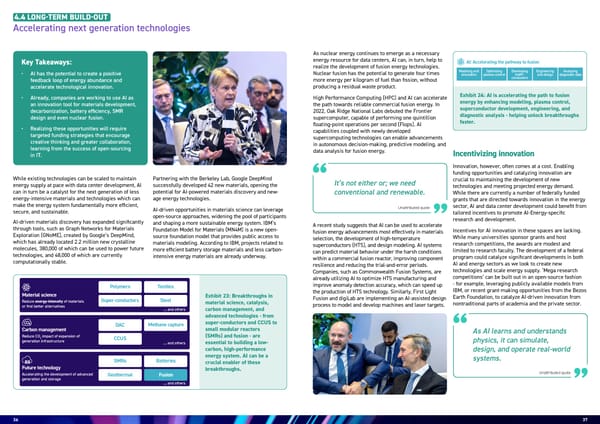
36 37 Key Takeaways: • AI has the potential to create a positive feedback loop of energy abundance and accelerate technological innovation. • Already, companies are working to use AI as an innovation tool for materials development, decarbonization, battery efficiency, SMR design and even nuclear fusion. • Realizing these opportunities will require targeted funding strategies that encourage creative thinking and greater collaboration, learning from the success of open-sourcing in IT. Accelerating next generation technologies While existing technologies can be scaled to maintain energy supply at pace with data center development, AI can in turn be a catalyst for the next generation of less energy-intensive materials and technologies which can make the energy system fundamentally more efficient, secure, and sustainable. AI-driven materials discovery has expanded significantly through tools, such as Graph Networks for Materials Exploration (GNoME), created by Google’s DeepMind, which has already located 2.2 million new crystalline molecules, 380,000 of which can be used to power future technologies, and 48,000 of which are currently computationally stable. Exhibit 24: AI is accelerating the path to fusion energy by enhancing modeling, plasma control, superconductor development, engineering, and diagnostic analysis - helping unlock breakthroughs faster. As nuclear energy continues to emerge as a necessary energy resource for data centers, AI can, in turn, help to realize the development of fusion energy technologies. Nuclear fusion has the potential to generate four times more energy per kilogram of fuel than fission, without producing a residual waste product. High Performance Computing (HPC) and AI can accelerate the path towards reliable commercial fusion energy. In 2022, Oak Ridge National Labs debuted the Frontier supercomputer, capable of performing one quintillion floating-point operations per second (Flops). AI capabilities coupled with newly developed supercomputing technologies can enable advancements in autonomous decision-making, predictive modeling, and data analysis for fusion energy. AI: Accelerating the pathway to fusion Modeling and simulation Engineering and design Optimizing plasma control Analyzing diagnostic data Developing super- conductors Partnering with the Berkeley Lab, Google DeepMind successfully developed 42 new materials, opening the potential for AI-powered materials discovery and new- age energy technologies. AI-driven opportunities in materials science can leverage open-source approaches, widening the pool of participants and shaping a more sustainable energy system. IBM’s Foundation Model for Materials (MN4M) is a new open- source foundation model that provides public access to materials modeling. According to IBM, projects related to more efficient battery storage materials and less carbon- intensive energy materials are already underway. Incentivizing innovation Innovation, however, often comes at a cost. Enabling funding opportunities and catalyzing innovation are crucial to maintaining the development of new technologies and meeting projected energy demand. While there are currently a number of federally funded grants that are directed towards innovation in the energy sector, AI and data center development could benefit from tailored incentives to promote AI-Energy-specific research and development. Incentives for AI innovation in these spaces are lacking. While many universities sponsor grants and host research competitions, the awards are modest and limited to research faculty. The development of a federal program could catalyze significant developments in both AI and energy sectors as we look to create new technologies and scale energy supply. ‘Mega research competitions’ can be built out in an open-source fashion - for example, leveraging publicly available models from IBM, or recent grant-making opportunities from the Bezos Earth Foundation, to catalyze AI-driven innovation from nontraditional parts of academia and the private sector. A recent study suggests that AI can be used to accelerate fusion energy advancements most effectively in materials selection, the development of high-temperature superconductors (HTS), and design modeling. AI systems can predict material behavior under the harsh conditions within a commercial fusion reactor, improving component resilience and reducing the trial-and-error periods. Companies, such as Commonwealth Fusion Systems, are already utilizing AI to optimize HTS manufacturing and improve anomaly detection accuracy, which can speed up the production of HTS technology. Similarly, First Light Fusion and digiLab are implementing an AI-assisted design process to model and develop machines and laser targets. Exhibit 23: Breakthroughs in material science, catalysis, carbon management, and advanced technologies - from super-conductors and CCUS to small modular reactors (SMRs) and fusion - are essential to building a low- carbon, high-performance energy system. AI can be a crucial enabler of these breakthroughs. Polymers Super-conductors Textiles Steel ... and others ... and others Material science Reduce energy-intensity of materials or find better alternatives Carbon management Reduce CO2 impact of expansion of generation infrastructure Future technology Accelerating the development of advanced generation and storage DAC CCUS Methane capture SMRs Geothermal Fusion Batteries ... and others 4.4 LONG-TERM BUILD-OUT As AI learns and understands physics, it can simulate, design, and operate real-world systems. It’s not either or; we need conventional and renewable. Unattributed quote Unattributed quote
 Energy-AI Nexus: Powering the Next Great Leap for Human Progress Page 18 Page 20