
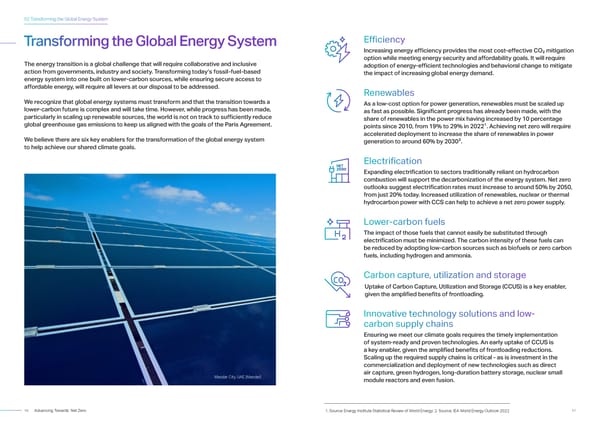
Transforming the Global Energy System The energy transition is a global challenge that will require collaborative and inclusive action from governments, industry and society. Transforming todays fossil-fuel-based energy system into one built on lower-carbon sources, while ensuring secure access to affordable energy, will require all levers at our disposal to be addressed. We recognize that global energy systems must transform and that the transition towards a lower-carbon future is complex and will take time. However, while progress has been made, particularly in scaling up renewable sources, the world is not on track to sufficiently reduce global greenhouse gas emissions to keep us aligned with the goals of the Paris Agreement. We believe there are six key enablers for the transformation of the global energy system to help achieve our shared climate goals. Increasing energy efficiency provides the most cost-effective CO2 mitigation option while meeting energy security and affordability goals. It will require adoption of energy-efficient technologies and behavioral change to mitigate the impact of increasing global energy demand. Efficiency Expanding electrification to sectors traditionally reliant on hydrocarbon combustion will support the decarbonization of the energy system. Net zero outlooks suggest electrification rates must increase to around 50% by 2050, from just 20% today. Increased utilization of renewables, nuclear or thermal hydrocarbon power with CCS can help to achieve a net zero power supply. Electrification As a low-cost option for power generation, renewables must be scaled up as fast as possible. Significant progress has already been made, with the share of renewables in the power mix having increased by 10 percentage points since 2010, from 19% to 29% in 20221. Achieving net zero will require accelerated deployment to increase the share of renewables in power generation to around 60% by 2030 2. Renewables Ensuring we meet our climate goals requires the timely implementation of system-ready and proven technologies. An early uptake of CCUS is a key enabler, given the amplified benefits of frontloading reductions. Scaling up the required supply chains is critical - as is investment in the commercialization and deployment of new technologies such as direct air capture, green hydrogen, long-duration battery storage, nuclear small module reactors and even fusion. Innovative technology solutions and low- carbon supply chains The impact of those fuels that cannot easily be substituted through electrification must be minimized. The carbon intensity of these fuels can be reduced by adopting low-carbon sources such as biofuels or zero carbon fuels, including hydrogen and ammonia. Lower-carbon fuels Uptake of Carbon Capture, Utilization and Storage (CCUS) is a key enabler, given the amplified benefits of frontloading. Carbon capture, utilization and storage 02 Transforming the Global Energy System 1. Source: Energy Institute Statistical Review of World Energy; 2. Source: IEA World Energy Outlook 2022 Masdar City, UAE [Masdar] 17 16 Advancing Towards Net Zero
 Advancing Towards Net Zero: Delivering Progress Page 7 Page 9