
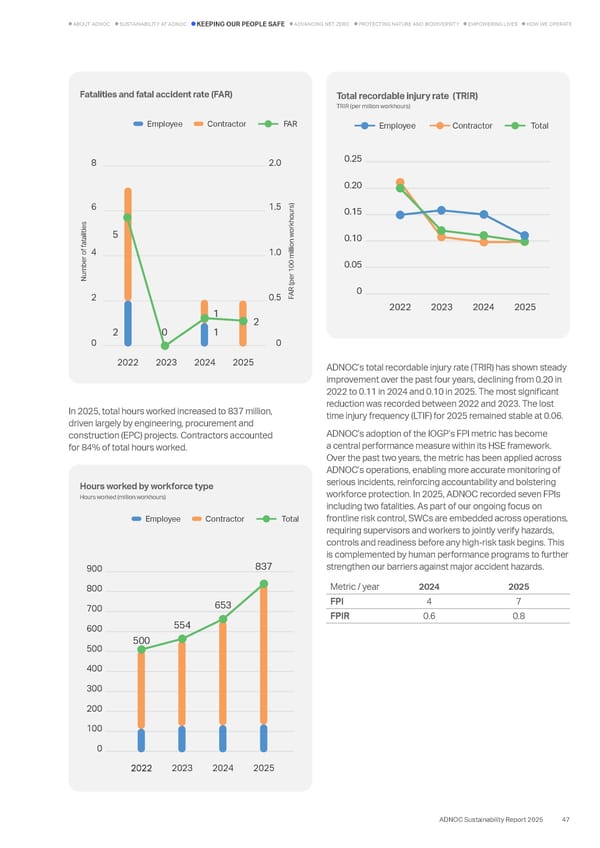
Hours worked by workforce type Contractor Employee Total 0 100 200 300 400 500 600 700 800 900 2022 2023 2024 2025 500 554 653 837 2022 2023 2024 2025 Hours worked (million workhours) 2022 2023 2024 2025 In 2025, total hours worked increased to 837 million, driven largely by engineering, procurement and construction (EPC) projects. Contractors accounted for 84% of total hours worked. Total recordable injury rate (TRIR) Contractor Employee Total 0 0.05 0.10 0.15 0.20 0.25 2022 2023 2024 2025 TRIR (per million workhours) ADNOC’s total recordable injury rate (TRIR) has shown steady improvement over the past four years, declining from 0.20 in 2022 to 0.11 in 2024 and 0.10 in 2025. The most significant reduction was recorded between 2022 and 2023. The lost time injury frequency (LTIF) for 2025 remained stable at 0.06. ADNOC’s adoption of the IOGP’s FPI metric has become a central performance measure within its HSE framework. Over the past two years, the metric has been applied across ADNOC’s operations, enabling more accurate monitoring of serious incidents, reinforcing accountability and bolstering workforce protection. In 2025, ADNOC recorded seven FPIs including two fatalities. As part of our ongoing focus on frontline risk control, SWCs are embedded across operations, requiring supervisors and workers to jointly verify hazards, controls and readiness before any high-risk task begins. This is complemented by human performance programs to further strengthen our barriers against major accident hazards. Metric / year 2024 2025 FPI 4 7 FPIR 0.6 0.8 Fatalities and fatal accident rate (FAR) FAR (per 100 million workhours) Contractor Employee FAR 0 0.5 1.0 1.5 2.0 0 2 4 6 8 2022 5 2 2025 2 2024 1 2023 0 1 Number of fatalities 47 ADNOC Sustainability Report 2025 KEEPING OUR PEOPLE SAFE ADVANCING NET ZERO EMPOWERING LIVES HOW WE OPERATE SUSTAINABILITY AT ADNOC ABOUT ADNOC PROTECTING NATURE AND BIODIVERSITY
 Sustainability Report 2025: Delivering Responsibly Page 44 Page 46