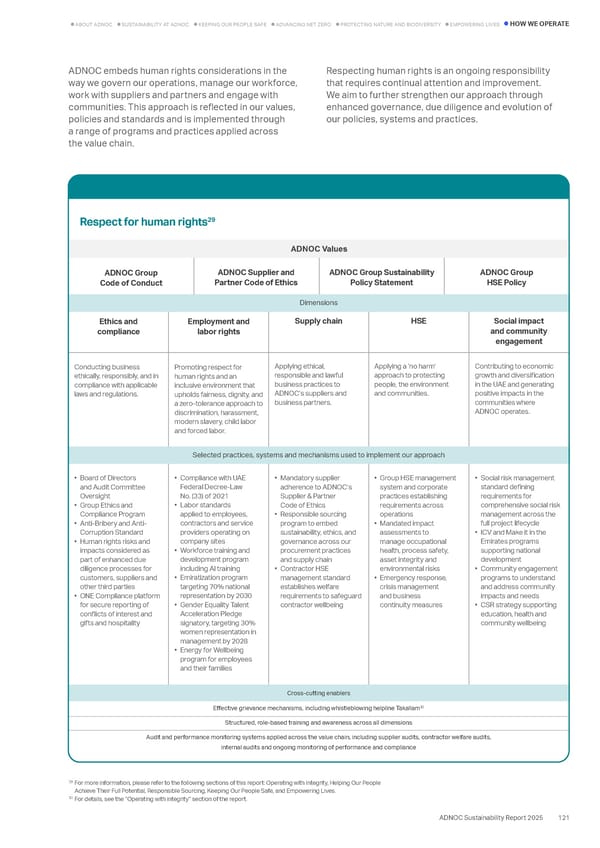
29 For more information, please refer to the following sections of this report: Operating with Integrity, Helping Our People Achieve Their Full Potential, Responsible Sourcing, Keeping Our People Safe, and Empowering Lives. 30 For details, see the “Operating with integrity” section of the report. ADNOC embeds human rights considerations in the way we govern our operations, manage our workforce, work with suppliers and partners and engage with communities. This approach is reflected in our values, policies and standards and is implemented through a range of programs and practices applied across the value chain. Respecting human rights is an ongoing responsibility that requires continual attention and improvement. We aim to further strengthen our approach through enhanced governance, due diligence and evolution of our policies, systems and practices. Promoting respect for human rights and an inclusive environment that upholds fairness, dignity, and a zero-tolerance approach to discrimination, harassment, modern slavery, child labor and forced labor. Employment and labor rights Contributing to economic growth and diversification in the UAE and generating positive impacts in the communities where ADNOC operates. Social impact and community engagement Applying ethical, responsible and lawful business practices to ADNOC’s suppliers and business partners. Supply chain Applying a ‘no harm’ approach to protecting people, the environment and communities. HSE Conducting business ethically, responsibly, and in compliance with applicable laws and regulations. Ethics and compliance • Compliance with UAE Federal Decree-Law No. (33) of 2021 • Labor standards applied to employees, contractors and service providers operating on company sites • Workforce training and development program including AI training • Emiratization program targeting 70% national representation by 2030 • Gender Equality Talent Acceleration Pledge signatory, targeting 30% women representation in management by 2028 • Energy for Wellbeing program for employees and their families • Social risk management standard defining requirements for comprehensive social risk management across the full project lifecycle • ICV and Make it in the Emirates programs supporting national development • Community engagement programs to understand and address community impacts and needs • CSR strategy supporting education, health and community wellbeing • Mandatory supplier adherence to ADNOC’s Supplier & Partner Code of Ethics • Responsible sourcing program to embed sustainability, ethics, and governance across our procurement practices and supply chain • Contractor HSE management standard establishes welfare requirements to safeguard contractor wellbeing • Group HSE management system and corporate practices establishing requirements across operations • Mandated impact assessments to manage occupational health, process safety, asset integrity and environmental risks • Emergency response, crisis management and business continuity measures • Board of Directors and Audit Committee Oversight • Group Ethics and Compliance Program • Anti-Bribery and Anti- Corruption Standard • Human rights risks and impacts considered as part of enhanced due diligence processes for customers, suppliers and other third parties • ONE Compliance platform for secure reporting of conflicts of interest and gifts and hospitality ADNOC Supplier and Partner Code of Ethics ADNOC Group Sustainability Policy Statement Dimensions ADNOC Values ADNOC Group HSE Policy ADNOC Group Code of Conduct Selected practices, systems and mechanisms used to implement our approach Cross-cutting enablers Structured, role-based training and awareness across all dimensions Effective grievance mechanisms, including whistleblowing helpline Takallam30 Audit and performance monitoring systems applied across the value chain, including supplier audits, contractor welfare audits, internal audits and ongoing monitoring of performance and compliance Respect for human rights29 121 ADNOC Sustainability Report 2025 HOW WE OPERATE KEEPING OUR PEOPLE SAFE ADVANCING NET ZERO EMPOWERING LIVES SUSTAINABILITY AT ADNOC ABOUT ADNOC PROTECTING NATURE AND BIODIVERSITY
 Sustainability Report 2025: Delivering Responsibly Page 118 Page 120