
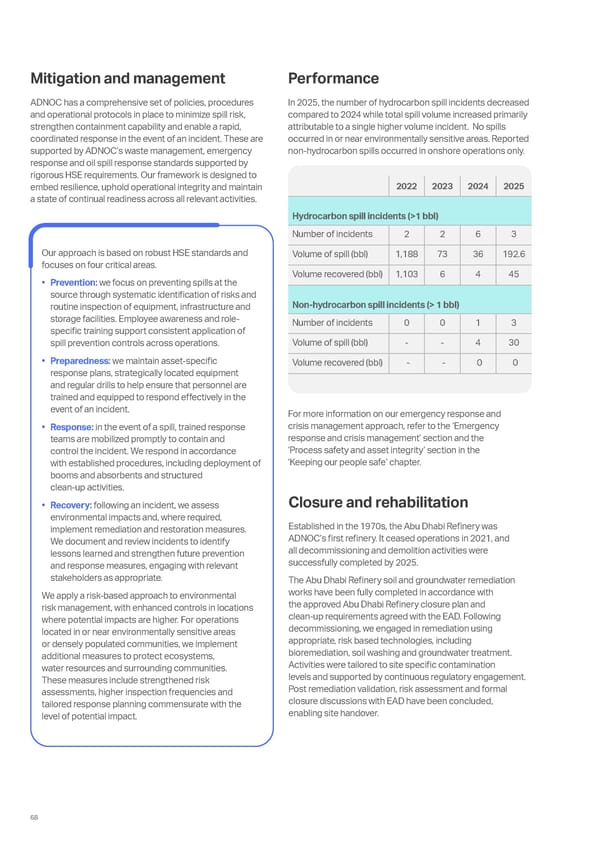
2022 2023 2024 2025 Hydrocarbon spill incidents (>1 bbl) Number of incidents 2 2 6 3 Volume of spill (bbl) 1,188 73 36 192.6 Volume recovered (bbl) 1,103 6 4 45 Non-hydrocarbon spill incidents (> 1 bbl) Number of incidents 0 0 1 3 Volume of spill (bbl) - - 4 30 Volume recovered (bbl) - - 0 0 Performance Closure and rehabilitation In 2025, the number of hydrocarbon spill incidents decreased compared to 2024 while total spill volume increased primarily attributable to a single higher volume incident. No spills occurred in or near environmentally sensitive areas. Reported non-hydrocarbon spills occurred in onshore operations only. Established in the 1970s, the Abu Dhabi Refinery was ADNOC’s first refinery. It ceased operations in 2021, and all decommissioning and demolition activities were successfully completed by 2025. The Abu Dhabi Refinery soil and groundwater remediation works have been fully completed in accordance with the approved Abu Dhabi Refinery closure plan and clean-up requirements agreed with the EAD. Following decommissioning, we engaged in remediation using appropriate, risk based technologies, including bioremediation, soil washing and groundwater treatment. Activities were tailored to site specific contamination levels and supported by continuous regulatory engagement. Post remediation validation, risk assessment and formal closure discussions with EAD have been concluded, enabling site handover. For more information on our emergency response and crisis management approach, refer to the ‘Emergency response and crisis management’ section and the ‘Process safety and asset integrity’ section in the ‘Keeping our people safe’ chapter. Mitigation and management ADNOC has a comprehensive set of policies, procedures and operational protocols in place to minimize spill risk, strengthen containment capability and enable a rapid, coordinated response in the event of an incident. These are supported by ADNOC’s waste management, emergency response and oil spill response standards supported by rigorous HSE requirements. Our framework is designed to embed resilience, uphold operational integrity and maintain a state of continual readiness across all relevant activities. Our approach is based on robust HSE standards and focuses on four critical areas. • Prevention: we focus on preventing spills at the source through systematic identification of risks and routine inspection of equipment, infrastructure and storage facilities. Employee awareness and role- specific training support consistent application of spill prevention controls across operations. • Preparedness: we maintain asset-specific response plans, strategically located equipment and regular drills to help ensure that personnel are trained and equipped to respond effectively in the event of an incident. • Response: in the event of a spill, trained response teams are mobilized promptly to contain and control the incident. We respond in accordance with established procedures, including deployment of booms and absorbents and structured clean-up activities. • Recovery: following an incident, we assess environmental impacts and, where required, implement remediation and restoration measures. We document and review incidents to identify lessons learned and strengthen future prevention and response measures, engaging with relevant stakeholders as appropriate. We apply a risk‑based approach to environmental risk management, with enhanced controls in locations where potential impacts are higher. For operations located in or near environmentally sensitive areas or densely populated communities, we implement additional measures to protect ecosystems, water resources and surrounding communities. These measures include strengthened risk assessments, higher inspection frequencies and tailored response planning commensurate with the level of potential impact. 68
 Sustainability Report 2025: Delivering Responsibly Page 65 Page 67