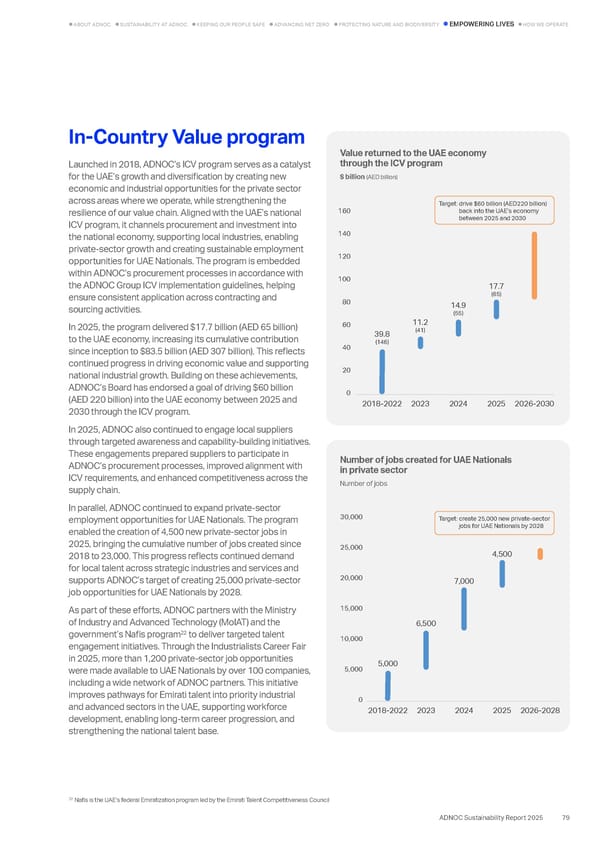
In-Country Value program Launched in 2018, ADNOC’s ICV program serves as a catalyst for the UAE’s growth and diversification by creating new economic and industrial opportunities for the private sector across areas where we operate, while strengthening the resilience of our value chain. Aligned with the UAE’s national ICV program, it channels procurement and investment into the national economy, supporting local industries, enabling private-sector growth and creating sustainable employment opportunities for UAE Nationals. The program is embedded within ADNOC’s procurement processes in accordance with the ADNOC Group ICV implementation guidelines, helping ensure consistent application across contracting and sourcing activities. In 2025, the program delivered $17.7 billion (AED 65 billion) to the UAE economy, increasing its cumulative contribution since inception to $83.5 billion (AED 307 billion). This reflects continued progress in driving economic value and supporting national industrial growth. Building on these achievements, ADNOC’s Board has endorsed a goal of driving $60 billion (AED 220 billion) into the UAE economy between 2025 and 2030 through the ICV program. In 2025, ADNOC also continued to engage local suppliers through targeted awareness and capability-building initiatives. These engagements prepared suppliers to participate in ADNOC’s procurement processes, improved alignment with ICV requirements, and enhanced competitiveness across the supply chain. In parallel, ADNOC continued to expand private-sector employment opportunities for UAE Nationals. The program enabled the creation of 4,500 new private-sector jobs in 2025, bringing the cumulative number of jobs created since 2018 to 23,000. This progress reflects continued demand for local talent across strategic industries and services and supports ADNOC’s target of creating 25,000 private-sector job opportunities for UAE Nationals by 2028. As part of these efforts, ADNOC partners with the Ministry of Industry and Advanced Technology (MoIAT) and the government’s Nafis program22 to deliver targeted talent engagement initiatives. Through the Industrialists Career Fair in 2025, more than 1,200 private-sector job opportunities were made available to UAE Nationals by over 100 companies, including a wide network of ADNOC partners. This initiative improves pathways for Emirati talent into priority industrial and advanced sectors in the UAE, supporting workforce development, enabling long-term career progression, and strengthening the national talent base. 40 60 100 80 120 0 20 140 160 Value returned to the UAE economy through the ICV program $ billion (AED billion) 2018-2022 2023 2024 2025 2026-2030 39.8 (146) 11.2 (41) 14.9 (55) 17.7 (65) Target: drive $60 billion (AED220 billion) back into the UAE’s economy between 2025 and 2030 Number of jobs created for UAE Nationals in private sector Number of jobs 2018-2022 2023 2024 2025 2026-2028 5,000 6,500 7,000 4,500 Target: create 25,000 new private-sector jobs for UAE Nationals by 2028 10,000 15,000 25,000 20,000 30,000 0 5,000 22 Nafis is the UAE’s federal Emiratization program led by the Emirati Talent Competitiveness Council 79 ADNOC Sustainability Report 2025 EMPOWERING LIVES KEEPING OUR PEOPLE SAFE ADVANCING NET ZERO HOW WE OPERATE SUSTAINABILITY AT ADNOC ABOUT ADNOC PROTECTING NATURE AND BIODIVERSITY
 Sustainability Report 2025: Delivering Responsibly Page 76 Page 78