
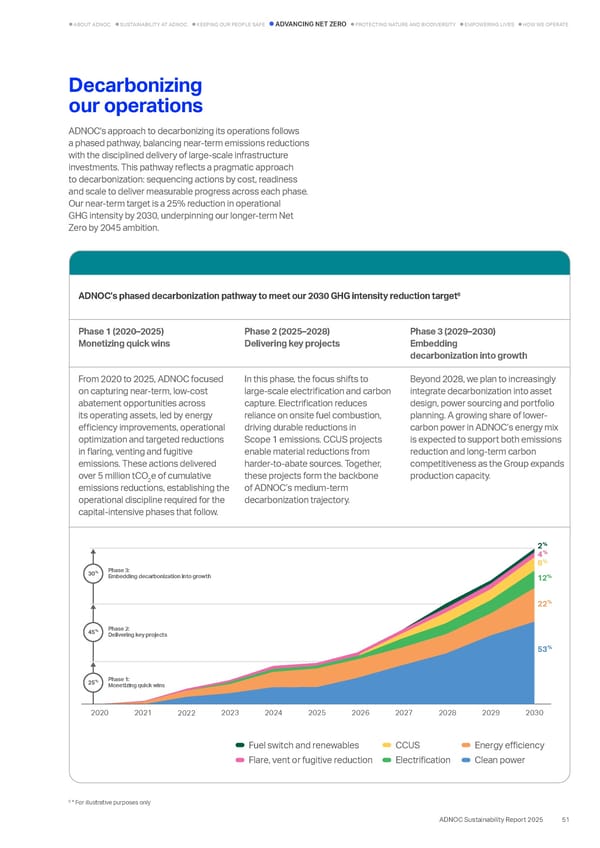
Decarbonizing our operations ADNOC's approach to decarbonizing its operations follows a phased pathway, balancing near-term emissions reductions with the disciplined delivery of large-scale infrastructure investments. This pathway reflects a pragmatic approach to decarbonization: sequencing actions by cost, readiness and scale to deliver measurable progress across each phase. Our near-term target is a 25% reduction in operational GHG intensity by 2030, underpinning our longer-term Net Zero by 2045 ambition. Clean power Energy efficiency Electrification Flare, vent or fugitive reduction CCUS Fuel switch and renewables 2020 2021 2022 2023 2024 2025 2026 2027 2028 2029 2030 53% 22% 12% 8% 4% 2% 30% 45% 25% Phase 3: Embedding decarbonization into growth Phase 2: Delivering key projects Phase 1: Monetizing quick wins Phase 1 (2020–2025) Monetizing quick wins Phase 2 (2025–2028) Delivering key projects Phase 3 (2029–2030) Embedding decarbonization into growth From 2020 to 2025, ADNOC focused on capturing near-term, low-cost abatement opportunities across its operating assets, led by energy efficiency improvements, operational optimization and targeted reductions in flaring, venting and fugitive emissions. These actions delivered over 5 million tCO2e of cumulative emissions reductions, establishing the operational discipline required for the capital-intensive phases that follow. In this phase, the focus shifts to large-scale electrification and carbon capture. Electrification reduces reliance on onsite fuel combustion, driving durable reductions in Scope 1 emissions. CCUS projects enable material reductions from harder-to-abate sources. Together, these projects form the backbone of ADNOC’s medium-term decarbonization trajectory. Beyond 2028, we plan to increasingly integrate decarbonization into asset design, power sourcing and portfolio planning. A growing share of lower- carbon power in ADNOC’s energy mix is expected to support both emissions reduction and long-term carbon competitiveness as the Group expands production capacity. 8 * For illustrative purposes only ADNOC’s phased decarbonization pathway to meet our 2030 GHG intensity reduction target8 51 ADNOC Sustainability Report 2025 ADVANCING NET ZERO KEEPING OUR PEOPLE SAFE EMPOWERING LIVES HOW WE OPERATE SUSTAINABILITY AT ADNOC ABOUT ADNOC PROTECTING NATURE AND BIODIVERSITY
 Sustainability Report 2025: Delivering Responsibly Page 48 Page 50