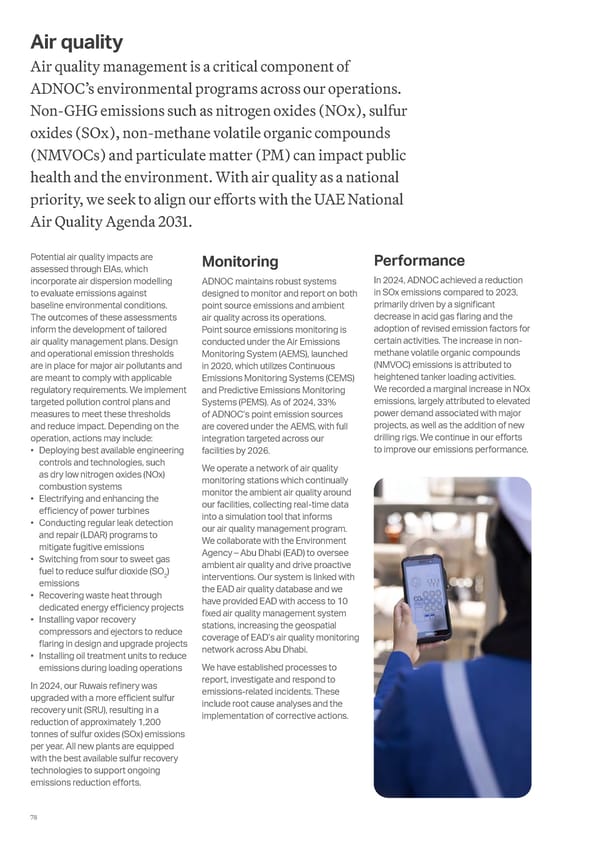
Air quality Potential air quality impacts are assessed through EIAs, which incorporate air dispersion modelling to evaluate emissions against baseline environmental conditions. The outcomes of these assessments inform the development of tailored air quality management plans. Design and operational emission thresholds are in place for major air pollutants and are meant to comply with applicable regulatory requirements. We implement targeted pollution control plans and measures to meet these thresholds and reduce impact. Depending on the operation, actions may include: • Deploying best available engineering controls and technologies, such as dry low nitrogen oxides (NOx) combustion systems • Electrifying and enhancing the efficiency of power turbines • Conducting regular leak detection and repair (LDAR) programs to mitigate fugitive emissions • Switching from sour to sweet gas fuel to reduce sulfur dioxide (SO 2 ) emissions • Recovering waste heat through dedicated energy efficiency projects • Installing vapor recovery compressors and ejectors to reduce flaring in design and upgrade projects • Installing oil treatment units to reduce emissions during loading operations In 2024, our Ruwais refinery was upgraded with a more efficient sulfur recovery unit (SRU), resulting in a reduction of approximately 1,200 tonnes of sulfur oxides (SOx) emissions per year. All new plants are equipped with the best available sulfur recovery technologies to support ongoing emissions reduction efforts. Monitoring ADNOC maintains robust systems designed to monitor and report on both point source emissions and ambient air quality across its operations. Point source emissions monitoring is conducted under the Air Emissions Monitoring System (AEMS), launched in 2020, which utilizes Continuous Emissions Monitoring Systems (CEMS) and Predictive Emissions Monitoring Systems (PEMS). As of 2024, 33% of ADNOC’s point emission sources are covered under the AEMS, with full integration targeted across our facilities by 2026. We operate a network of air quality monitoring stations which continually monitor the ambient air quality around our facilities, collecting real-time data into a simulation tool that informs our air quality management program. We collaborate with the Environment Agency – Abu Dhabi (EAD) to oversee ambient air quality and drive proactive interventions. Our system is linked with the EAD air quality database and we have provided EAD with access to 10 fixed air quality management system stations, increasing the geospatial coverage of EAD’s air quality monitoring network across Abu Dhabi. We have established processes to report, investigate and respond to emissions-related incidents. These include root cause analyses and the implementation of corrective actions. Performance In 2024, ADNOC achieved a reduction in SOx emissions compared to 2023, primarily driven by a significant decrease in acid gas flaring and the adoption of revised emission factors for certain activities. The increase in non- methane volatile organic compounds (NMVOC) emissions is attributed to heightened tanker loading activities. We recorded a marginal increase in NOx emissions, largely attributed to elevated power demand associated with major projects, as well as the addition of new drilling rigs. We continue in our efforts to improve our emissions performance. Air quality management is a critical component of ADNOC’s environmental programs across our operations. Non-GHG emissions such as nitrogen oxides (NOx), sulfur oxides (SOx), non-methane volatile organic compounds (NMVOCs) and particulate matter (PM) can impact public health and the environment. With air quality as a national priority, we seek to align our efforts with the UAE National Air Quality Agenda 2031. 78
 ADNOC Sustainability Report 2024: Driving Progress & Prosperity Page 77 Page 79