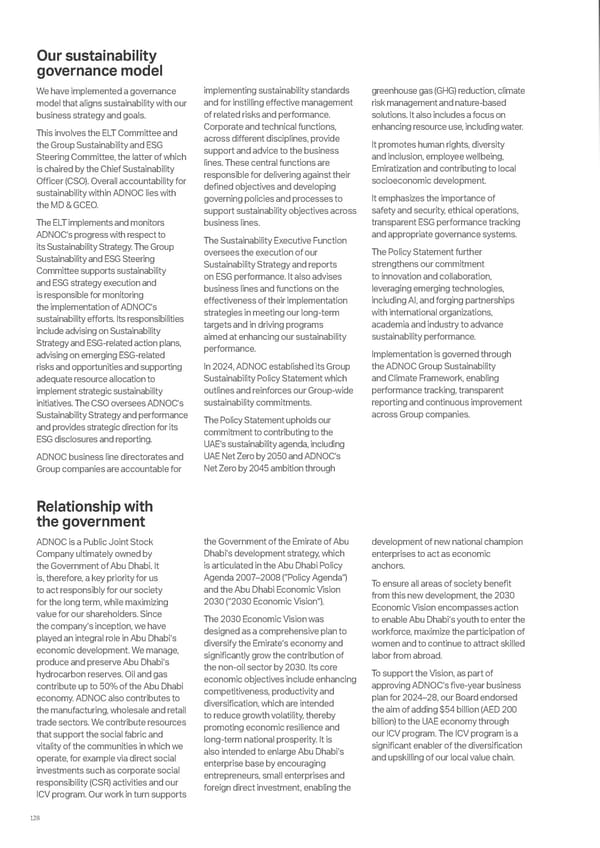
Our sustainability governance model Relationship with the government We have implemented a governance model that aligns sustainability with our business strategy and goals. This involves the ELT Committee and the Group Sustainability and ESG Steering Committee, the latter of which is chaired by the Chief Sustainability Officer (CSO). Overall accountability for sustainability within ADNOC lies with the MD & GCEO. The ELT implements and monitors ADNOC’s progress with respect to its Sustainability Strategy. The Group Sustainability and ESG Steering Committee supports sustainability and ESG strategy execution and is responsible for monitoring the implementation of ADNOC’s sustainability efforts. Its responsibilities include advising on Sustainability Strategy and ESG-related action plans, advising on emerging ESG-related risks and opportunities and supporting adequate resource allocation to implement strategic sustainability initiatives. The CSO oversees ADNOC’s Sustainability Strategy and performance and provides strategic direction for its ESG disclosures and reporting. ADNOC business line directorates and Group companies are accountable for ADNOC is a Public Joint Stock Company ultimately owned by the Government of Abu Dhabi. It is, therefore, a key priority for us to act responsibly for our society for the long term, while maximizing value for our shareholders. Since the company’s inception, we have played an integral role in Abu Dhabi’s economic development. We manage, produce and preserve Abu Dhabi’s hydrocarbon reserves. Oil and gas contribute up to 50% of the Abu Dhabi economy. ADNOC also contributes to the manufacturing, wholesale and retail trade sectors. We contribute resources that support the social fabric and vitality of the communities in which we operate, for example via direct social investments such as corporate social responsibility (CSR) activities and our ICV program. Our work in turn supports implementing sustainability standards and for instilling effective management of related risks and performance. Corporate and technical functions, across different disciplines, provide support and advice to the business lines. These central functions are responsible for delivering against their defined objectives and developing governing policies and processes to support sustainability objectives across business lines. The Sustainability Executive Function oversees the execution of our Sustainability Strategy and reports on ESG performance. It also advises business lines and functions on the effectiveness of their implementation strategies in meeting our long-term targets and in driving programs aimed at enhancing our sustainability performance. In 2024, ADNOC established its Group Sustainability Policy Statement which outlines and reinforces our Group-wide sustainability commitments. The Policy Statement upholds our commitment to contributing to the UAE’s sustainability agenda, including UAE Net Zero by 2050 and ADNOC’s Net Zero by 2045 ambition through the Government of the Emirate of Abu Dhabi’s development strategy, which is articulated in the Abu Dhabi Policy Agenda 2007–2008 (“Policy Agenda”) and the Abu Dhabi Economic Vision 2030 (“2030 Economic Vision”). The 2030 Economic Vision was designed as a comprehensive plan to diversify the Emirate’s economy and significantly grow the contribution of the non-oil sector by 2030. Its core economic objectives include enhancing competitiveness, productivity and diversification, which are intended to reduce growth volatility, thereby promoting economic resilience and long-term national prosperity. It is also intended to enlarge Abu Dhabi’s enterprise base by encouraging entrepreneurs, small enterprises and foreign direct investment, enabling the greenhouse gas (GHG) reduction, climate risk management and nature-based solutions. It also includes a focus on enhancing resource use, including water. It promotes human rights, diversity and inclusion, employee wellbeing, Emiratization and contributing to local socioeconomic development. It emphasizes the importance of safety and security, ethical operations, transparent ESG performance tracking and appropriate governance systems. The Policy Statement further strengthens our commitment to innovation and collaboration, leveraging emerging technologies, including AI, and forging partnerships with international organizations, academia and industry to advance sustainability performance. Implementation is governed through the ADNOC Group Sustainability and Climate Framework, enabling performance tracking, transparent reporting and continuous improvement across Group companies. development of new national champion enterprises to act as economic anchors. To ensure all areas of society benefit from this new development, the 2030 Economic Vision encompasses action to enable Abu Dhabi’s youth to enter the workforce, maximize the participation of women and to continue to attract skilled labor from abroad. To support the Vision, as part of approving ADNOC’s five-year business plan for 2024–28, our Board endorsed the aim of adding $54 billion (AED 200 billion) to the UAE economy through our ICV program. The ICV program is a significant enabler of the diversification and upskilling of our local value chain. 128
 ADNOC Sustainability Report 2024: Driving Progress & Prosperity Page 127 Page 129