
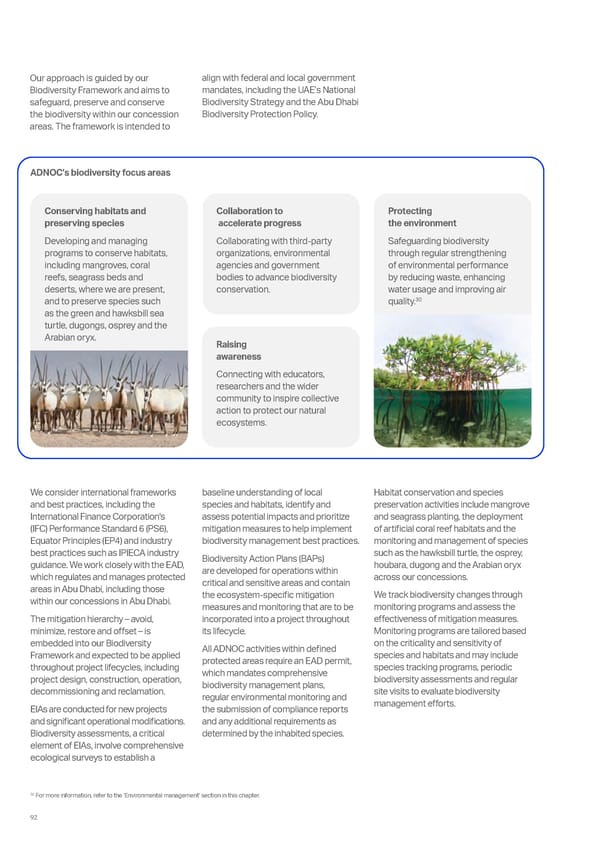
Our approach is guided by our Biodiversity Framework and aims to safeguard, preserve and conserve the biodiversity within our concession areas. The framework is intended to We consider international frameworks and best practices, including the International Finance Corporation's (IFC) Performance Standard 6 (PS6), Equator Principles (EP4) and industry best practices such as IPIECA industry guidance. We work closely with the EAD, which regulates and manages protected areas in Abu Dhabi, including those within our concessions in Abu Dhabi. The mitigation hierarchy – avoid, minimize, restore and offset – is embedded into our Biodiversity Framework and expected to be applied throughout project lifecycles, including project design, construction, operation, decommissioning and reclamation. EIAs are conducted for new projects and significant operational modifications. Biodiversity assessments, a critical element of EIAs, involve comprehensive ecological surveys to establish a align with federal and local government mandates, including the UAE’s National Biodiversity Strategy and the Abu Dhabi Biodiversity Protection Policy. Conserving habitats and preserving species Developing and managing programs to conserve habitats, including mangroves, coral reefs, seagrass beds and deserts, where we are present, and to preserve species such as the green and hawksbill sea turtle, dugongs, osprey and the Arabian oryx. ADNOC’s biodiversity focus areas Collaboration to accelerate progress Collaborating with third-party organizations, environmental agencies and government bodies to advance biodiversity conservation. Protecting the environment Safeguarding biodiversity through regular strengthening of environmental performance by reducing waste, enhancing water usage and improving air quality. 30 Raising awareness Connecting with educators, researchers and the wider community to inspire collective action to protect our natural ecosystems. baseline understanding of local species and habitats, identify and assess potential impacts and prioritize mitigation measures to help implement biodiversity management best practices. Biodiversity Action Plans (BAPs) are developed for operations within critical and sensitive areas and contain the ecosystem-specific mitigation measures and monitoring that are to be incorporated into a project throughout its lifecycle. All ADNOC activities within defined protected areas require an EAD permit, which mandates comprehensive biodiversity management plans, regular environmental monitoring and the submission of compliance reports and any additional requirements as determined by the inhabited species. Habitat conservation and species preservation activities include mangrove and seagrass planting, the deployment of artificial coral reef habitats and the monitoring and management of species such as the hawksbill turtle, the osprey, houbara, dugong and the Arabian oryx across our concessions. We track biodiversity changes through monitoring programs and assess the effectiveness of mitigation measures. Monitoring programs are tailored based on the criticality and sensitivity of species and habitats and may include species tracking programs, periodic biodiversity assessments and regular site visits to evaluate biodiversity management efforts. 30 For more information, refer to the ‘Environmental management’ section in this chapter. 92
 ADNOC Sustainability Report 2024: Driving Progress & Prosperity Page 91 Page 93