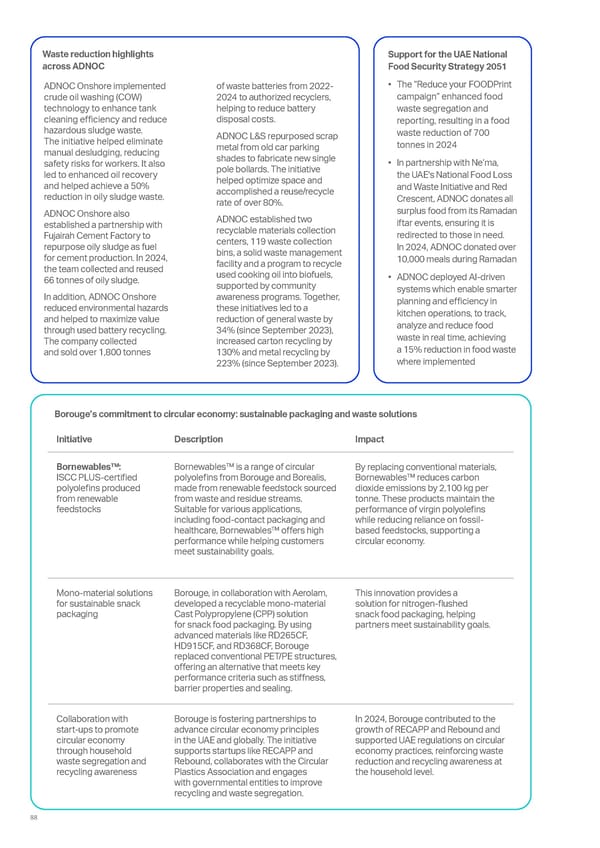
Initiative Description Impact Bornewables™: ISCC PLUS-certified polyolefins produced from renewable feedstocks Bornewables™ is a range of circular polyolefins from Borouge and Borealis, made from renewable feedstock sourced from waste and residue streams. Suitable for various applications, including food-contact packaging and healthcare, Bornewables™ offers high performance while helping customers meet sustainability goals. By replacing conventional materials, Bornewables™ reduces carbon dioxide emissions by 2,100 kg per tonne. These products maintain the performance of virgin polyolefins while reducing reliance on fossil- based feedstocks, supporting a circular economy. Mono-material solutions for sustainable snack packaging Borouge, in collaboration with Aerolam, developed a recyclable mono-material Cast Polypropylene (CPP) solution for snack food packaging. By using advanced materials like RD265CF, HD915CF, and RD368CF, Borouge replaced conventional PET/PE structures, offering an alternative that meets key performance criteria such as stiffness, barrier properties and sealing. This innovation provides a solution for nitrogen-flushed snack food packaging, helping partners meet sustainability goals. Collaboration with start-ups to promote circular economy through household waste segregation and recycling awareness Borouge is fostering partnerships to advance circular economy principles in the UAE and globally. The initiative supports startups like RECAPP and Rebound, collaborates with the Circular Plastics Association and engages with governmental entities to improve recycling and waste segregation. In 2024, Borouge contributed to the growth of RECAPP and Rebound and supported UAE regulations on circular economy practices, reinforcing waste reduction and recycling awareness at the household level. ADNOC Onshore implemented crude oil washing (COW) technology to enhance tank cleaning efficiency and reduce hazardous sludge waste. The initiative helped eliminate manual desludging, reducing safety risks for workers. It also led to enhanced oil recovery and helped achieve a 50% reduction in oily sludge waste. ADNOC Onshore also established a partnership with Fujairah Cement Factory to repurpose oily sludge as fuel for cement production. In 2024, the team collected and reused 66 tonnes of oily sludge. In addition, ADNOC Onshore reduced environmental hazards and helped to maximize value through used battery recycling. The company collected and sold over 1,800 tonnes of waste batteries from 2022- 2024 to authorized recyclers, helping to reduce battery disposal costs. ADNOC L&S repurposed scrap metal from old car parking shades to fabricate new single pole bollards. The initiative helped optimize space and accomplished a reuse/recycle rate of over 80%. ADNOC established two recyclable materials collection centers, 119 waste collection bins, a solid waste management facility and a program to recycle used cooking oil into biofuels, supported by community awareness programs. Together, these initiatives led to a reduction of general waste by 34% (since September 2023), increased carton recycling by 130% and metal recycling by 223% (since September 2023). Waste reduction highlights across ADNOC Borouge’s commitment to circular economy: sustainable packaging and waste solutions Support for the UAE National Food Security Strategy 2051 • The “Reduce your FOODPrint campaign” enhanced food waste segregation and reporting, resulting in a food waste reduction of 700 tonnes in 2024 • In partnership with Ne’ma, the UAE's National Food Loss and Waste Initiative and Red Crescent, ADNOC donates all surplus food from its Ramadan iftar events, ensuring it is redirected to those in need. In 2024, ADNOC donated over 10,000 meals during Ramadan • ADNOC deployed AI-driven systems which enable smarter planning and efficiency in kitchen operations, to track, analyze and reduce food waste in real time, achieving a 15% reduction in food waste where implemented 88
 ADNOC Sustainability Report 2024: Driving Progress & Prosperity Page 87 Page 89