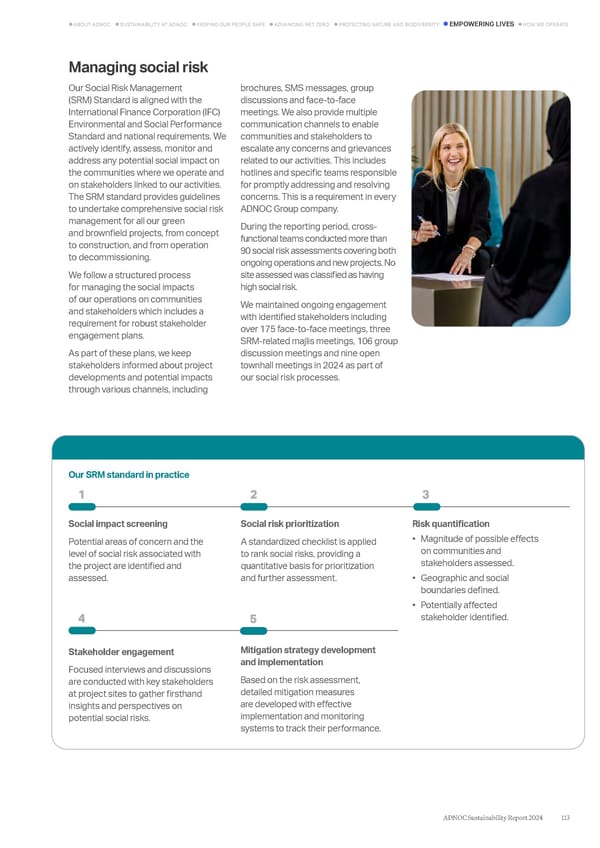
Managing social risk Our Social Risk Management (SRM) Standard is aligned with the International Finance Corporation (IFC) Environmental and Social Performance Standard and national requirements. We actively identify, assess, monitor and address any potential social impact on the communities where we operate and on stakeholders linked to our activities. The SRM standard provides guidelines to undertake comprehensive social risk management for all our green and brownfield projects, from concept to construction, and from operation to decommissioning. We follow a structured process for managing the social impacts of our operations on communities and stakeholders which includes a requirement for robust stakeholder engagement plans. As part of these plans, we keep stakeholders informed about project developments and potential impacts through various channels, including brochures, SMS messages, group discussions and face-to-face meetings. We also provide multiple communication channels to enable communities and stakeholders to escalate any concerns and grievances related to our activities. This includes hotlines and specific teams responsible for promptly addressing and resolving concerns. This is a requirement in every ADNOC Group company. During the reporting period, cross- functional teams conducted more than 90 social risk assessments covering both ongoing operations and new projects. No site assessed was classified as having high social risk. We maintained ongoing engagement with identified stakeholders including over 175 face-to-face meetings, three SRM-related majlis meetings, 106 group discussion meetings and nine open townhall meetings in 2024 as part of our social risk processes. Our SRM standard in practice 1 4 2 5 3 Social impact screening Potential areas of concern and the level of social risk associated with the project are identified and assessed. Stakeholder engagement Focused interviews and discussions are conducted with key stakeholders at project sites to gather firsthand insights and perspectives on potential social risks. Social risk prioritization A standardized checklist is applied to rank social risks, providing a quantitative basis for prioritization and further assessment. Mitigation strategy development and implementation Based on the risk assessment, detailed mitigation measures are developed with effective implementation and monitoring systems to track their performance. Risk quantification Magnitude of possible effects on communities and stakeholders assessed. Geographic and social boundaries defined. Potentially affected stakeholder identified. 113 ADNOC Sustainability Report 2024 EMPOWERING LIVES KEEPING OUR PEOPLE SAFE ADVANCING NET ZERO HOW WE OPERATE SUSTAINABILITY AT ADNOC ABOUT ADNOC PROTECTING NATURE AND BIODIVERSITY
 ADNOC Sustainability Report 2024: Driving Progress & Prosperity Page 112 Page 114