
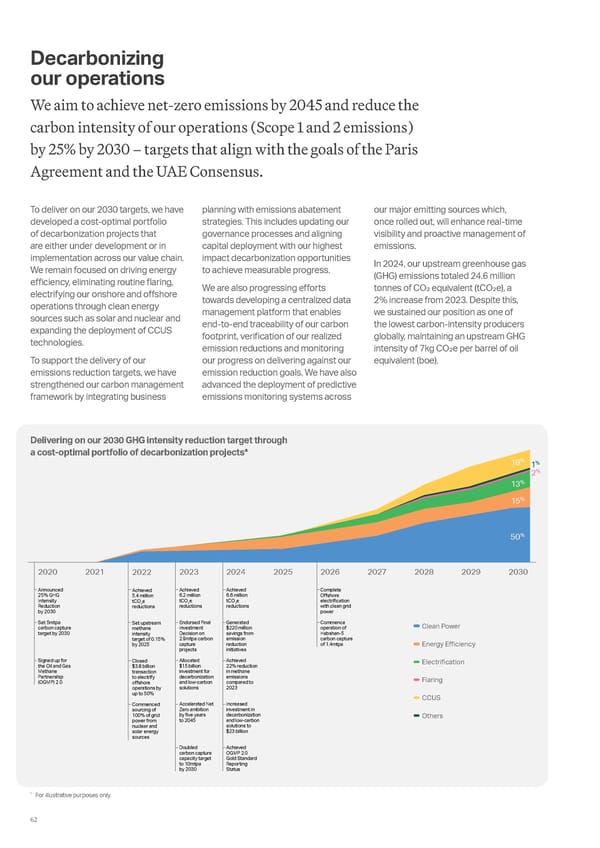
Decarbonizing our operations To deliver on our 2030 targets, we have developed a cost-optimal portfolio of decarbonization projects that are either under development or in implementation across our value chain. We remain focused on driving energy efficiency, eliminating routine flaring, electrifying our onshore and offshore operations through clean energy sources such as solar and nuclear and expanding the deployment of CCUS technologies. To support the delivery of our emissions reduction targets, we have strengthened our carbon management framework by integrating business planning with emissions abatement strategies. This includes updating our governance processes and aligning capital deployment with our highest impact decarbonization opportunities to achieve measurable progress. We are also progressing efforts towards developing a centralized data management platform that enables end-to-end traceability of our carbon footprint, verification of our realized emission reductions and monitoring our progress on delivering against our emission reduction goals. We have also advanced the deployment of predictive emissions monitoring systems across our major emitting sources which, once rolled out, will enhance real-time visibility and proactive management of emissions. In 2024, our upstream greenhouse gas (GHG) emissions totaled 24.6 million tonnes of CO₂ equivalent (tCO₂e), a 2% increase from 2023. Despite this, we sustained our position as one of the lowest carbon-intensity producers globally, maintaining an upstream GHG intensity of 7kg CO₂e per barrel of oil equivalent (boe). We aim to achieve net-zero emissions by 2045 and reduce the carbon intensity of our operations (Scope 1 and 2 emissions) by 25% by 2030 – targets that align with the goals of the Paris Agreement and the UAE Consensus. Delivering on our 2030 GHG intensity reduction target through a cost-optimal portfolio of decarbonization projects* Clean Power Energy Efficiency Electrification Flaring CCUS Others Announced 25% GHG Intensity Reduction by 2030 Set 5mtpa carbon capture target by 2030 Signed up for the Oil and Gas Methane Partnership (OGMP) 2.0 Achieved 5.4 million tCO 2 e reductions Set upstream methane intensity target of 0.15% by 2025 Closed $3.8 billion transaction to electrify offshore operations by up to 50% Commenced sourcing of 100% of grid power from nuclear and solar energy sources Achieved 6.2 million tCO 2 e reductions Endorsed Final Investment Decision on 2.9mtpa carbon capture projects Allocated $15 billion investment for decarbonization and low-carbon solutions Accelerated Net Zero ambition by five years to 2045 Doubled carbon capture capacity target to 10mtpa by 2030 Achieved 6.6 million tCO 2 e reductions Generated $220 million savings from emission reduction initiatives Achieved 22% reduction in methane emissions compared to 2023 Increased investment in decarbonization and low-carbon solutions to $23 billion Achieved OGMP 2.0 Gold Standard Reporting Status Complete Offshore electrification with clean grid power Commence operation of Habshan-5 carbon capture of 1.4mtpa 2020 2021 2022 2023 2024 2025 2026 2027 2028 2029 2030 50 % 15 % 13 % 18 % 1 % 2 % * For illustrative purposes only. 62
 ADNOC Sustainability Report 2024: Driving Progress & Prosperity Page 61 Page 63