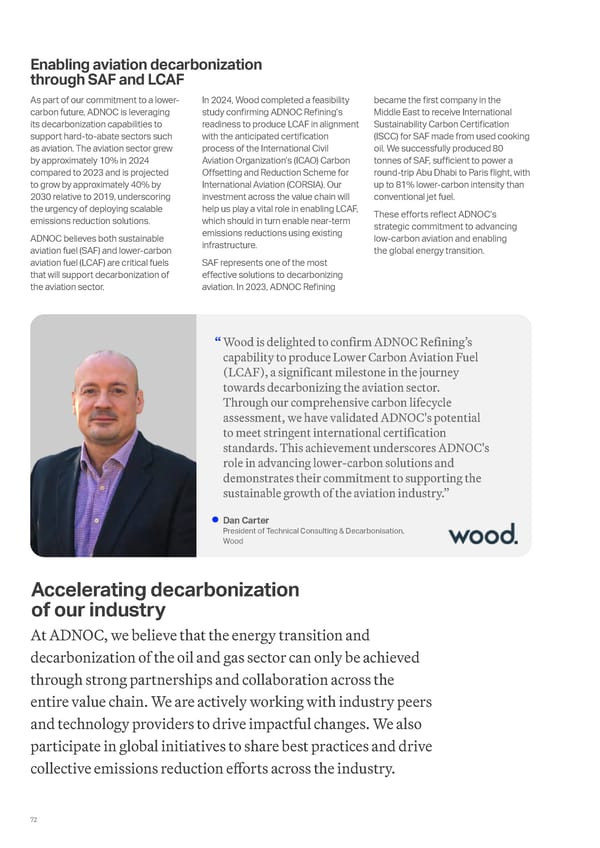
At ADNOC, we believe that the energy transition and decarbonization of the oil and gas sector can only be achieved through strong partnerships and collaboration across the entire value chain. We are actively working with industry peers and technology providers to drive impactful changes. We also participate in global initiatives to share best practices and drive collective emissions reduction efforts across the industry. “ Wood is delighted to confirm ADNOC Refining’s capability to produce Lower Carbon Aviation Fuel (LCAF), a significant milestone in the journey towards decarbonizing the aviation sector. Through our comprehensive carbon lifecycle assessment, we have validated ADNOC's potential to meet stringent international certification standards. This achievement underscores ADNOC's role in advancing lower-carbon solutions and demonstrates their commitment to supporting the sustainable growth of the aviation industry.” ● Dan Carter President of Technical Consulting & Decarbonisation, Wood Accelerating decarbonization of our industry As part of our commitment to a lower- carbon future, ADNOC is leveraging its decarbonization capabilities to support hard-to-abate sectors such as aviation. The aviation sector grew by approximately 10% in 2024 compared to 2023 and is projected to grow by approximately 40% by 2030 relative to 2019, underscoring the urgency of deploying scalable emissions reduction solutions. ADNOC believes both sustainable aviation fuel (SAF) and lower-carbon aviation fuel (LCAF) are critical fuels that will support decarbonization of the aviation sector. Enabling aviation decarbonization through SAF and LCAF In 2024, Wood completed a feasibility study confirming ADNOC Refining’s readiness to produce LCAF in alignment with the anticipated certification process of the International Civil Aviation Organization’s (ICAO) Carbon Offsetting and Reduction Scheme for International Aviation (CORSIA). Our investment across the value chain will help us play a vital role in enabling LCAF, which should in turn enable near-term emissions reductions using existing infrastructure. SAF represents one of the most effective solutions to decarbonizing aviation. In 2023, ADNOC Refining became the first company in the Middle East to receive International Sustainability Carbon Certification (ISCC) for SAF made from used cooking oil. We successfully produced 80 tonnes of SAF, sufficient to power a round-trip Abu Dhabi to Paris flight, with up to 81% lower-carbon intensity than conventional jet fuel. These efforts reflect ADNOC’s strategic commitment to advancing low-carbon aviation and enabling the global energy transition. 72
 ADNOC Sustainability Report 2024: Driving Progress & Prosperity Page 71 Page 73