
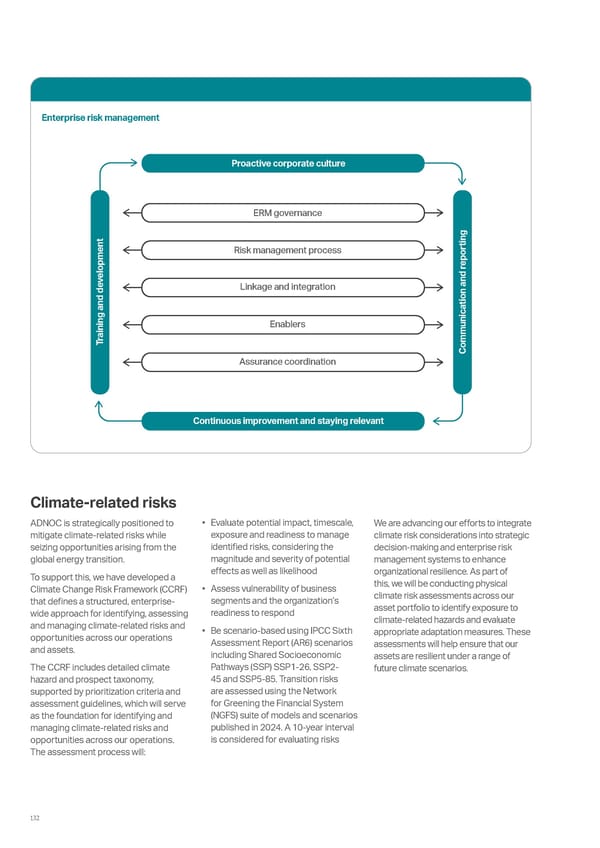
Climate-related risks ADNOC is strategically positioned to mitigate climate-related risks while seizing opportunities arising from the global energy transition. To support this, we have developed a Climate Change Risk Framework (CCRF) that defines a structured, enterprise- wide approach for identifying, assessing and managing climate-related risks and opportunities across our operations and assets. The CCRF includes detailed climate hazard and prospect taxonomy, supported by prioritization criteria and assessment guidelines, which will serve as the foundation for identifying and managing climate-related risks and opportunities across our operations. The assessment process will: ERM governance Risk management process Linkage and integration Enablers Assurance coordination • Evaluate potential impact, timescale, exposure and readiness to manage identified risks, considering the magnitude and severity of potential effects as well as likelihood • Assess vulnerability of business segments and the organization’s readiness to respond • Be scenario-based using IPCC Sixth Assessment Report (AR6) scenarios including Shared Socioeconomic Pathways (SSP) SSP1-26, SSP2- 45 and SSP5-85. Transition risks are assessed using the Network for Greening the Financial System (NGFS) suite of models and scenarios published in 2024. A 10-year interval is considered for evaluating risks We are advancing our efforts to integrate climate risk considerations into strategic decision-making and enterprise risk management systems to enhance organizational resilience. As part of this, we will be conducting physical climate risk assessments across our asset portfolio to identify exposure to climate-related hazards and evaluate appropriate adaptation measures. These assessments will help ensure that our assets are resilient under a range of future climate scenarios. Enterprise risk management Proactive corporate culture Continuous improvement and staying relevant Training and development Communication and reporting 132
 ADNOC Sustainability Report 2024: Driving Progress & Prosperity Page 131 Page 133