
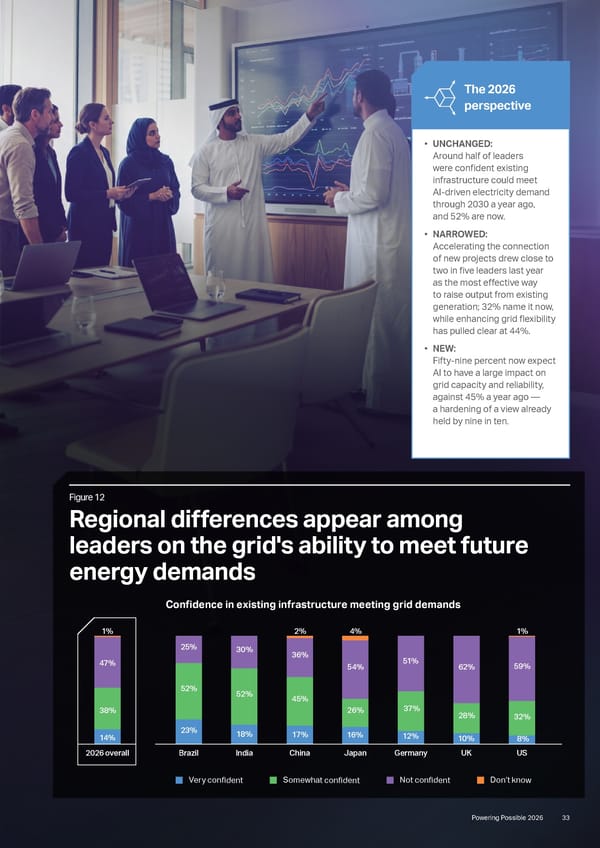
The 2026 perspective | • | UNCHANGED: | | Around half of leaders | | were confident existing | | infrastructure could meet | | AI-driven electricity demand | | through 2030 a year ago, | | and 52% are now. | | • | NARROWED: | | Accelerating the connection | | of new projects drew close to | | two in five leaders last year | | as the most effective way | | to raise output from existing | | generation; 32% name it now, | | while enhancing grid flexibility | | has pulled clear at 44%. | | • | NEW: | | Fifty-nine percent now expect | | AI to have a large impact on | | grid capacity and reliability, | | against 45% a year ago — | | a hardening of a view already | | held by nine in ten. | | Figure 12 | | Regional differences appear among | | leaders on the grid's ability to meet future | | energy demands | | Confidence in existing infrastructure meeting grid demands | | 1% | 2% | 4% | 1% | | 25% | 30% | | 36% | | 47% | 54% | 51% | 62% | 59% | | 52% | | 52% | | 45% | | 38% | 26% | 37% | | 28% | 32% | | 14% | 23% | 18% | 17% | 16% | 12% | 10% | 8% | 2026 overall Brazil India China Japan Germany UK US Very confident Somewhat confident Not confident Don’t know Powering Possible 2026 33
 Powering Possible 2026: Energy Resilience in the Intelligence Era Page 32 Page 34