
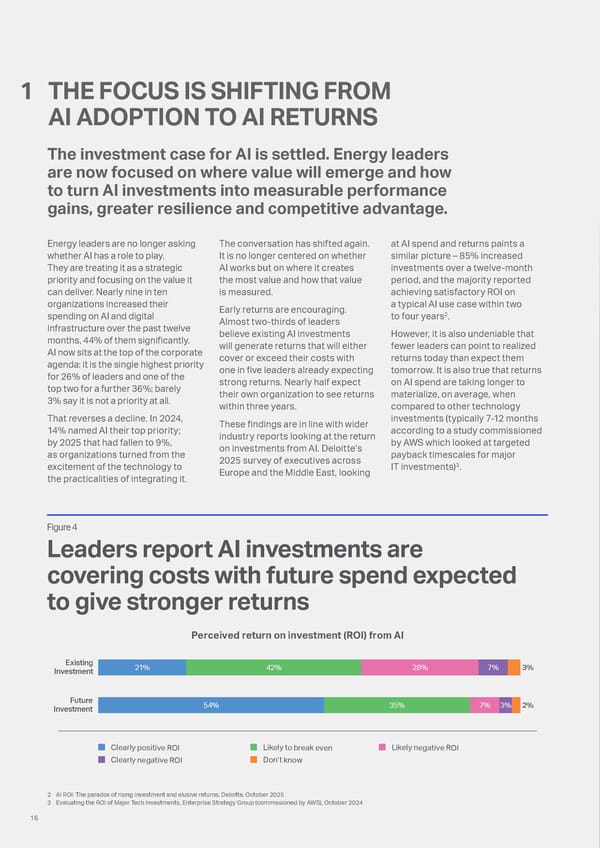
Energy leaders are no longer asking whether AI has a role to play. They are treating it as a strategic priority and focusing on the value it can deliver. Nearly nine in ten organizations increased their spending on AI and digital infrastructure over the past twelve months, 44% of them significantly. AI now sits at the top of the corporate agenda: it is the single highest priority for 26% of leaders and one of the top two for a further 36%; barely 3% say it is not a priority at all. That reverses a decline. In 2024, 14% named AI their top priority; by 2025 that had fallen to 9%, as organizations turned from the excitement of the technology to the practicalities of integrating it. The investment case for AI is settled. Energy leaders are now focused on where value will emerge and how to turn AI investments into measurable performance gains, greater resilience and competitive advantage. The conversation has shifted again. It is no longer centered on whether AI works but on where it creates the most value and how that value is measured. Early returns are encouraging. Almost two-thirds of leaders believe existing AI investments will generate returns that will either cover or exceed their costs with one in five leaders already expecting strong returns. Nearly half expect their own organization to see returns within three years. These findings are in line with wider industry reports looking at the return on investments from AI. Deloitte’s 2025 survey of executives across Europe and the Middle East, looking at AI spend and returns paints a similar picture – 85% increased investments over a twelve-month period, and the majority reported achieving satisfactory ROI on a typical AI use case within two to four years2. However, it is also undeniable that fewer leaders can point to realized returns today than expect them tomorrow. It is also true that returns on AI spend are taking longer to materialize, on average, when compared to other technology investments (typically 7-12 months according to a study commissioned by AWS which looked at targeted payback timescales for major IT investments)3. Leaders report AI investments are covering costs with future spend expected to give stronger returns Figure 4 54% 35% 7% 3% 2% InvestmentExisting 21% 42% 28% 7% 3% Future Investment Clearly positive ROI Likely to break even Likely negative ROI Clearly negative ROI Don’t know Perceived return on investment (ROI) from AI 1 THE FOCUS IS SHIFTING FROM AI ADOPTION TO AI RETURNS 2 AI ROI: The paradox of rising investment and elusive returns, Deloitte, October 2025 3 Evaluating the ROI of Major Tech Investments, Enterprise Strategy Group (commissioned by AWS), October 2024 16
 Powering Possible 2026: Energy Resilience in the Intelligence Era Page 15 Page 17