
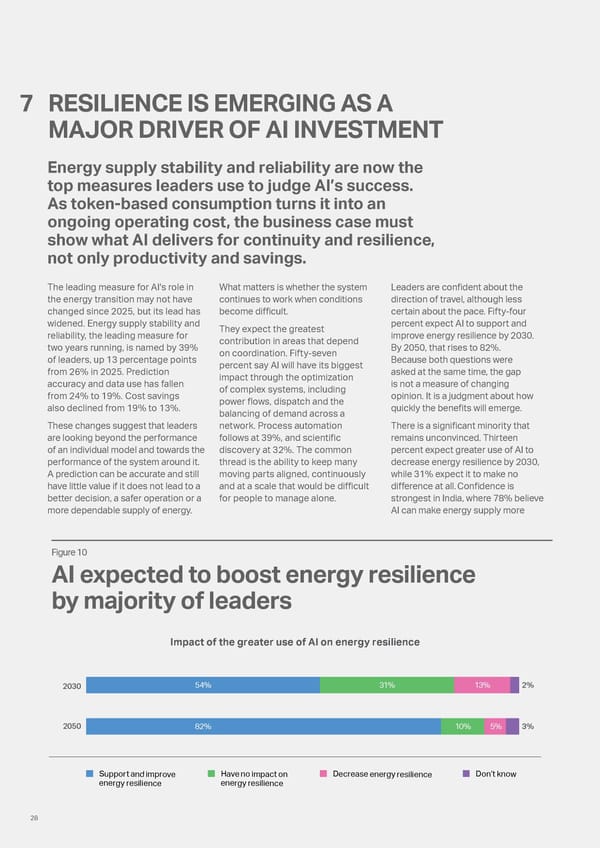
The leading measure for AI's role in the energy transition may not have changed since 2025, but its lead has widened. Energy supply stability and reliability, the leading measure for two years running, is named by 39% of leaders, up 13 percentage points from 26% in 2025. Prediction accuracy and data use has fallen from 24% to 19%. Cost savings also declined from 19% to 13%. These changes suggest that leaders are looking beyond the performance of an individual model and towards the performance of the system around it. A prediction can be accurate and still have little value if it does not lead to a better decision, a safer operation or a more dependable supply of energy. Energy supply stability and reliability are now the top measures leaders use to judge AI’s success. As token-based consumption turns it into an ongoing operating cost, the business case must show what AI delivers for continuity and resilience, not only productivity and savings. What matters is whether the system continues to work when conditions become difficult. They expect the greatest contribution in areas that depend on coordination. Fifty-seven percent say AI will have its biggest impact through the optimization of complex systems, including power flows, dispatch and the balancing of demand across a network. Process automation follows at 39%, and scientific discovery at 32%. The common thread is the ability to keep many moving parts aligned, continuously and at a scale that would be difficult for people to manage alone. Leaders are confident about the direction of travel, although less certain about the pace. Fifty-four percent expect AI to support and improve energy resilience by 2030. By 2050, that rises to 82%. Because both questions were asked at the same time, the gap is not a measure of changing opinion. It is a judgment about how quickly the benefits will emerge. There is a significant minority that remains unconvinced. Thirteen percent expect greater use of AI to decrease energy resilience by 2030, while 31% expect it to make no difference at all.Confidence is strongest in India, where 78% believe AI can make energy supply more 7 RESILIENCE IS EMERGING AS A MAJOR DRIVER OF AI INVESTMENT AI expected to boost energy resilience by majority of leaders Figure 10 2030 2% 2050 3% Support and improve energy resilience Have no impact on energy resilience Decrease energy resilience Don’t know Impact of the greater use of AI on energy resilience 54% 31% 13% 82% 10% 5% 28
 Powering Possible 2026: Energy Resilience in the Intelligence Era Page 27 Page 29