
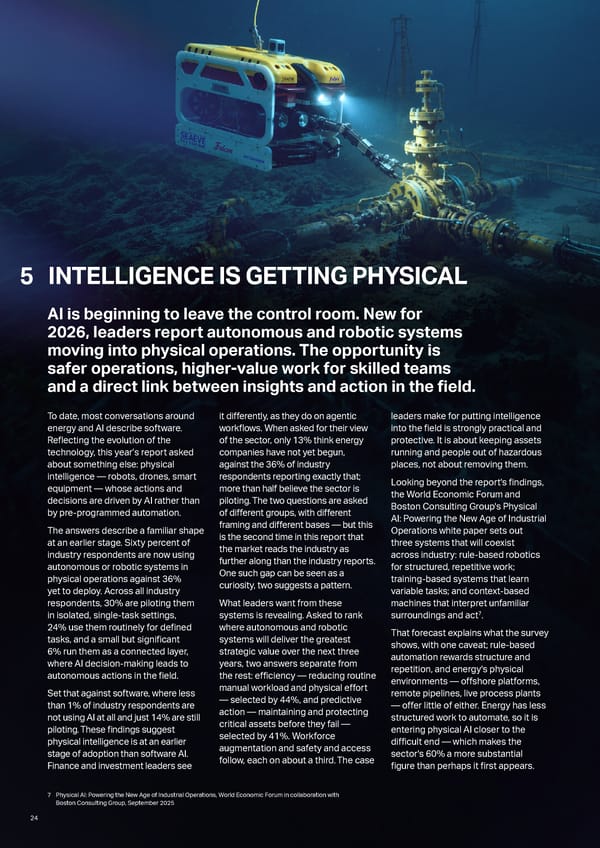
To date, most conversations around energy and AI describe software. Reflecting the evolution of the technology, this year’s report asked about something else: physical intelligence — robots, drones, smart equipment — whose actions and decisions are driven by AI rather than by pre-programmed automation. The answers describe a familiar shape at an earlier stage. Sixty percent of industry respondents are now using autonomous or robotic systems in physical operations against 36% yet to deploy. Across all industry respondents, 30% are piloting them in isolated, single-task settings, 24% use them routinely for defined tasks, and a small but significant 6% run them as a connected layer, where AI decision-making leads to autonomous actions in the field. Set that against software, where less than 1% of industry respondents are not using AI at all and just 14% are still piloting.These findings suggest physical intelligence is at an earlier stage of adoption than software AI. Finance and investment leaders see AI is beginning to leave the control room. New for 2026, leaders report autonomous and robotic systems moving into physical operations. The opportunity is safer operations, higher-value work for skilled teams and a direct link between insights and action in the field. it differently, as they do on agentic workflows. When asked for their view of the sector, only 13% think energy companies have not yet begun, against the 36% of industry respondents reporting exactly that; more than half believe the sector is piloting.The two questions are asked of different groups, with different framing and different bases — but this is the second time in this report that the market reads the industry as further along than the industry reports. One such gap can be seen as a curiosity, two suggests a pattern. What leaders want from these systems is revealing. Asked to rank where autonomous and robotic systems will deliver the greatest strategic value over the next three years, two answers separate from the rest: efficiency — reducing routine manual workload and physical effort — selected by 44%, and predictive action — maintaining and protecting critical assets before they fail — selected by 41%. Workforce augmentation and safety and access follow, each on about a third.The case leaders make for putting intelligence into the field is strongly practical and protective. It is about keeping assets running and people out of hazardous places, not about removing them. Looking beyond the report's findings, the World Economic Forum and Boston Consulting Group's Physical AI: Powering the New Age of Industrial Operations white paper sets out three systems that will coexist across industry: rule-based robotics for structured, repetitive work; training-based systems that learn variable tasks; and context-based machines that interpret unfamiliar surroundings and act7. That forecast explains what the survey shows, with one caveat; rule-based automation rewards structure and repetition, and energy's physical environments — offshore platforms, remote pipelines, live process plants — offer little of either. Energy has less structured work to automate, so it is entering physical AI closer to the difficult end — which makes the sector's 60% a more substantial figure than perhaps it first appears. 5 INTELLIGENCE IS GETTING PHYSICAL 7 Physical AI: Powering the New Age of Industrial Operations, World Economic Forum in collaboration with Boston Consulting Group, September 2025 24
 Powering Possible 2026: Energy Resilience in the Intelligence Era Page 23 Page 25