Inside ADNOC’s global gas ambitions
This document explores how ADNOC Gas, XRG, and ADNOC Trading are developing one of the largest integrated gas businesses globally, focusing on flexible and reliable energy solutions.
Inside ADNOC’s global gas ambitions ADNOC Gas, XRG and ADNOC Trading are building one of the world’s largest integrated gas businesses, serving growing demand with flexible, reliable energy.
ADNOC produces around 11.5 billion standard cubic feet of gas a day from 29 fields in Abu Dhabi, onshore and offshore
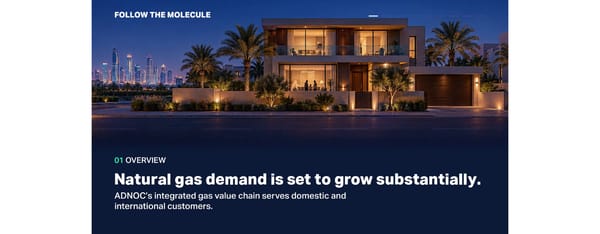
26 Oct 2026・7 min read Natural gas, long a mainstay of the global energy mix, is taking on an even bigger role as fast- growing Asian economies reduce their reliance on coal, Europe secures new sources of supply and power-hungry AI data centers multiply around the world. ADNOC is changing with the market. For decades, it was known as a dependable Gulf supplier, but is now evolving a global, integrated gas business with investments stretching from Argentina’s Vaca Muerta shale basin to LNG facilities in Texas and deep-water developments off Mozambique. This global ambition rests on solid domestic foundations. The UAE holds the world’s seventh-largest natural gas reserves, while ADNOC produces 11.5 billion standard cubic feet (bscf) of natural gas per day and has built nearly five decades of experience as an LNG supplier.
“Our role is to unlock and maximize value from Abu Dhabi’s world-scale, low-cost, lower- carbon-intensity hydrocarbon resources for the benefit of the UAE, and our partners and customers around the world,” says Musabbeh Al Kaabi, ADNOC Upstream CEO. Its international strategy, however, goes beyond producing and exporting domestic gas. It is designed to combine supply from several continents with flexible contracts, one of the world’s largest owned shipping fleets and global trading expertise. In July 2026, ADNOC brought the LNG marketing operations of ADNOC Gas and XRG, its international investment company, together with ADNOC Trading on a single platform in Abu Dhabi Global Market. The target is 47 million metric tonnes a year of combined marketable LNG by 2030+, more than a tenth of all LNG traded worldwide in 2025 and about three times the volume ADNOC Gas will be able to produce domestically once its new Ruwais LNG plant begins operating.
The case for this rapid expansion and integration rests on demand. Global natural gas consumption reached a record 4,202 billion cubic meters in 2025, while LNG trade rose to a record 437 million metric tonnes, according to the International Gas Union. ADNOC expects demand for LNG and electricity to grow by at least 50% by 2040. Much of that growth will come from Asia, where economies are electrifying rapidly, with gas a preferred power source to traditional coal use due to lower air pollution and carbon emissions. Data centers are among the newest sources of demand. They consumed around 485 terawatt-hours of electricity in 2025, and the International Energy Agency expects that figure to almost double by 2030. They operate around the clock, and in the United States, their largest market, gas is expected to supply more of the additional electricity they need than any other energy source. Orders for new gas-fired power plants reached a 25-year high last year, driven largely by data-center operators building generation on site. That is the market ADNOC is building for. Decades of reliable supply from Abu Dhabi under long-term contracts established ADNOC as one of the world’s most trusted LNG suppliers. Competing for the next wave of demand requires more: supply from several continents, pricing against different benchmarks, transportation on its own ships and the ability to redirect cargoes as markets change. Each of ADNOC’s gas businesses contributes to this new vision to deliver a top tier integrated global LNG supplier. ADNOC Gas supplies the core volumes from Abu Dhabi and plans to invest around $28 billion between 2026 and 2030. Ruwais LNG and other projects are expected to increase its volumes by about 45% by 2030 compared with 2023.
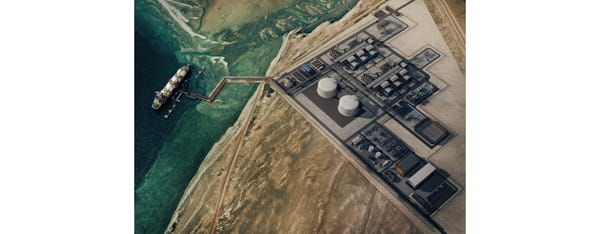
An artist's impression of Ruwais LNG, which will more than double ADNOC Gas's LNG capacity to around 15 million metric tonnes a year XRG, ADNOC’s international investment arm, adds supply from outside the Gulf through investments in the United States, Mozambique, Argentina and Azerbaijan, with a target of 20 million to 25 million metric tonnes a year by 2035. ADNOC Trading turns that global portolio into options for customers, while ADNOC Logistics & Services (ADNOC L&S) delivers the cargoes. “Ultimately, energy security means delivering certainty,” says Captain Abdulkareem Al Masabi, CEO of ADNOC L&S. “Resources must be delivered safely, reliably and consistently, when and where they are needed.” Delivering that certainty involves an extraordinary journey. Natural gas moves from reservoirs through processing plants and pipelines, into the tanks of specialized vessels and across oceans before reaching the homes, industries and power systems that depend on it. For ADNOC, that journey is connected from end to end. It begins across 29 producing fields in Abu Dhabi, onshore and offshore, where ADNOC produces around 11.5 billion standard cubic feet of gas a day. New developments will bring more resources into the network. Announced within weeks of each other in 2026, the Bab and Umm Shaif Gas Cap projects are expected to unlock more than 2.1 billion standard cubic feet per day, comparable with the total daily gas consumption of Poland or Kazakhstan. Bab, the world’s largest gas-cap development of its kind, is expected to contribute around 1.5 billion standard cubic feet per day, while Umm Shaif will add more than 600 million by 2030.
Before gas reaches customers, it must be processed into products that power stations, industries and homes can use. That is the role of ADNOC Gas, the world’s largest listed integrated gas-processing company. Mouza Almansoori, Team Leader for Gas Operations Support, calls it “the beating heart of ADNOC”. The description reflects the company’s position between upstream production and downstream customers. Its network turns feed gas into sales gas for power generation and industry, ethane for petrochemicals, and other liquids used in manufacturing. ADNOC Gas supplies more than 60% of the UAE’s gas needs. Its products go to Borouge for materials used in pipes, packaging and healthcare, and to Fertiglobe for fertilizer production. Overseas, the company serves customers in more than 20 countries. “Without upstream, we cannot operate,” Almansoori says, “and without the downstream, there is no way out to sell our products.” Integration keeps that system running, with each part working closely with the next to deliver products “on time, on spec”. Gas destined for customers thousands of miles away undergoes another transformation. Cooled below minus 160°C, it becomes LNG, shrinking dramatically in volume and making ocean transport possible. ADNOC Gas has supplied LNG internationally for almost 50 years and delivered more than 3,500 cargoes. Its first shipment left Das Island for Japan in April 1977 under a 20-year agreement with Tokyo Electric Power Company, whose LNG business is now part of JERA. The shipment began a partnership with Japan that continues today. Das Island is now the world’s third-longest-operating LNG plant and runs at around 98% reliability. At Al Ruwais Industrial City, two new LNG trains designed to run on clean power will add 9.6 million metric tonnes of annual processing capacity. Once commercial operations begin, Ruwais LNG will more than double ADNOC Gas’s LNG capacity to around 15 million metric tonnes a year. More than 90% of the new capacity is already committed to buyers in Asia and Europe, including nearly 23% to Japanese customers.
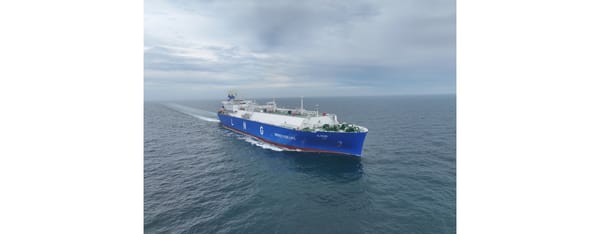
Long-term contracts provide one kind of certainty, but customers have different needs. Some want supply for decades; others need cargo at short notice. And increasingly, supply can come not only from Abu Dhabi but a range of other global locations. XRG is building this wider supply base. In the United States, it holds stakes in all five trains under construction at Rio Grande LNG in Texas, which will have combined capacity of around 30 million metric tonnes a year. ADNOC Trading has agreed to buy 1.9 million tonnes annually from Train 4 for 20 years. In Mozambique, XRG holds 10% of three developments: the producing Coral South floating facility, its sister project Coral North and the larger onshore Rovuma LNG project. The purpose is not geographic reach for its own sake, but optionality. Supply from several regions creates more ways to match gas with customers and respond when conditions change. The Abu Dhabi Global Market platform brings those options together: long-term marketing for ADNOC Gas and XRG is centralized there, while ADNOC Trading handles trading. “Marketing is when you’ve got a product to sell,” says Paul O’Sullivan, Head of LNG Trading at ADNOC Trading. “Trading is when you’re trying to create value from elsewhere.” That value can come from price, timing or geography. ADNOC can source LNG from different regions, trade against different benchmarks and redirect cargoes as markets move. Trading also helps manage the risks created by shifting weather, closed routes, delayed ships and tight markets. It can save freight costs, allow an additional voyage or redirect a cargo to a higher-value destination. Every optimization on a trading screen eventually becomes a physical journey. ADNOC L&S operates around 350 vessels, with 24 more under construction, and serves more than 100 customers in over 50 countries. Its owned LNG carrier fleet comprises 20 vessels.

Data centers are among the newest sources of gas demand. The IEA expects their electricity use to almost double by 2030. For Al Masabi, resilience depends as much on people as on assets. Having begun his career at sea, he emphasizes the discipline, training and preparedness of crews whose work often goes unseen but remains essential to global trade. Asia is a particular focus, and the Gulf’s proximity gives ADNOC an advantage through shorter transit times, more reliable delivery and lower costs. ADNOC L&S is expanding and modernizing its fleet with new LNG carriers and very large ethane and ammonia carriers. Its AW Shipping joint venture with China’s Wanhua Chemical also serves industrial customers in Asia. However, neither geography nor scale can entirely eliminate market disruption, which increasingly can come from a range of directions and causes. “What matters most is how effectively you respond,” Al Masabi says. Eventually, after wells, processing plants, contracts, trading decisions and an ocean voyage, the molecule reaches the customer at the end of the chain. At the receiving terminal, LNG is warmed back into gas and sent through pipelines to power stations, industries and homes. This journey is largely invisible, but its reliability rests on every link working together.
MORE STORIES How ADNOC is quietly making carbon storage work How governance and human judgment can accelerate AI adoption Driven by Safety: David Coulthard Reveals Formula 1’s Safety Culture – and the Parallels with ADNOC How ADNOC’s In Country Value Program Reaches Every Emirate in the UAE